
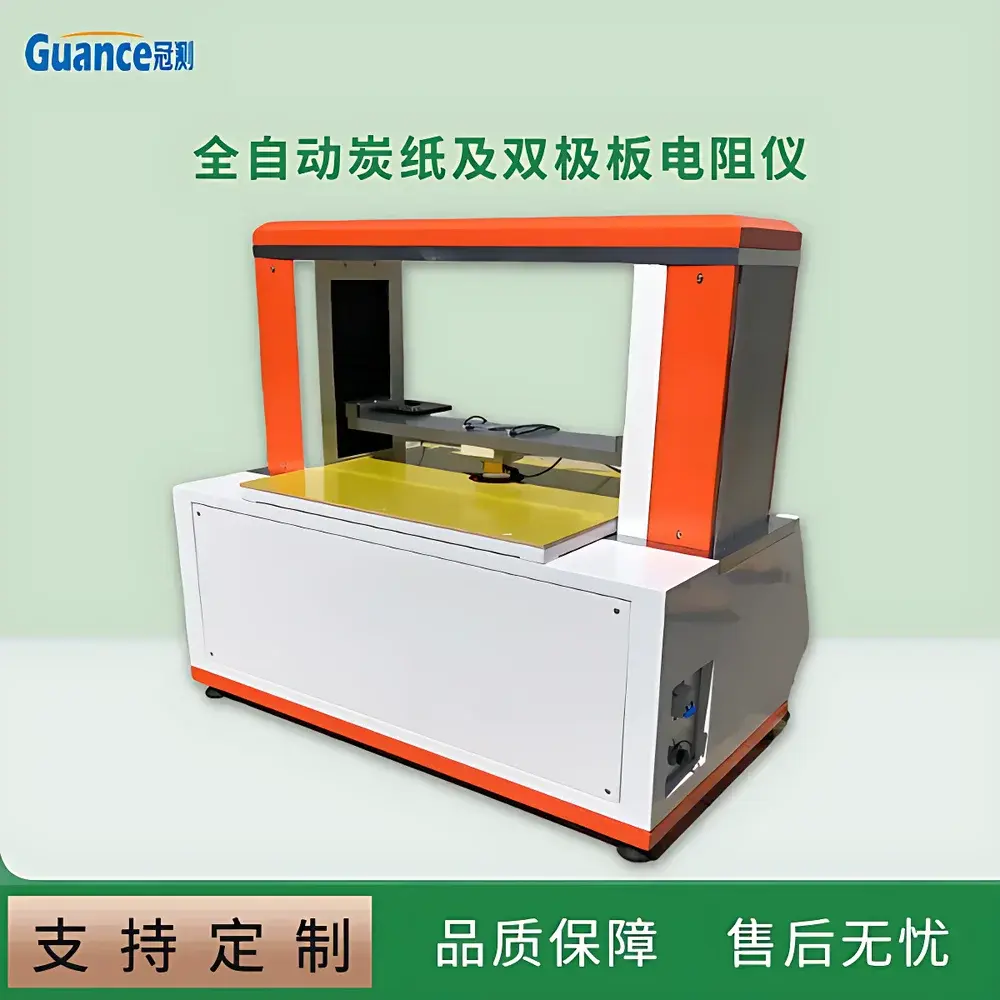
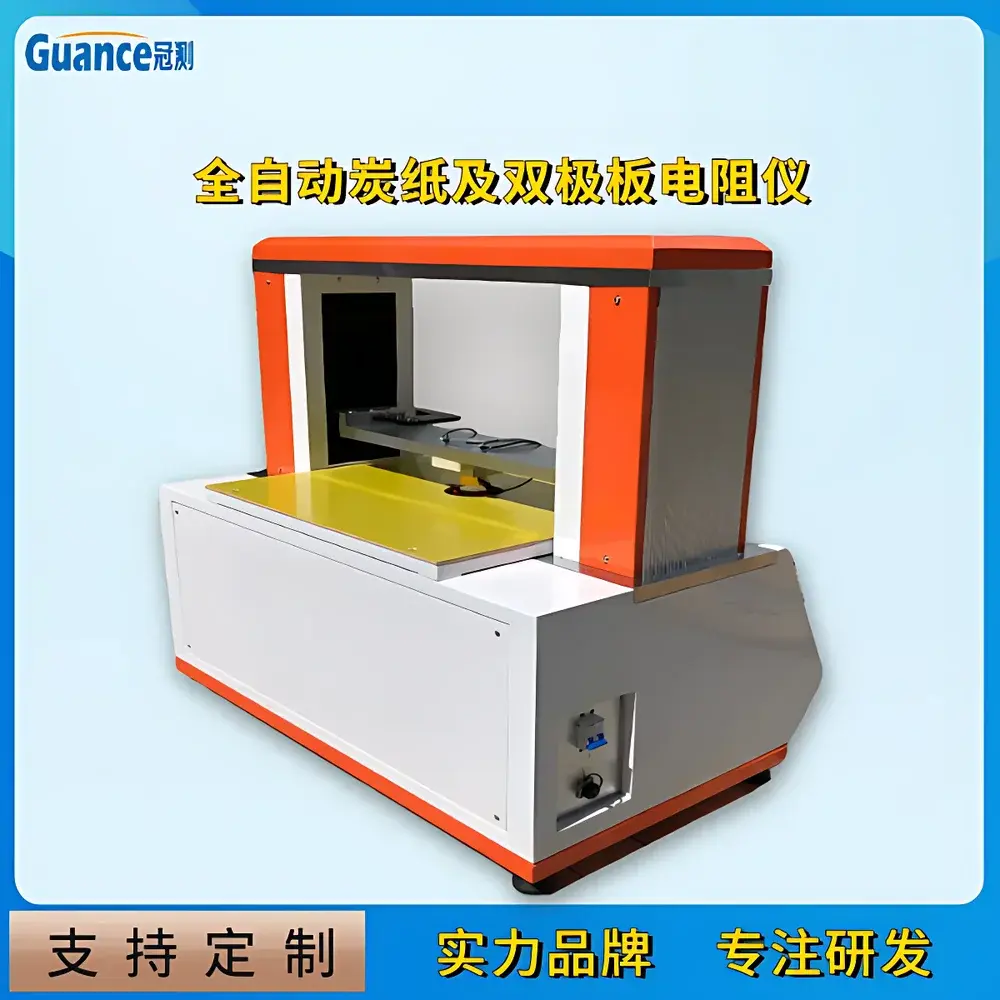
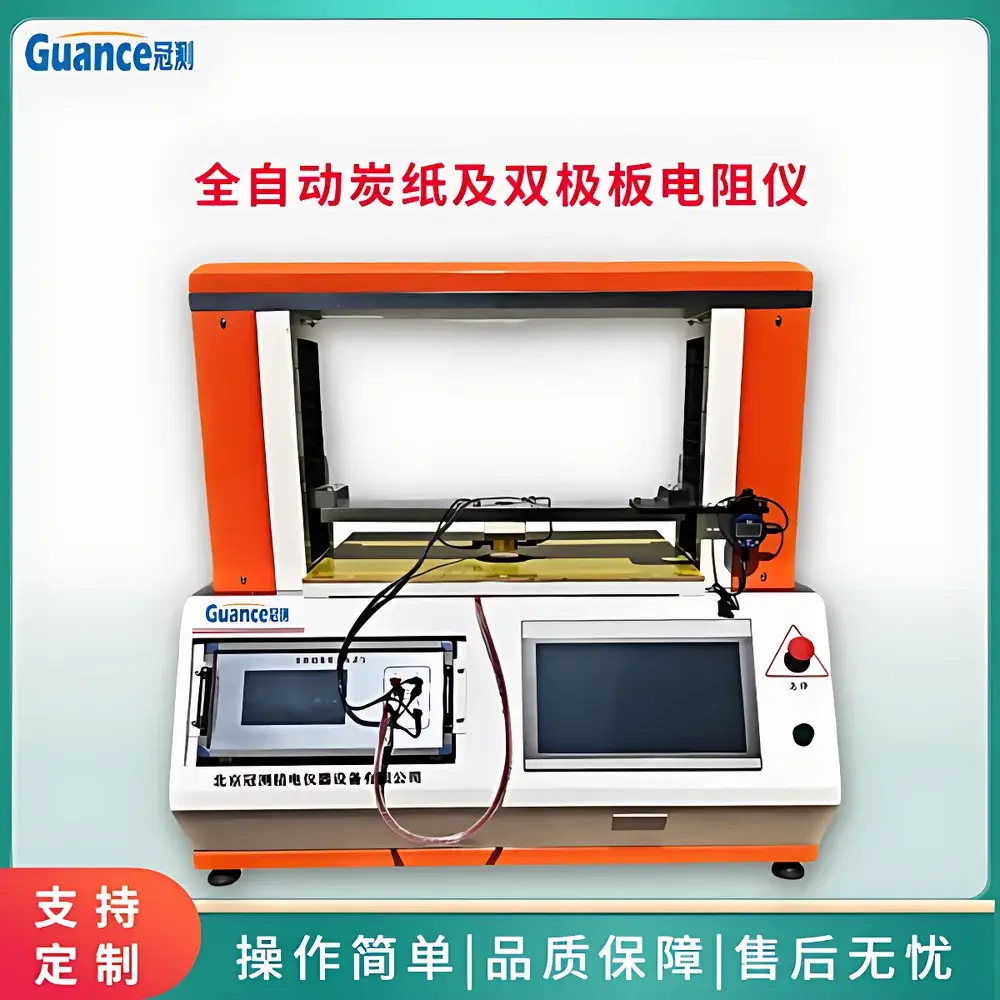
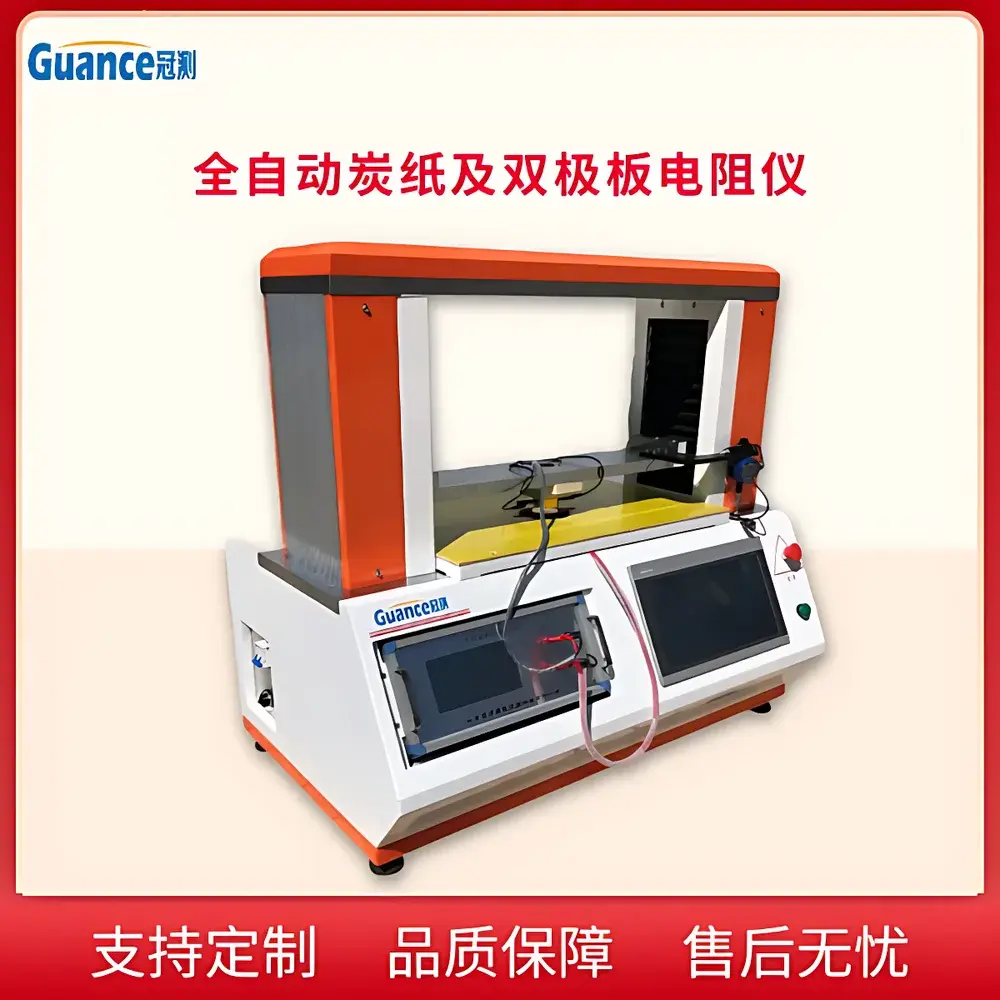
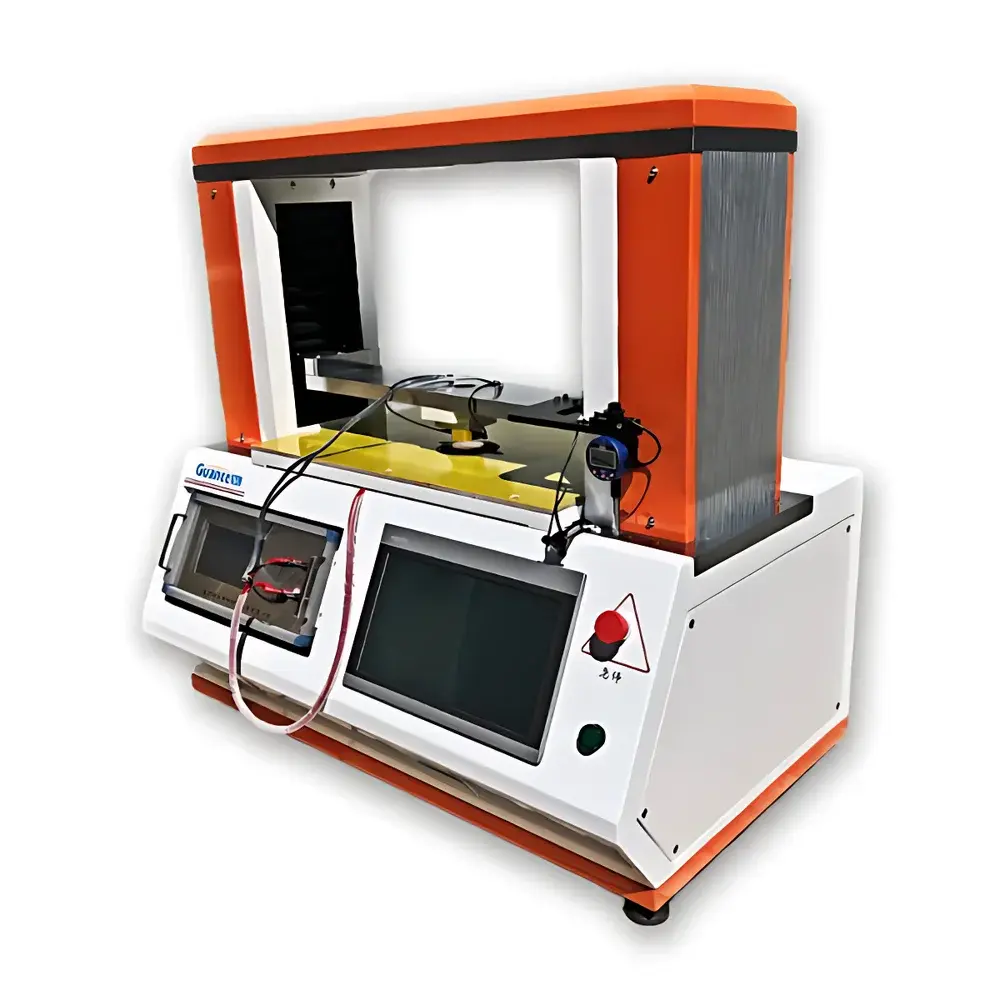
Brookfield GEST-20042F Bipolar Plate Bulk Resistivity Tester
| Brand | Guance Instruments |
|---|---|
| Origin | Beijing, China |
| Model | GEST-20042F |
| Compliance | GB/T 20042.6–2011, GB/T 20042.7–2014 |
| Measurement Modes | Through-plane (2-probe) & In-plane (4-probe) |
| Electrode Diameter | 50 mm gold-plated |
| Control Interface | 10-inch industrial touchscreen HMI |
| Loading Actuation | Servo-motor-driven precision force application |
| Data Output | Real-time pressure, compressive strain, voltage, current, resistance, resistivity (mΩ·cm, Ω·cm, kΩ·cm), conductivity (S/cm, S/m) |
| Test Protocols | Constant-force, constant-pressure, stepwise gradient (force/pressure/strain), compression-ratio control |
| Data Export | CSV via USB |
| Auto-reset | Yes |
| Reporting | On-screen preview + thermal printout |
Overview
The Brookfield GEST-20042F Bipolar Plate Bulk Resistivity Tester is a purpose-built instrumentation system engineered for the precise, repeatable, and standards-compliant characterization of bulk electrical resistivity in proton exchange membrane fuel cell (PEMFC) components—specifically carbon paper gas diffusion layers (GDLs) and graphite/composite bipolar plates (BPPs). It operates on two fundamental measurement geometries: through-plane (vertical) resistivity—measured using a calibrated 2-probe configuration under controlled mechanical compression—and in-plane (horizontal) resistivity—determined via a four-point probe (Kelvin sensing) method to eliminate contact resistance artifacts. The instrument implements ASTM D257–22 and IEC 62893–2 principles in its electrical architecture while fully adhering to the test protocols defined in GB/T 20042.6–2011 (Bipolar Plate Characterization) and GB/T 20042.7–2014 (Carbon Paper Testing). Its servo-driven loading system enables programmable, noise-free application of compressive forces up to 5,000 N with sub-Newton resolution, ensuring reproducible interfacial contact conditions critical for correlating microstructural deformation with bulk conduction behavior.
Key Features
- Servo-motor actuated force application system delivering high-resolution, closed-loop control of compressive load (0.1–5,000 N) and real-time monitoring of pressure (MPa), thickness reduction (µm), and compression ratio (%)
- Dual-mode electrical measurement architecture: 2-probe configuration for through-plane resistivity (ASTM D257 compliant) and 4-probe Kelvin configuration for in-plane resistivity (IEC 62893–2 compliant)
- 50 mm diameter gold-plated stainless-steel electrodes—electrochemically inert, low-contact-resistance, and optimized for uniform current distribution across heterogeneous porous substrates
- Integrated 10-inch industrial-grade capacitive touchscreen HMI with embedded real-time data visualization: simultaneous display of voltage, current, resistance, calculated resistivity (mΩ·cm, Ω·cm, kΩ·cm), conductivity (S/cm, S/m), compressive strain, and contact pressure
- Seven programmable test modes: constant-force, constant-pressure, constant-strain, linear gradient force, stepwise pressure ramp, compression-ratio sweep, and custom multi-step sequences
- Automated differential analysis: calculates absolute and relative resistivity change (Δρ/ρ₀ %) across user-defined compression or pressure intervals; exports tabulated delta values with timestamped metadata
- Fully autonomous operation cycle: auto-zero calibration, contact detection, load ramping, measurement acquisition, data logging, and mechanical reset—all executed without manual intervention
Sample Compatibility & Compliance
The GEST-20042F accommodates standard PEMFC component geometries: carbon paper rolls (cut to 50 × 50 mm or larger), machined graphite BPP specimens (up to 100 × 100 mm), and coated composite plates. Its modular electrode stage accepts samples 0.1–5.0 mm thick with surface roughness ≤ Ra 5 µm. All test procedures align with national and international quality assurance frameworks: GB/T 20042.6–2011 and GB/T 20042.7–2014 define mandatory test parameters—including minimum dwell time under load (≥30 s), maximum allowable voltage drop (<10 mV during zero-current verification), and repeatability thresholds (RSD ≤ 3% across n=5 replicates). The system supports GLP-compliant audit trails: each test record embeds operator ID, timestamp, environmental temperature/humidity (optional external sensor input), firmware version, and raw ADC counts—enabling full traceability for ISO/IEC 17025 accreditation or internal QA audits.
Software & Data Management
The embedded firmware implements deterministic real-time sampling at 100 Hz per channel (force, voltage, current, displacement). All measurements are time-synchronized and stored in IEEE 754 double-precision format. Data export occurs via USB 2.0 to FAT32-formatted drives in comma-separated value (CSV) format, preserving column headers, units, and metadata headers (e.g., “Test_ID”, “GB_T_20042_6_Compliance_Flag”, “Probe_Configuration”). Thermal printer output includes calibrated resistivity values with uncertainty estimates derived from combined standard uncertainties (force transducer ±0.5% FS, voltmeter ±0.02% RDG, current source ±0.05% FS, displacement encoder ±1 µm). Remote firmware updates are supported over Ethernet or Wi-Fi (optional module), maintaining backward compatibility with legacy test templates and report formats.
Applications
- Quantifying compressive strain–resistivity coupling in carbon fiber-based GDLs for automotive PEMFC stack design
- Evaluating interfacial contact resistance (ICR) evolution in coated titanium or graphite BPPs under simulated stack clamping loads
- Screening conductive filler dispersion homogeneity in polymer-composite bipolar plates via in-plane resistivity mapping
- Validating manufacturing process consistency across BPP production batches per QC release criteria (e.g., ρₜₕᵣₒᵤgₕ₋ₚₗₐₙₑ ≤ 15 mΩ·cm @ 1.4 MPa)
- Supporting DOE-funded R&D on next-generation anisotropic conductive materials by generating pressure-dependent resistivity tensors
- Providing traceable reference data for computational models of electron transport in porous electrodes (e.g., Lattice Boltzmann simulations)
FAQ
Does the GEST-20042F meet FDA 21 CFR Part 11 requirements for electronic records?
No—this instrument is not intended for regulated pharmaceutical or clinical diagnostics use. It does not include electronic signatures, audit trail encryption, or role-based access control required under Part 11. It is designed for industrial R&D and QC environments operating under ISO 9001 or IATF 16949.
Can the system be integrated into a LabVIEW or Python-based automated test bench?
Yes—RS-232 and Modbus TCP/IP communication protocols are supported via optional interface modules, enabling bidirectional command/control and streaming of live sensor data for third-party automation frameworks.
What is the calibration interval recommendation for force and electrical measurement channels?
Annual calibration is recommended for both load cell and metrology-grade source-measure unit (SMU), traceable to NIM (National Institute of Metrology, China) or equivalent national metrology institutes (NMI) under ISO/IEC 17025.
Is sample heating or environmental chamber integration available?
Not as a standard feature. However, the base platform includes mounting provisions and signal breakout terminals to support user-installed temperature-controlled stages (−20 °C to +80 °C) with external PID controllers.
How is contact resistance minimized during vertical resistivity measurement?
Through a combination of gold-plated electrodes (contact resistivity < 10⁻⁶ Ω·cm²), active force feedback control to maintain constant interfacial pressure, and real-time voltage compensation algorithms that reject thermoelectric offsets and lead resistance contributions.



