
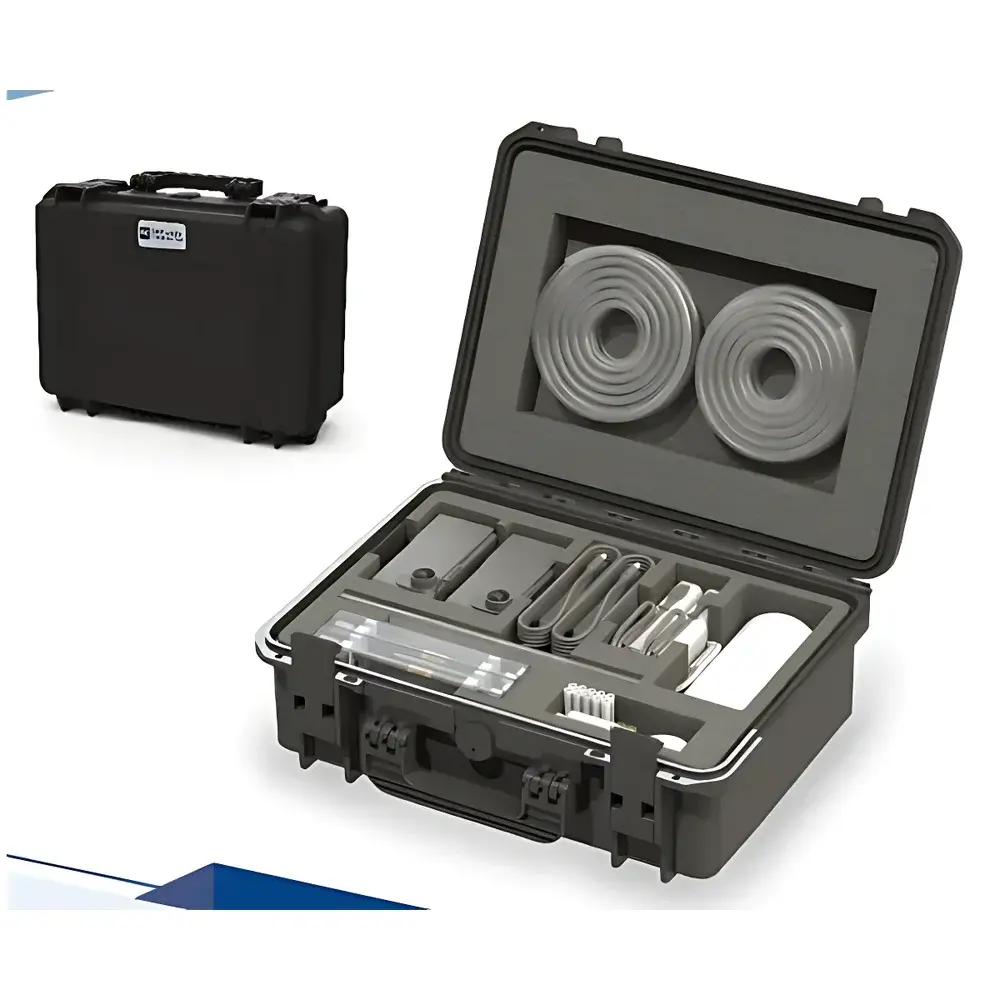
Brookfield SK-1000A Ambient Air Mercury Sampling Kit
| Brand | Brookfield |
|---|---|
| Origin | Beijing, China |
| Manufacturer Type | Direct Manufacturer |
| Regional Classification | Domestic (China) |
| Model | SK-1000A |
| Instrument Type | Portable |
| Measurement Principle | Cold Vapor Atomic Absorption Spectrometry (CVAAS) via Gold Amalgamation |
Overview
The Brookfield SK-1000A Ambient Air Mercury Sampling Kit is a field-deployable, standardized sampling system engineered for the quantitative collection and stabilization of total gaseous mercury (TGM) — predominantly elemental mercury (Hg⁰), with minor contributions from reactive gaseous mercury (RGM) and particulate-bound mercury (PBM) — from ambient air matrices. It operates on the internationally recognized gold amalgamation principle: mercury vapor selectively binds to gold-coated surfaces at ambient temperatures, forming a stable amalgam that prevents loss, oxidation, or adsorption artifacts during transport and storage. This passive, diffusion-controlled capture mechanism eliminates the need for active pumps or power sources during sampling, ensuring robustness in remote or low-infrastructure environments. The collected sample remains chemically inert until thermally desorbed in a certified laboratory instrument — typically a WA-5A or WA-5F mercury analyzer — where quantification is performed via cold vapor atomic absorption spectrometry (CVAAS) or cold vapor atomic fluorescence spectrometry (CVAFS). The SK-1000A complies with methodological frameworks aligned with JIS K 0312 (Japanese Industrial Standard for ambient air Hg), EPA Method 1631E (for aqueous and atmospheric mercury), and ISO 6978-2 (natural gas mercury analysis), providing traceable, legally defensible data for regulatory reporting and environmental monitoring programs.
Key Features
- Portable, self-contained sampling enclosure designed for field deployment without external power or compressed gas
- Incorporates N-160 or N-65 gold-coated quartz amalgamation traps — high-purity, pre-conditioned, and individually sealed in glass vials with inert stoppers to prevent cross-contamination
- Gold amalgamation chemistry enables selective, interference-resistant capture of Hg⁰ across wide temperature and humidity ranges (−20 °C to +45 °C; 10–95% RH)
- Reusable trap design: after thermal desorption (typically 600–800 °C), traps undergo in-situ cleaning and reconditioning, supporting ≥50 analytical cycles with documented recovery stability (≥95% ±3% RSD per batch)
- Integrated flow control orifice and calibrated sampling duration markers for standardized volumetric uptake (e.g., 10–100 L at 0.1–1.0 L/min)
- Compliant packaging meets IATA Section II requirements for transport of non-hazardous mercury-stabilized samples
Sample Compatibility & Compliance
The SK-1000A is validated for use with ambient air, urban background air, industrial fence-line air, and indoor air matrices. It is not intended for high-particulate or corrosive gas streams (e.g., flue gas without prior filtration). All components conform to RoHS Directive 2011/65/EU and REACH Annex XVII restrictions on mercury-containing materials. Trap performance is verified against NIST SRM 2783 (Air Particulate Matter) and certified reference gas standards traceable to NIST SP-253. Data generated using this kit supports compliance with national ambient air quality standards (e.g., China’s GB 3095-2012 Annex D), EU Directive 2004/107/EC (mercury in ambient air), and WHO Air Quality Guidelines (2021) for Hg⁰ exposure assessment.
Software & Data Management
While the SK-1000A itself is hardware-only, its integration into regulated workflows requires full audit trail support. When used with WA-5A/WA-5F analyzers, data acquisition software (e.g., WA-Link v4.2+) provides 21 CFR Part 11-compliant electronic records, including user authentication, instrument calibration logs, desorption temperature profiles, peak integration parameters, and automatic calculation of TGM concentration (ng/m³) with uncertainty propagation. All raw spectra and metadata are stored in vendor-neutral .csv and .xml formats compatible with LIMS platforms (e.g., LabWare, Thermo Fisher SampleManager) and GLP/GMP documentation systems.
Applications
- Long-term trend monitoring of atmospheric mercury deposition in remote ecosystems (e.g., Arctic, alpine, marine boundary layer)
- Source apportionment studies near coal-fired power plants, chlor-alkali facilities, and artisanal gold mining sites
- Validation of continuous mercury monitors (CMMs) and passive samplers in QA/QC protocols
- Indoor air quality assessments in dental clinics, laboratories, and legacy mercury-spill remediation sites
- Research on mercury redox cycling, atmospheric lifetime modeling, and global biogeochemical budgeting
FAQ
What is the recommended sampling duration and flow rate for ambient air?
Standard operation uses 10–100 L at 0.1–1.0 L/min, corresponding to 10–1000 minutes depending on target detection limit (typical MDL: 0.1 ng/m³ for 24-hr sampling).
Can the gold traps be reused after thermal desorption?
Yes — each N-160/N-65 trap is qualified for ≥50 cycles when cleaned per WA-5 series instrument SOPs and verified with blank and standard spikes.
Does the SK-1000A require calibration before field use?
No field calibration is needed; however, batch-specific breakthrough testing and recovery validation (using spiked air standards) must be performed prior to regulatory submission.
Is the kit compatible with CVAFS detection?
Yes — the trapped mercury is fully compatible with both CVAAS (WA-5A) and CVAFS (WA-5F) detection modes; no chemical modification is required.
How should spent traps be disposed of?
Traps containing recovered mercury must be treated as hazardous waste per local regulations (e.g., US EPA 40 CFR 261.24, China’s HW29 listing); Brookfield provides certified recycling pathways upon request.





