
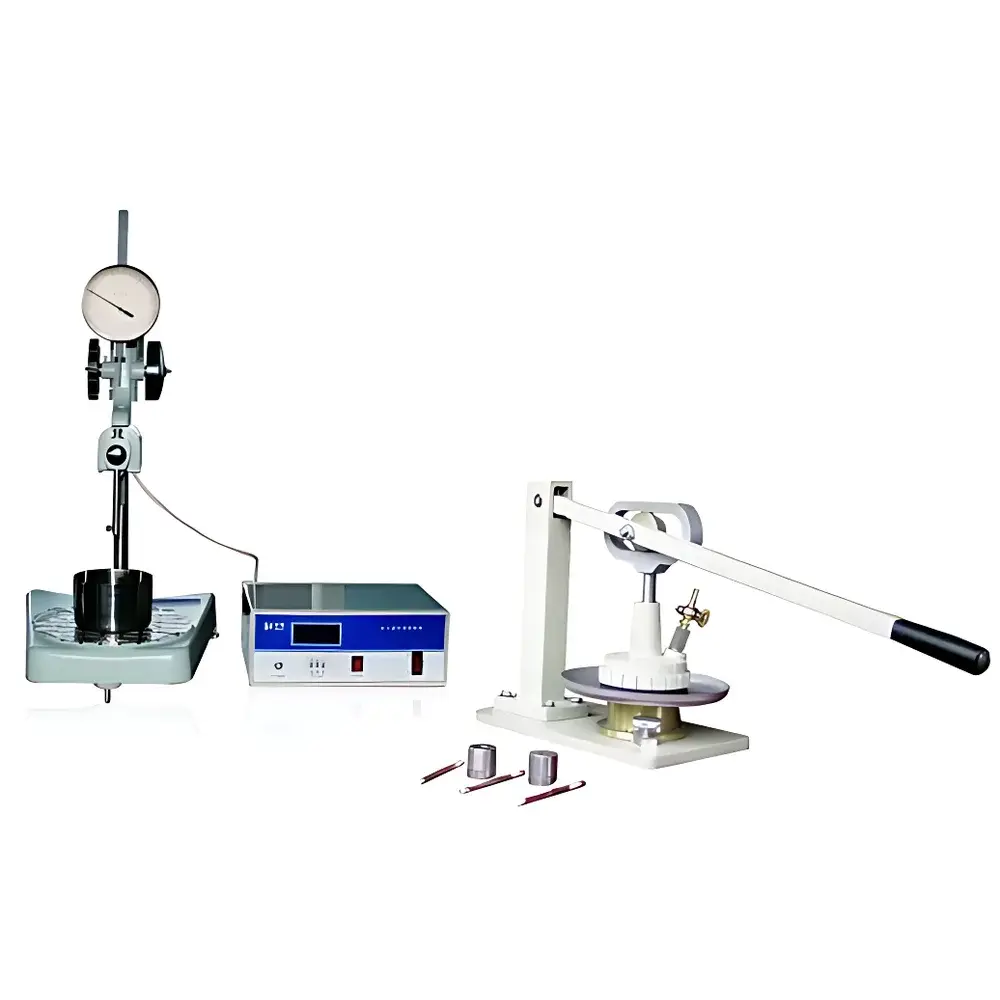
Brookfield SYP4100-I Standard Penetrometer for Greases and Petroleum Jellies
| Brand | Shenkai |
|---|---|
| Origin | Shanghai, China |
| Manufacturer Type | Authorized Distributor |
| Country of Origin | PRC |
| Model | SYP4100-I |
| Price | Upon Request |
| Penetration Time Range | 0–9 min 59 s |
| Time Accuracy | ±0.1 s |
| Max Penetration Depth | ≤620 dmm (0.1 mm increments) |
| Standard Cone Mass | 102.5 g (conforms to GB/T 269, ISO 2137, ASTM D217, IP 50) |
| Standard Rod Mass | 47.5 g |
| Digital Depth Measurement System | Yes |
| Manual Release Mechanism | Integrated |
| Horizontal Leveling Adjustment | Precision Knob-Actuated Platform |
| Operating Environment | Ambient or Constant-Temperature Water Bath Compatible |
Overview
The Brookfield SYP4100-I Standard Penetrometer is a precision mechanical instrument engineered for the quantitative determination of consistency in semi-solid materials—primarily lubricating greases and petroleum jellies—through standardized cone penetration testing. Based on the fundamental principle of quasi-static indentation under controlled load and time, the device measures the depth (in tenths of a millimeter, dmm) to which a standardized cone assembly penetrates a sample under gravity alone, following strict protocols defined in GB/T 269, ISO 2137, ASTM D217, and IP 50. This measurement directly correlates with material yield behavior, structural stability, and shear resistance—critical parameters for grease classification (e.g., NLGI grades), formulation validation, and quality control across refining, additive manufacturing, and OEM lubricant supply chains.
Key Features
- Digitally calibrated depth sensing system with high-resolution linear encoder output, delivering repeatable readings to ±0.1 dmm under laboratory conditions.
- Dual-speed vertical positioning mechanism: coarse travel for rapid cone approach and fine micrometer feed for precise surface contact alignment—reducing operator-induced variability during zero-point establishment.
- Integrated manual release lever enabling deterministic initiation of penetration without reliance on electronic timing circuits—essential for method verification, troubleshooting, and environments where electromagnetic interference may affect solenoid-based actuation.
- Adjustable leveling platform with three-point kinematic support and precision leveling screws ensures orthogonal alignment between cone axis and sample surface, minimizing angular deviation errors per ISO 2137 Annex A.
- Modular base design permits secure mounting inside temperature-controlled water baths (e.g., ASTM D217 Annex A), supporting low-temperature (–20 °C) and elevated-temperature (77 °C) penetration tests required for multi-grade grease evaluation.
- Compliant cone and rod assembly: 102.5 g conical penetrometer (30° apex angle, 0.38 mm tip radius) and 47.5 g stainless-steel rod meet dimensional and mass tolerances specified in all referenced standards.
Sample Compatibility & Compliance
The SYP4100-I accommodates a broad spectrum of non-Newtonian, viscoelastic, and structured materials beyond petroleum-derived greases—including metalworking pastes, bituminous sealants, pharmaceutical ointments, food-grade gels (e.g., cheese curd, butter, whipped cream), and cosmetic emulsions. Its mechanical architecture satisfies the physical requirements of ASTM D217 (Standard Test Method for Cone Penetration of Lubricating Grease), ISO 2137 (Petroleum products — Lubricating greases — Determination of penetration), GB/T 269 (Chinese national standard for grease consistency), and IP 50 (Institute of Petroleum method). While not an electronically validated system per FDA 21 CFR Part 11, its manual operation and deterministic mechanical release support GLP-compliant recordkeeping when paired with auditable lab notebooks and timestamped digital imaging of penetration readings.
Software & Data Management
The SYP4100-I operates as a standalone mechanical instrument with no embedded firmware or proprietary software. All measurements are recorded manually or transcribed into LIMS-compatible spreadsheets. Time control is executed via a high-stability quartz timer (0–9:59 range, ±0.1 s accuracy), and depth values are read directly from the digital display—eliminating interpolation errors associated with analog dial gauges. For laboratories requiring traceable digital data capture, optional third-party USB-connected depth loggers or machine vision systems (e.g., calibrated CCD-based displacement analyzers) may be integrated externally without modifying the core instrument.
Applications
- Quality assurance of NLGI Grade 000–6 greases during batch release testing.
- Evaluation of thermal stability and shear thinning behavior via multi-temperature penetration profiling (e.g., –20 °C, 25 °C, 77 °C).
- Comparative assessment of thickener efficiency in lithium-, calcium-, and polyurea-based formulations.
- Consistency screening of asphaltic cutbacks, mastics, and cold-applied sealants in pavement engineering labs.
- Texture analysis of dairy and confectionery products under food regulatory frameworks (e.g., Codex Alimentarius Section VII).
- Validation of storage stability in organogels and colloidal suspensions used in catalysis and battery electrolyte research.
FAQ
Does the SYP4100-I comply with ASTM D217 Appendix X1 for multi-temperature testing?
Yes—the mechanical design supports immersion in thermostatically controlled baths meeting ASTM D217 Annex A specifications, and the leveling platform remains functional at bath depths up to 150 mm.
Can the instrument be used for NLGI grade verification without additional calibration tools?
Yes—when operated with certified reference greases (e.g., NIST SRM 1972), the SYP4100-I meets repeatability criteria (≤4 dmm for single-operator testing) required for NLGI classification per ASTM D217 Section 8.
Is the digital depth display traceable to national metrology institutes?
The encoder-based display is factory-calibrated against gauge blocks traceable to CNAS-accredited standards; full calibration certificates are available upon request.
What maintenance is required to sustain measurement accuracy over extended use?
Biannual verification of cone tip geometry (via optical profilometry), annual torque check of leveling screws, and quarterly cleaning of the guide sleeve with isopropyl alcohol to prevent particulate-induced friction variance.
Can the manual release lever be locked during automated timing sequences?
No—the lever is purely mechanical and disengages fully upon actuation; timing independence ensures compliance with ISO 2137 Clause 7.3 regarding unambiguous start-of-penetration definition.






