
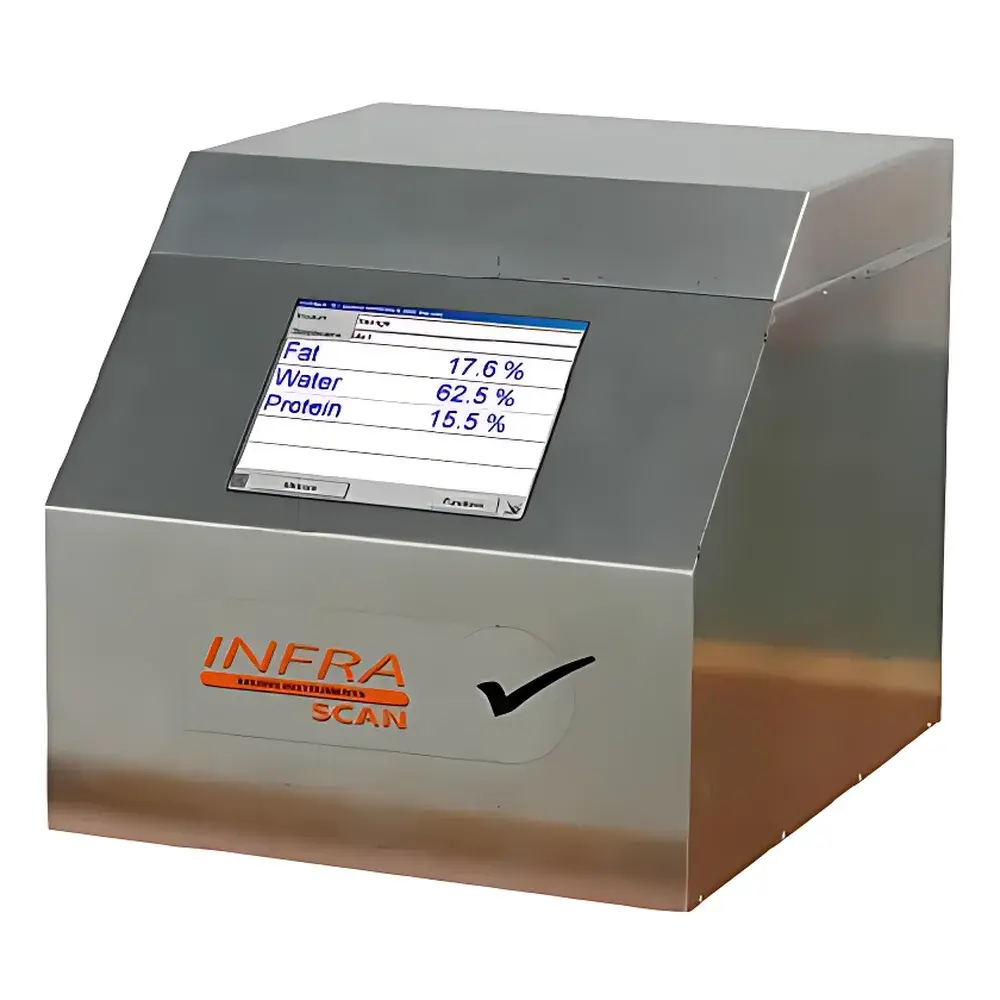
Bruins InfraScan Research-Grade Near-Infrared Spectrometer
| Brand | Bruins |
|---|---|
| Origin | Germany |
| Model | InfraScan |
| Instrument Type | Laboratory |
| Principle | Grating-based non-scanning array detector |
| Wavelength Range | 730–1100 nm (standard), optional 380–1100 nm |
| Scan Speed | 45 spectra/sec |
| Data Sampling Interval | 1 second |
| Measurement Modes | Diffuse Reflectance / Transmission |
| Chemometrics Software | RIMP |
| Dimensions | 370 × 370 × 460 mm |
| Weight | 28 kg |
| Power Supply | 220–240 V / 50 Hz |
| Power Consumption | 45 W |
| Environmental Protection | Dust- and moisture-resistant |
| Interface | USB, Ethernet, Parallel Port |
| Wavelength Resolution | 0.5 nm (standard) |
| Optional High-Resolution Models | Omega 10 (0.2 nm), Omega 20 (0.1 nm) |
Overview
The Bruins InfraScan is a research-grade, dual-mode near-infrared (NIR) spectrometer engineered for high-fidelity spectral acquisition across the visible-to-NIR continuum (380–1100 nm, standard configuration: 730–1100 nm). Unlike scanning monochromator systems, the InfraScan employs a fixed grating with a linear CCD/CMOS array detector, enabling true non-scanning, full-spectrum capture in a single integration event. This optical architecture delivers superior photometric stability, high signal-to-noise ratio (SNR), and exceptional repeatability—critical for quantitative method development and spectral library construction. Its dual-beam, patented linear grating monochromator ensures long-term wavelength accuracy and linearity without mechanical recalibration. Designed explicitly for laboratory-based fundamental research and application model development—not routine QC—the InfraScan supports exploratory studies in material characterization, spectral response mapping, and chemometric algorithm validation under controlled experimental conditions.
Key Features
- Non-scanning full-spectrum acquisition using a high-stability linear grating and array detector architecture
- Dual measurement capability: simultaneous or independent diffuse reflectance and transmission mode operation
- Configurable spectral range: standard 730–1100 nm; optionally extended to 380–1100 nm for VIS-NIR correlation studies
- Wavelength resolution of 0.5 nm (FWHM), with traceable calibration against NIST-traceable standards
- Ruggedized benchtop housing (370 × 370 × 460 mm, 28 kg) featuring IP54-rated dust and moisture protection
- Multi-interface connectivity: USB 2.0, 10/100 Ethernet, and legacy parallel port for industrial integration
- Low-power design (45 W max) compatible with standard laboratory mains (220–240 V / 50 Hz)
Sample Compatibility & Compliance
The InfraScan accommodates heterogeneous sample formats—including powders, granules, pastes, liquids, films, and solid tablets—via interchangeable optical modules optimized for either diffuse reflectance (e.g., integrating sphere, contact probe) or transmission (e.g., cuvette holder, fiber-coupled path). Its optical geometry adheres to ASTM E1655–22 guidelines for NIR method development and complies with ISO 12099:2017 for performance verification of spectroscopic analyzers. While not pre-certified for GMP environments, the system supports GLP-compliant workflows through audit-trail-enabled software logging and user-access controls. All hardware components meet CE, RoHS, and IEC 61010-1 safety directives for laboratory instrumentation.
Software & Data Management
The InfraScan operates exclusively with RIMP (Research Instrument Modeling Platform), Bruins’ proprietary chemometrics suite designed for method development, multivariate calibration (PLS, PCR, PCA), and spectral preprocessing (baseline correction, SNV, derivatives, smoothing). RIMP supports raw spectrum export in ASTM E131-compliant JCAMP-DX format and enables batch processing of >10,000 spectra per session. It includes built-in tools for outlier detection, model validation (cross-validation, test-set prediction), and uncertainty estimation per predicted property. Data integrity is reinforced via timestamped acquisition logs, user authentication, and optional 21 CFR Part 11 compliance packages (electronic signatures, audit trails, role-based permissions) available upon request.
Applications
The InfraScan serves as a foundational tool in academic and industrial research laboratories where spectral understanding precedes deployment. Key use cases include: development of predictive models for moisture, protein, fat, and starch content in agricultural commodities; investigation of pigment dispersion and oxidation kinetics in cosmetic emulsions; real-time monitoring of polymer crystallinity during extrusion; quantification of active pharmaceutical ingredient (API) homogeneity in tablet blends; and validation of reference methods for colorimetric indices (CIE L*a*b*, ΔE) in food and packaging materials. Its broad spectral coverage enables cross-domain correlation—for example, linking chlorophyll absorption features (650–680 nm) with NIR water bands (970 nm, 1450 nm) to improve drought-stress modeling in plant phenotyping.
FAQ
Is the InfraScan suitable for regulated quality control environments?
It is primarily intended for research and method development. For validated production QC, Bruins recommends the Omega series with enhanced traceability and 21 CFR Part 11-ready firmware.
Can the 380–1100 nm option be retrofitted to an existing unit?
Yes—subject to optical alignment recalibration and firmware update; performed by authorized Bruins service engineers.
Does RIMP support third-party model import (e.g., MATLAB or Python-generated PLS models)?
RIMP accepts PLS models exported in PMML 4.4 format and provides conversion utilities for common binary model containers.
What is the typical warm-up time before photometric stability is achieved?
Less than 15 minutes under ambient lab conditions (20–25°C, <60% RH); wavelength calibration remains stable for ≥8 hours post-warm-up.
Are application databases provided with the instrument?
No—Bruins offers custom database development services separately, aligned with client-specific matrices, reference methods, and regulatory requirements.




