
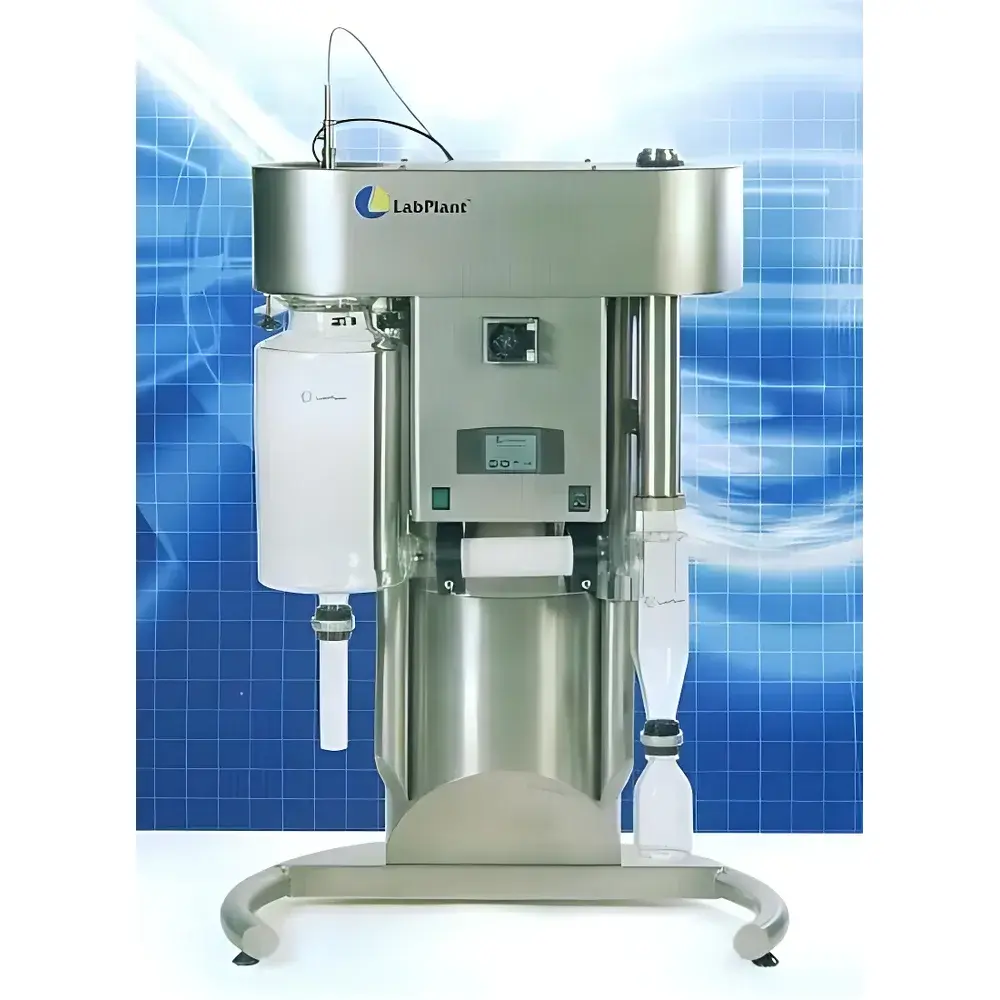
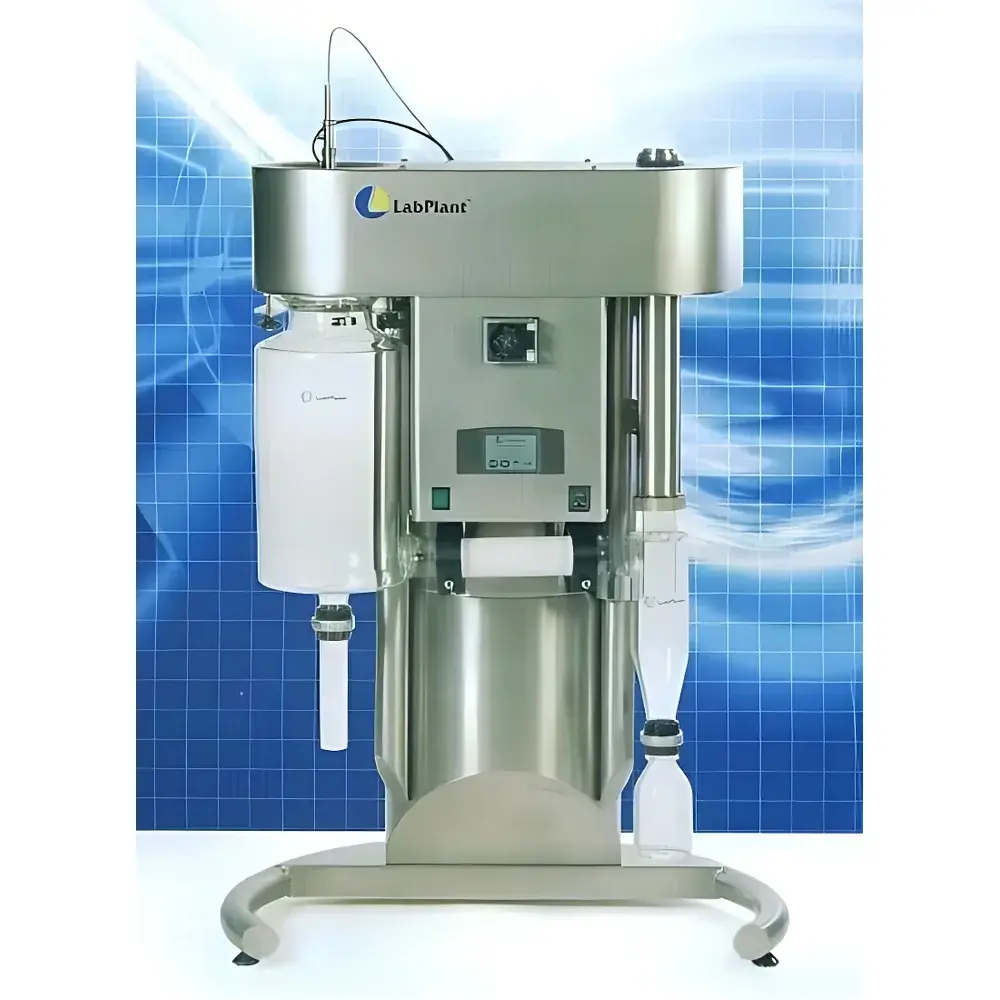
LabPlant SD-06 Automated Spray Dryer
| Brand | LabPlant |
|---|---|
| Origin | United Kingdom |
| Model | SD-06 |
| Max. Feed Rate | 32 mL/min |
| Inlet Temp. Range | 40–250 °C |
| Outlet Temp. Control | Yes |
| Air Flow | 100–500 m³/h |
| Heating Power | 3 kW |
| Built-in Compressor | 2.0 m³/h @ 5 bar, up to 9 bar |
| Nozzle Diameter (Std.) | 0.5 mm |
| Particle Size Range | 0.1–40 µm |
| Drying Time | 1.0–2.0 s |
| Max. Throughput | 1.5 L/h (water), 2.0 L/h (organic solvents) |
| Dimensions (H×W×D) | 1110 × 825 × 600 mm |
| Weight | 80 kg |
| Voltage | 220 V / 50 Hz, 13 A |
| Material | 316L stainless steel frame, borosilicate glass drying chamber & cyclone |
| Solvent Compatibility | Yes (with N₂ inerting option) |
Overview
The LabPlant SD-06 Automated Spray Dryer is a fully integrated, benchtop-scale spray drying system engineered for precision, safety, and operational autonomy in research and development laboratories. Based on over three decades of iterative design refinement across six generations, the SD-06 implements the core principles of concurrent atomization, rapid convective drying, and inertial particle separation—enabling reproducible conversion of liquid feeds (solutions, suspensions, emulsions) into free-flowing, spherical dry powders within seconds. Its closed-loop architecture integrates all essential subsystems—including a built-in oil-free air compressor, programmable peristaltic feed pump, multi-fluid nozzle with ruby orifice, heated drying chamber, high-efficiency cyclonic separator, and real-time thermal monitoring—eliminating dependency on external utilities or ancillary hardware. Designed specifically for both aqueous and organic solvent-based formulations, the SD-06 incorporates dual-safety engineering: nitrogen purging capability to suppress flammability limits and interlocked thermal control logic ensuring heater activation only when airflow is verified.
Key Features
- Fully self-contained design: no external air supply, vacuum pump, or chiller required—operational upon power connection
- Built-in oil-free air compressor delivering up to 2.0 m³/h at 5 bar (peak 9 bar), with integrated inlet particulate filter
- Three-roller peristaltic pump with adjustable speed (0–32 mL/min), enabling precise volumetric dosing and compatibility with shear-sensitive biologics
- Multi-fluid stainless steel (316L) nozzle with ruby-coated orifice (standard 0.5 mm; optional 0.7, 1.0, or 2.0 mm); includes automated cleaning cycle (pressure-controlled at 2.3 bar, frequency programmable)
- Transparent borosilicate glass drying chamber (Ø300 mm) and cyclone for real-time process observation and contamination-free operation
- Intelligent safety interlocks: heater power disabled unless fan is confirmed running; N₂ purge mode enforces oxygen displacement prior to solvent processing
- LED touchscreen interface for simultaneous control and logging of inlet/outlet temperature, air flow rate, feed rate, drying time profile, and nozzle cleaning schedule
Sample Compatibility & Compliance
The SD-06 accommodates a broad spectrum of thermolabile and solvent-based feedstocks, including pharmaceutical actives, polymer dispersions, food-grade emulsions, ceramic precursors, and botanical extracts. Its inerting-ready configuration supports safe drying of flammable solvents such as acetone, ethanol, isopropanol, and methyl ethyl ketone—provided compatible elastomers (e.g., FKM seals) are installed per solvent compatibility guidelines. All wetted components comply with USP Class VI and FDA 21 CFR Part 11–ready data integrity standards when paired with LabPlant’s optional audit-trail-enabled software. The system meets ISO 9001 manufacturing requirements and conforms to CE Machinery Directive 2006/42/EC and Electromagnetic Compatibility Directive 2014/30/EU. Optional anti-static coating on the cyclone enables handling of electrostatically sensitive APIs under GMP-aligned workflows.
Software & Data Management
The SD-06’s embedded controller records timestamped process parameters—including real-time inlet/outlet temperature differentials, mass flow-derived air velocity, feed rate stability, and thermal decay curves—into non-volatile memory. Exportable CSV logs support post-run analysis in MATLAB, Python, or statistical process control (SPC) platforms. When connected to LabPlant’s optional SD-Link™ PC software, users gain access to advanced features: remote parameter adjustment, multi-step drying protocol sequencing, comparative batch trending, and electronic signature–enabled report generation compliant with ALCOA+ principles. Audit trails capture user login events, parameter changes, and system alarms—fully traceable for GLP/GMP audits and regulatory submissions (e.g., FDA IND/ANDA modules).
Applications
- Pharmaceutical R&D: production of inhalable dry powders, amorphous solid dispersions, and microencapsulated APIs
- Food science: encapsulation of probiotics, flavors, and omega-3 oils; stabilization of heat-sensitive nutraceuticals
- Materials engineering: synthesis of nano-ceramic precursors, battery cathode materials, and functional polymer microparticles
- Agrochemical development: formulation of water-dispersible granules (WDGs) and controlled-release pesticides
- Biotechnology: lyoprotectant-free drying of enzymes, vaccines, and monoclonal antibody conjugates
- Academic research: parametric studies on droplet evaporation kinetics, particle morphology evolution, and glass transition behavior during drying
FAQ
Can the SD-06 handle heat-sensitive biological samples?
Yes—the short residence time (1.0–2.0 s), precise outlet temperature control (±1 °C), and low thermal mass design minimize thermal degradation; inlet temperature can be reduced to 40 °C for highly labile compounds.
Is nitrogen inerting mandatory for organic solvent drying?
It is strongly recommended and functionally required for safe operation; the SD-06’s N₂ purge mode ensures O₂ concentration remains below 8% v/v, mitigating ignition risk per NFPA 30 and ATEX Zone 2 guidelines.
What maintenance is required for the ruby nozzle?
No routine replacement is needed; the ruby orifice resists erosion from abrasive slurries and solvents—cleaning cycles every 2–4 hours during extended runs maintain consistent atomization performance.
How is particle size distribution controlled?
Primary control variables include nozzle diameter, feed concentration, inlet temperature, and atomization air pressure; secondary influence comes from outlet temperature setpoint and cyclone geometry—empirical DOE protocols are supported via the SD-Link™ software.
Does the system comply with 21 CFR Part 11 for electronic records?
Hardware-level compliance requires optional SD-Link™ with password-protected user roles, electronic signatures, and immutable audit trails—validated configurations are available for regulated environments.



