
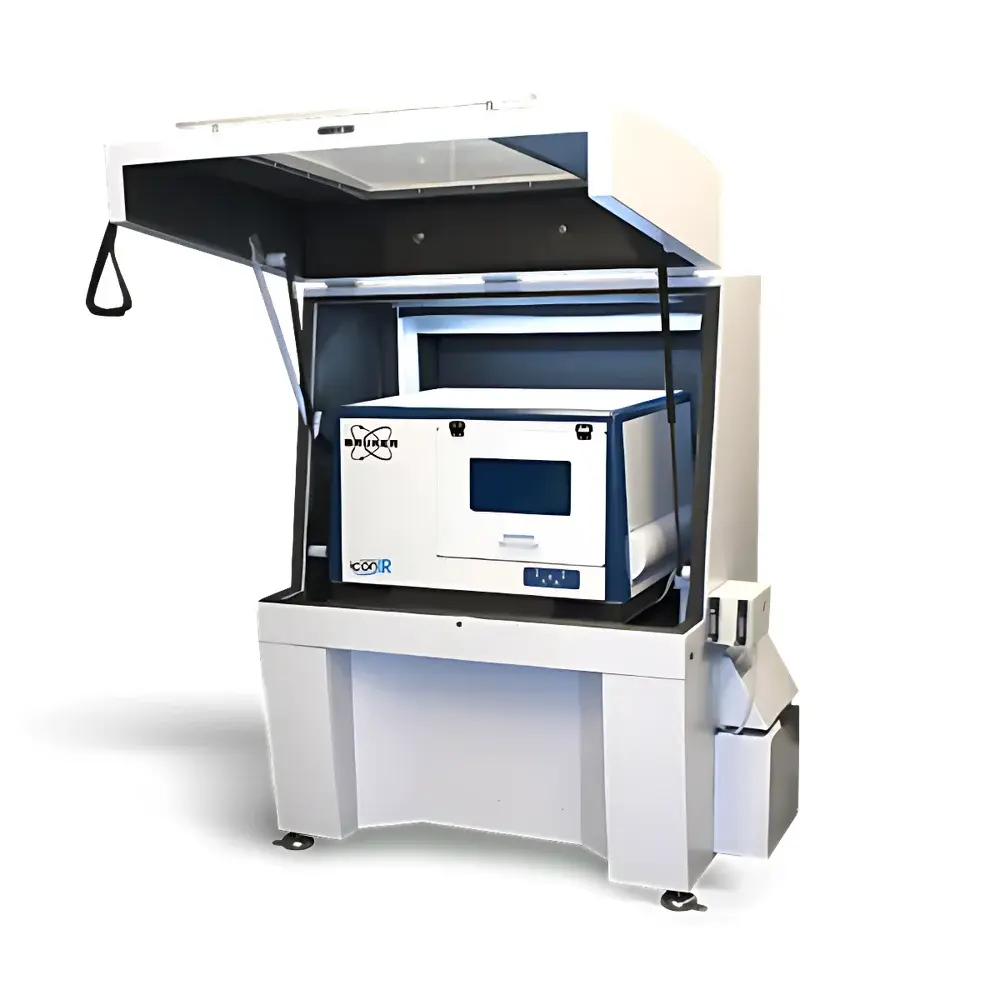
Bruker Dimension IconIR Nanoscale Infrared Spectroscopy and Chemical Imaging System
| Brand | Bruker |
|---|---|
| Origin | USA |
| Model | Dimension IconIR |
| Type | Modular Scanning Probe Microscope (SPM) with Integrated AFM-IR |
| Measurement Principle | Photothermal Induced Resonance (PTIR) / Nanoscale Fourier Transform Infrared (nano-FTIR) |
| Spatial Resolution | <10 nm |
| Sensitivity | Monolayer-level chemical detection |
| Compatibility | PeakForce Tapping® for nanomechanical & nanoelectrical correlative mapping |
| Software Platform | NanoScope Analysis with IR spectral library integration |
| Compliance | Supports GLP/GMP audit trails, ASTM E2987 (for nanoscale spectroscopic imaging), ISO/IEC 17025 traceability frameworks |
Overview
The Bruker Dimension IconIR is a purpose-engineered multimodal scanning probe microscopy platform that unifies atomic force microscopy (AFM) with nanoscale infrared (IR) spectroscopy—enabling direct, label-free chemical identification at spatial resolutions far below the diffraction limit of conventional FTIR. Unlike optical or synchrotron-based microspectroscopy, the Dimension IconIR operates on the photothermal induced resonance (PTIR) principle: pulsed tunable IR laser irradiation induces localized thermal expansion in regions where the sample absorbs at the selected wavelength; this nanoscale mechanical response is detected in real time by a high-bandwidth AFM cantilever operating in PeakForce Tapping® mode. The resulting signal amplitude is directly proportional to the local IR absorption coefficient, yielding spectra quantitatively aligned with bulk FTIR references—verified across polymer standards, biological membranes, and 2D materials per ASTM E2987 guidelines. This physical correlation ensures spectral fidelity without empirical calibration transfer, making the system suitable for regulatory-compliant material characterization in pharmaceutical development, semiconductor failure analysis, and advanced battery research.
Key Features
- Sub-10 nm spatial resolution IR chemical imaging—enabled by patented contact-resonance enhancement and tunable pulsed laser synchronization
- Monolayer sensitivity across mid-IR range (1000–4000 cm⁻¹), validated using self-assembled monolayers (SAMs) and supported lipid bilayers
- Full integration of PeakForce Tapping® for simultaneous acquisition of topography, nanomechanical modulus, adhesion, deformation, and surface potential
- Automated beam steering and dynamic focus correction compensates for angular dispersion during laser wavelength tuning—eliminating manual realignment
- Real-time laser energy normalization maintains constant photon flux density at the sample surface, ensuring spectral reproducibility across multi-day experiments
- Modular design supports optional add-ons: conductive AFM (c-AFM), Kelvin probe force microscopy (KPFM), and magnetic force microscopy (MFM)
Sample Compatibility & Compliance
The Dimension IconIR accommodates rigid and soft samples up to 200 mm in diameter and 50 mm in height—including wafers, cross-sectioned devices, freeze-dried tissues, and air-sensitive battery electrodes. Its open-stage architecture permits in situ environmental control via vacuum, inert gas, or temperature stages (−150 °C to +300 °C). All spectral data acquisition and processing comply with ISO/IEC 17025 requirements for analytical laboratories; raw interferograms and processed spectra retain full metadata (laser power, dwell time, pixel size, ambient conditions) required for FDA 21 CFR Part 11–compliant audit trails when deployed with Bruker’s NanoScope Analysis software configured for GLP/GMP environments.
Software & Data Management
NanoScope Analysis v9.0+ provides unified workflow control for AFM imaging, point-spectrum acquisition, hyperspectral IR mapping, and multivariate statistical analysis (PCA, cluster analysis). Spectral libraries (e.g., Polymer Additives, Pharma Excipients, Biomolecules) are embedded with NIST-traceable reference spectra. Batch processing supports automated peak fitting (Gaussian/Lorentzian deconvolution), functional group mapping, and overlay with mechanical property maps. Export formats include HDF5 (for MATLAB/Python integration), JCAMP-DX (ASTM E131 compliant), and TIFF with embedded EXIF metadata for LIMS compatibility.
Applications
- Pharmaceutical solid-state characterization: polymorph distribution, API-excipient interactions, and coating homogeneity in controlled-release tablets
- Microelectronics: nanoscale delamination detection, contaminant ID in BEOL structures, and interfacial chemistry of low-k dielectrics
- Energy materials: SEI composition mapping on cycled Li-ion anodes, binder degradation in silicon composites, and ionomer distribution in PEM fuel cell membranes
- Life sciences: protein secondary structure localization in amyloid fibrils, lipid phase segregation in model membranes, and subcellular organelle chemical fingerprinting
- Advanced polymers: nanophase separation in block copolymers, filler dispersion in nanocomposites, and degradation front propagation in UV-aged films
FAQ
How does Dimension IconIR achieve spectral alignment with conventional FTIR?
It relies on PTIR physics: thermal expansion amplitude is linearly proportional to local absorption cross-section—identical to the Beer–Lambert basis of FTIR. No chemometric transfer functions are needed.
Can it operate under ambient conditions?
Yes—no vacuum or cryogenic cooling is required for standard operation. Optional environmental chambers extend functionality to controlled humidity or reactive atmospheres.
What is the minimum detectable feature size for chemical contrast?
Consistently <10 nm for crystalline polymers and inorganic nanoparticles; lateral resolution is limited by tip radius and contact mechanics—not optical diffraction.
Is spectral quantification supported?
Yes—peak area integration follows ASTM E168 protocols; relative band intensities correlate linearly with concentration in homogeneous thin films (R² > 0.998 over 0.1–100 nm thickness range).
How is data integrity ensured for regulated workflows?
NanoScope Analysis logs all instrument parameters, user actions, and software versions in immutable HDF5 containers; electronic signatures and role-based access control align with 21 CFR Part 11 Annex 11 requirements.




