
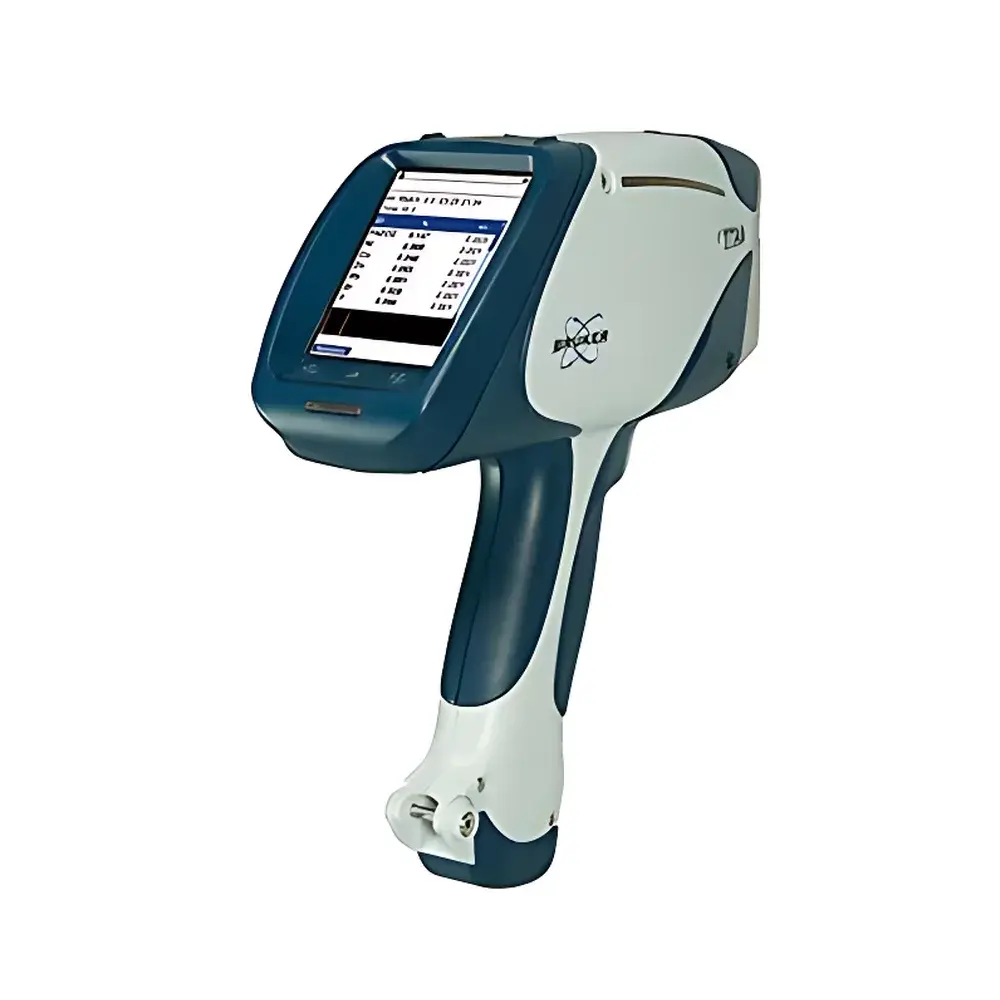
Bruker S1 TITAN N Handheld Energy Dispersive X-Ray Fluorescence (ED-XRF) Spectrometer
| Brand | Bruker |
|---|---|
| Origin | Germany |
| Model | S1 TITAN N |
| Application | Handheld / Portable |
| Element Range | Mg–U |
| Detection Limit | 1 ppm – 99.99% |
| Energy Resolution | <140 eV (Mn Kα) |
| Repeatability | ±0.1% RSD |
| Detector | Silicon Drift Detector (SDD) |
Overview
The Bruker S1 TITAN N is a field-deployable, handheld energy dispersive X-ray fluorescence (ED-XRF) spectrometer engineered for rapid, non-destructive elemental analysis of solid and powdered materials in situ. Based on fundamental ED-XRF physics—where primary X-rays from a miniature Rh or Ag anode tube excite characteristic secondary (fluorescent) X-rays from sample atoms—the instrument quantifies elemental composition by measuring the energy and intensity of emitted photons. Its optimized optical path, high-efficiency SDD detector, and real-time spectral deconvolution enable reliable identification and quantification of elements from magnesium (Mg, Z=12) to uranium (U, Z=92), supporting regulatory screening across electronics, consumer goods, recycling, and manufacturing supply chains.
Key Features
- Compact, ruggedized IP54-rated housing with integrated ergonomic grip and reinforced shock-absorbing casing for industrial field use
- High-performance silicon drift detector (SDD) delivering <140 eV energy resolution at Mn Kα, ensuring precise peak separation for overlapping transitions (e.g., Cr–Fe–Mn, As–Pb)
- Automated tube voltage (up to 50 kV) and current control, dynamically optimized per element group to maximize signal-to-noise ratio
- Real-time spectrum acquisition and on-device qualitative/quantitative analysis using Bruker’s proprietary S1 PXRF software suite
- Self-calibrating measurement protocol with embedded reference standards; no manual calibration required between analyses
- Battery-operated (rechargeable Li-ion, >8 h typical runtime); fully functional without external power or PC connection
- Onboard data storage (≥32 GB) with timestamped spectra, measurement reports, and audit-ready metadata exportable via USB or Wi-Fi
Sample Compatibility & Compliance
The S1 TITAN N accommodates heterogeneous, irregular, and non-flat surfaces—including PCBs, plastic housings, metal alloys, textiles, ceramics, and coated substrates—without sample preparation. It meets critical regulatory requirements for restricted substance screening under EU RoHS Directive 2011/65/EU (Pb, Hg, Cd, Cr⁶⁺, PBB, PBDE), US CPSIA 2008 (Pb in children’s products ≤100 ppm), and China RoHS II. Measurement repeatability of ±0.1% RSD (relative standard deviation) supports GLP-compliant workflows. Data integrity complies with FDA 21 CFR Part 11 principles via electronic signatures, audit trails, and user-access controls when paired with Bruker’s desktop reporting module.
Software & Data Management
Bruker’s S1 PXRF software provides intuitive touchscreen operation, library-based material classification (e.g., “RoHS Pass/Fail”, “Alloy Grade ID”), and customizable quantification methods (fundamental parameters, empirical calibration). All spectra are stored with full traceability: operator ID, GPS coordinates (optional), environmental temperature/humidity, tube settings, and live count statistics. Reports export in PDF, CSV, or XML formats compatible with LIMS integration. Software updates are delivered via secure OTA (over-the-air) or local firmware flash, maintaining compliance with evolving ISO/IEC 17025 documentation standards.
Applications
- Routine RoHS II and CPSIA compliance verification of electronics components, cables, connectors, and enclosures
- Lead content screening in toys, childcare articles, and apparel per ASTM F963 and EN71-3
- Scrap metal sorting and alloy grade confirmation (e.g., stainless steels, aluminum series, brass, nickel superalloys)
- Consumer product safety audits for Cd, Cr, Hg, Br (flame retardants), and Sb in plastics and coatings
- Environmental monitoring of contaminated soils and electronic waste (WEEE) fractions
- Quality assurance in plating thickness estimation (e.g., Ni/Cu/Zn layers) using FP-based thin-film algorithms
FAQ
Does the S1 TITAN N require annual recalibration?
No—its self-calibrating design uses internal reference sources and automatic spectral alignment, eliminating scheduled recalibration. Verification checks can be performed daily using supplied check standards.
Can it detect hexavalent chromium (Cr⁶⁺)?
ED-XRF measures total chromium. Cr⁶⁺ speciation requires wet chemistry (e.g., EPA 3060A) or XPS; however, the S1 TITAN N flags elevated Cr levels that trigger confirmatory testing.
Is operator radiation safety training required?
Yes—users must complete site-specific radiation safety orientation per local regulations (e.g., IAEA SSG-46, NRC 10 CFR 35). The device features dual interlocks, beam-on indicators, and dose rate monitoring (<1 µSv/h at 10 cm).
How does it handle surface contamination or paint layers?
Analysis depth is ~1–50 µm depending on element mass and matrix density. For coated samples, optional “thin film mode” applies matrix correction algorithms to estimate underlying substrate composition.
Is method validation support available?
Bruker provides IQ/OQ documentation templates, CRM-based validation protocols (e.g., NIST SRM 2582, BAM 181), and on-site application support for ISO 17025 accreditation preparation.




