
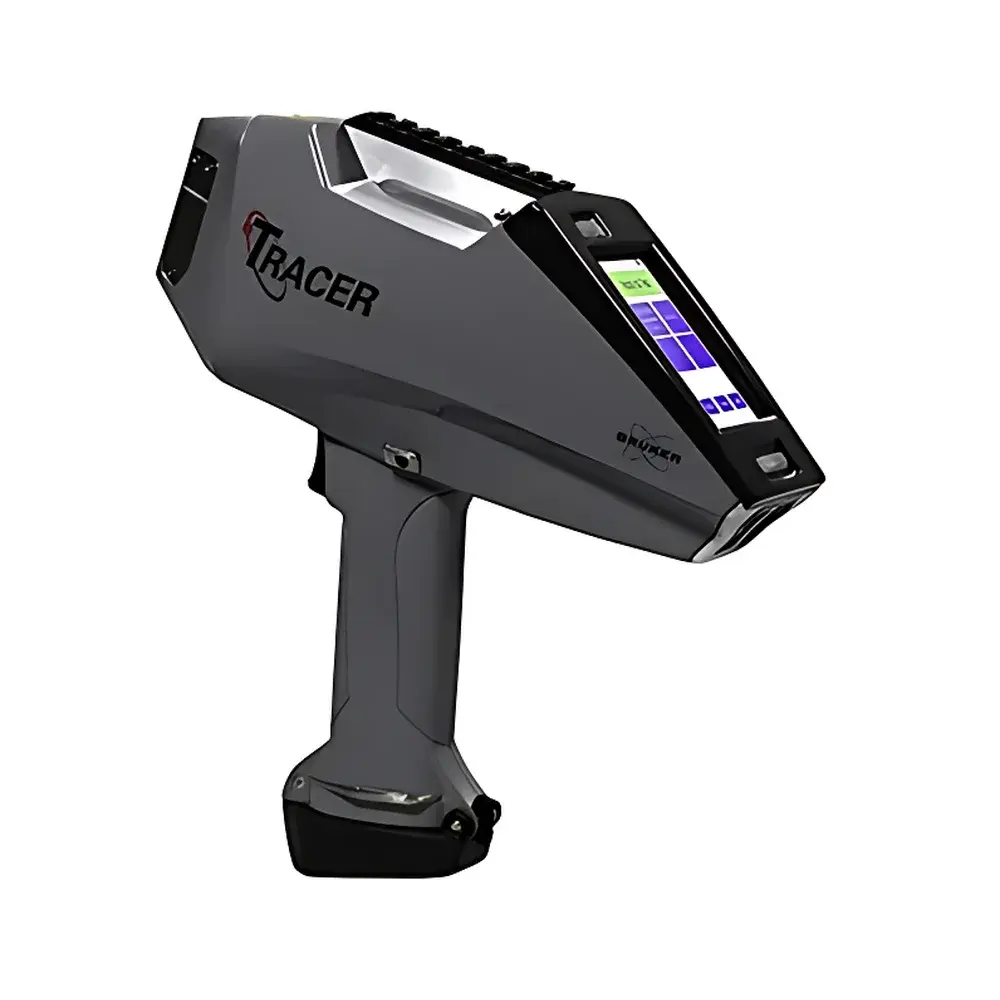
Bruker TRACER 5g Handheld Energy Dispersive X-Ray Fluorescence (ED-XRF) Spectrometer
| Brand | Bruker |
|---|---|
| Origin | Germany |
| Model | TRACER 5g |
| Application | Handheld/Portable |
| Instrument Type | General-Purpose Research-Grade ED-XRF |
| Industry-Specific Use | Geoscience & Mineral Exploration |
| Elemental Range | Na (Z=11) to U (Z=92) |
| Quantification Range | 1 ppm – 99.99% |
| Energy Resolution | <140 eV |
| Repeatability | 0.1% RSD |
| Detector | Silicon Drift Detector (SDD) with 1 µm Graphene Window |
Overview
The Bruker TRACER 5g is a research-grade handheld energy dispersive X-ray fluorescence (ED-XRF) spectrometer engineered for high-fidelity elemental analysis in field and laboratory environments. Unlike conventional portable XRF systems optimized for industrial screening, the TRACER 5g implements fundamental physics-based design principles—including optimized excitation geometry, ultra-low-noise detection architecture, and vacuum/He purged measurement pathways—to enable quantitative analysis of light elements down to fluorine (F, Z=9). Its operation relies on primary X-ray excitation of sample atoms, followed by detection of characteristic secondary (fluorescent) X-rays emitted upon electron shell relaxation. The system’s spectral response is calibrated against certified reference materials traceable to NIST and ISO 18504 standards, supporting compliance with GLP, ASTM E1621, and ISO 21043 for elemental analysis in geoscience, cultural heritage, and advanced materials research.
Key Features
- Graphene-window SDD detector: Replaces traditional 8 µm Be windows with a 1 µm graphene membrane, increasing transmission efficiency across the full 0.9–20 keV range—particularly critical for F Kα (0.677 keV), O Kα (0.525 keV), and Na Kα (1.041 keV) lines.
- SharpBeam™ optical geometry: Minimizes source-to-sample and sample-to-detector distances while maintaining collimated beam integrity, reducing scatter contribution and improving peak-to-background ratios for light elements.
- Tri-environment measurement capability: Switchable analysis modes—ambient air, He-purged, or vacuum—enable method-specific optimization: He mode enhances sensitivity for Na–Mg; vacuum mode extends detection to F and O.
- Programmable excitation control: Real-time adjustment of tube voltage (4–50 kV) and current (0–50 µA) via touchscreen interface, allowing empirical optimization for matrix-matched calibration and interference mitigation.
- Interchangeable collimation: Standard 3 mm and 8 mm diameter apertures; custom collimators compatible for micro-spot analysis (e.g., inclusion mapping in mineral grains).
- Integrated imaging subsystem: High-resolution CMOS camera with on-screen crosshair overlay enables precise spatial registration of analysis spots relative to sample morphology—critical for heterogeneous geological or archaeological specimens.
Sample Compatibility & Compliance
The TRACER 5g accommodates solid, powdered, and irregularly shaped samples without requiring pelletization or fusion—ideal for in situ rock outcrop scanning, core logging, soil horizon profiling, and non-invasive artifact examination. Its lightweight chassis (1.58 kg) and ergonomic grip support extended field deployment. Regulatory alignment includes IEC 61000-6-3 (EMC), IEC 61000-6-4 (emissions), and compliance with EU RoHS Directive 2011/65/EU for restricted substances. Data acquisition workflows support 21 CFR Part 11-compliant audit trails when used with Bruker Toolbox software under validated configurations. Method validation documentation adheres to ISO/IEC 17025 requirements for testing laboratories.
Software & Data Management
The TRACER 5g operates with three integrated software modules: Atrax™ (real-time spectral visualization and qualitative/quantitative analysis), EasyCal™ (calibration curve development, matrix correction, and empirical coefficient optimization), and Bruker Toolbox (secure Wi-Fi/USB data transfer, report generation, alloy library management, and firmware updates). All modules support Unicode character sets, multi-language UIs, and export to CSV, PDF, and ASTM E1301-compliant XML formats. Spectral libraries include >1,200 geological reference materials (USGS, CRPG, MPI-DING), certified alloys (ISO 5755), and conservation-relevant pigment databases (CAMEO, FORARCH). Raw spectra are stored with full metadata (GPS coordinates, operator ID, environmental parameters, excitation settings).
Applications
- Geoscience & mineral exploration: Quantitative determination of major oxides (SiO₂, Al₂O₃, Fe₂O₃), trace metals (Ni, Cr, V), and pathfinder elements (As, Sb, Bi) in drill chips, grab samples, and exposed bedrock—enabling real-time lithological classification and vectoring toward mineralization.
- Cultural heritage science: Non-destructive provenance studies of ceramics, metals, and pigments; detection of corrosion products (e.g., Cu₂(OH)₃Cl in bronze disease); verification of restoration interventions.
- Semiconductor process monitoring: In-line detection of fluorine contamination on chamber walls, wafer carriers, and etch residues—supporting root-cause analysis of plasma-induced defects without disassembly.
- Environmental & agricultural science: Field-deployable soil screening for heavy metals (Pb, Cd, As), nutrient cations (K, Ca, Mg), and anionic surrogates (via Cl, S quantification); rapid assessment of fertilizer composition and contaminant migration.
- Materials R&D: Compositional mapping of thin-film stacks, catalyst formulations, battery electrode coatings, and additive-manufactured alloys—leveraging collimator-swapping and He-mode sensitivity for interfacial chemistry analysis.
FAQ
What light elements can the TRACER 5g reliably quantify?
Fluorine (F), oxygen (O), sodium (Na), magnesium (Mg), and aluminum (Al) are routinely quantified using He-purge or vacuum mode, with detection limits of 300 ppm (Na) and 100 ppm (Mg) under He atmosphere.
Is the TRACER 5g suitable for regulatory reporting?
Yes—when operated with validated methods, certified standards, and audit-trail-enabled software (Toolbox + EasyCal™), it supports data submission for EPA Method 6200, ISO 12885, and CLP Regulation Annex VI reporting frameworks.
How does the graphene window improve analytical performance?
The 1 µm graphene membrane transmits ~90% of photons below 1 keV versus ~30% for standard Be windows, directly enhancing count rates for F Kα and O Kα peaks and reducing minimum detection limits by up to 3× compared to legacy handheld platforms.
Can the TRACER 5g be used for depth-profiling?
No—it performs bulk surface analysis to ~20–50 µm depth (matrix-dependent); for stratigraphic resolution, complementary techniques such as SEM-EDS or LA-ICP-MS are recommended.
What maintenance is required for field operation?
Annual detector vacuum integrity verification, biannual calibration verification using check standards (e.g., NIST 2711a), and routine lens cleaning with nitrogen purge; no consumables beyond optional filter foils.




