
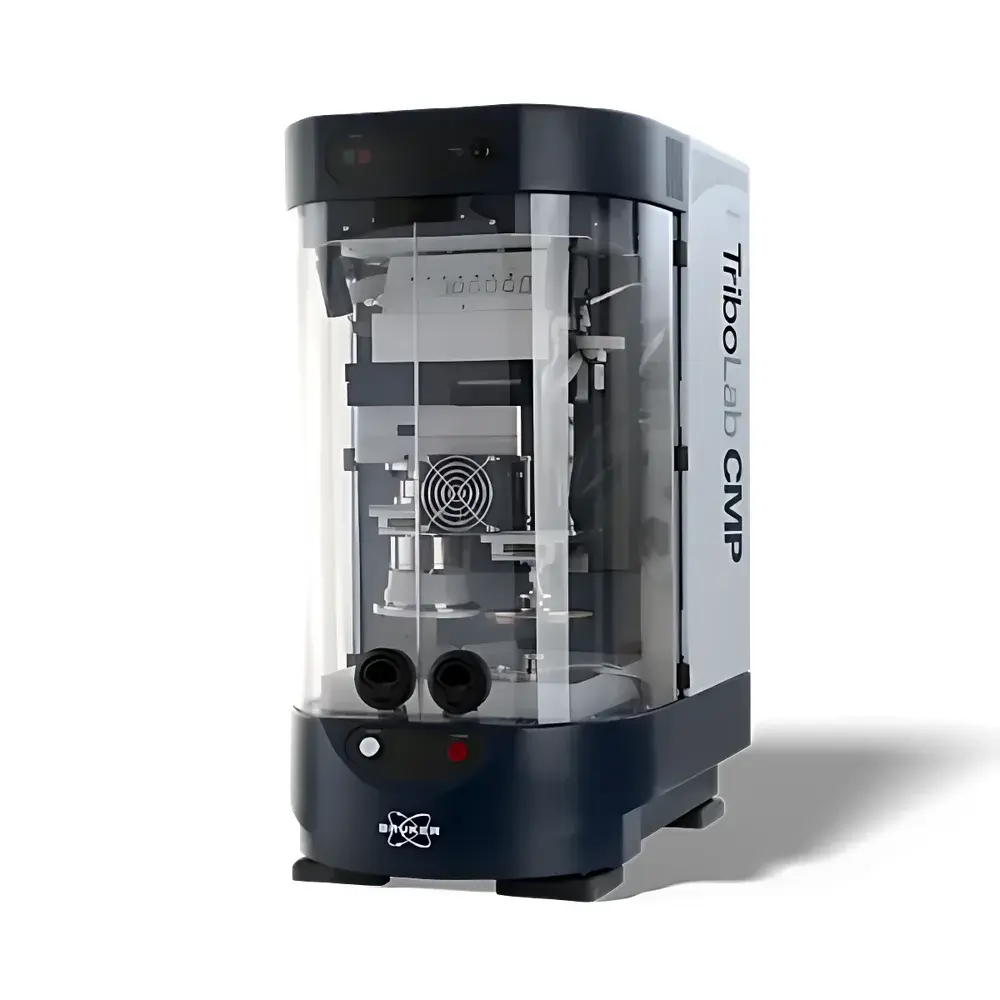
Bruker TriboLab CMP Tribological Tester for Chemical Mechanical Polishing Process Characterization
| Brand | Bruker |
|---|---|
| Origin | USA |
| Manufacturer Type | Authorized Distributor |
| Product Category | Imported Instrument |
| Model | TriboLab CMP |
| Instrument Type | Multifunctional Tribological Tester |
| Maximum Friction Force | 200 N |
| Friction Force Resolution | 10 mN |
| Maximum Operating Temperature | 1000 °C |
Overview
The Bruker TriboLab CMP is a purpose-built tribological testing system engineered specifically for chemical mechanical polishing (CMP) process development, material characterization, and consumables evaluation in semiconductor manufacturing. Leveraging over two decades of domain expertise derived from the legacy Bruker CP-4 platform, the TriboLab CMP implements a rigorously validated Couette-based tribometry architecture to replicate full-scale wafer polishing conditions at the laboratory scale. It operates on fundamental principles of interfacial shear stress measurement, real-time friction coefficient derivation, acoustic emission (AE) monitoring, and in-situ surface temperature tracking—enabling quantitative correlation between mechanical loading, slurry chemistry, pad topography, and material removal rate (MRR). Unlike generic wear testers, the TriboLab CMP integrates synchronized multi-sensor acquisition with sub-millisecond temporal resolution, delivering traceable, GLP-compliant datasets essential for DOE-driven CMP optimization and root-cause analysis of defects such as dishing, erosion, or non-uniform planarization.
Key Features
- Full-range CMP parameter emulation: programmable downforce (0.05–50 psi), rotational speed (1–500 rpm), and oscillatory motion profiles compliant with industry-standard polishing protocols.
- High-fidelity force metrology: dual-axis load cell with 200 N maximum capacity and 10 mN resolution, calibrated per ISO 7500-1 Class 0.5 specifications.
- In-situ thermal monitoring: integrated thermocouple array embedded in the polishing platen and sample holder, enabling real-time surface temperature mapping up to 1000 °C—critical for high-temperature oxide and metal CMP studies.
- Acoustic emission sensing: broadband AE transducer (100 kHz–1.2 MHz bandwidth) co-located with the contact zone for detecting micro-fracture events, pad glazing onset, and slurry film breakdown.
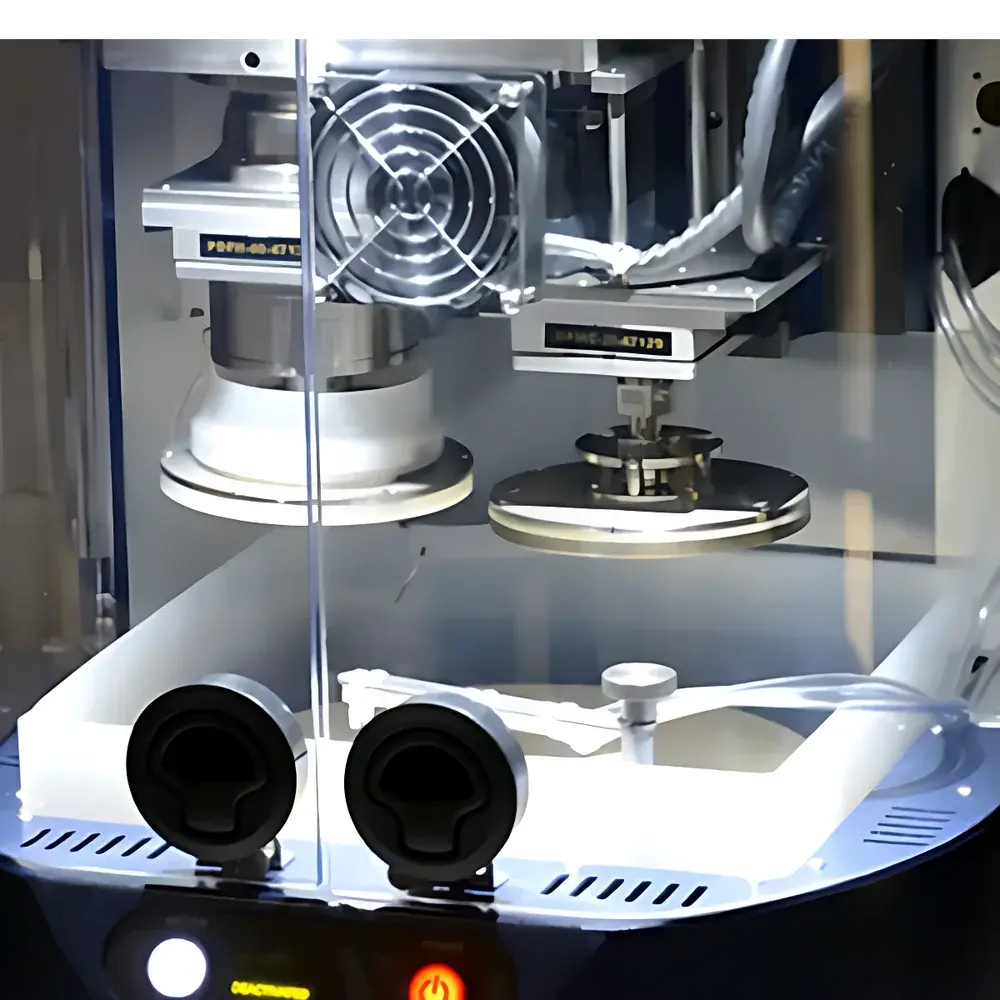
- Modular sample stage: accommodates wafers up to 100 mm diameter, diced dies, thin films on carriers, and non-circular substrates; supports quick-change fixtures for rapid transition between pad, slurry, and consumable evaluations.
- Robust mechanical architecture: granite base, air-bearing spindle, and active vibration isolation ensure measurement stability under dynamic loading, achieving < ±0.5% coefficient of variation across replicate runs.
Sample Compatibility & Compliance
The TriboLab CMP accepts planarized substrates including silicon, SiO₂, low-k dielectrics, Cu, Co, Ru, and advanced barrier metals—regardless of native surface roughness or post-CMP residue. It supports all commercially available polishing pads (polyurethane, fixed-abrasive, hybrid), slurries (colloidal silica, alumina, ceria, and novel chelating formulations), and conditioning disks. The system complies with ASTM F2638 (Standard Test Method for Measuring Material Removal Rate in CMP), ISO/IEC 17025 requirements for test equipment validation, and supports audit-ready documentation per FDA 21 CFR Part 11 when paired with Bruker’s optional compliance software module. All calibration certificates are NIST-traceable and include uncertainty budgets.
Software & Data Management
Control and analysis are executed via Bruker’s TriboWare™ v5.2 software suite—a Windows-based application featuring real-time waveform visualization, synchronized multi-channel data logging (friction, normal force, AE RMS, temperature, RPM), and automated report generation. Raw data is stored in HDF5 format with embedded metadata (user ID, timestamp, environmental conditions, calibration status). Advanced post-processing includes time-domain filtering, frequency spectrum analysis of AE bursts, MRR calculation from displacement-integrated force curves, and statistical process control (SPC) charting. Data export supports CSV, MATLAB .mat, and ASTM E1447-compliant XML schemas for integration into enterprise LIMS or MES platforms.
Applications
- Development and qualification of next-generation CMP slurries and pads for logic, memory, and 3D-IC applications.
- Quantitative assessment of consumable lifetime, pad wear mechanisms, and slurry-pH-dependent tribochemical interactions.
- Fundamental investigation of interfacial rheology during polishing—e.g., hydrodynamic vs. boundary lubrication regimes, slurry film thickness estimation via Stribeck curve modeling.
- Root-cause analysis of post-CMP defects through correlation of AE event clustering with localized temperature spikes and friction transients.
- Accelerated process window qualification (PWQ) by executing Design of Experiments (DOE) across pressure, speed, slurry flow, and temperature variables within a single instrument setup.
- Supporting ITRS roadmap targets for atomic-level surface finish control via sub-nanometer repeatability in friction and force measurements.
FAQ
Does the TriboLab CMP support real-time closed-loop control of polishing parameters?
Yes—the system enables PID-controlled regulation of downforce and rotational speed based on feedback from friction, temperature, or AE signals, facilitating adaptive polishing protocol execution.
Can it emulate full-wafer CMP tool kinematics, including carrier head oscillation and platen eccentricity?
Yes—TriboWare™ includes customizable motion profiles that replicate orbital, linear, and compound motions found in commercial CMP tools (e.g., Applied Materials Reflexion®, Ebara DF-3000™).
Is the 1000 °C capability intended for high-temperature oxide CMP or for specialized research applications?
Primarily for high-temperature CMP of advanced gate oxides and ferroelectric materials; also used for in-situ thermal aging studies of pads and slurries under polishing-relevant shear stress.
How is traceability ensured for regulatory submissions (e.g., ISO 9001, IATF 16949)?
Each instrument ships with full calibration documentation, uncertainty analysis reports, and optional 21 CFR Part 11 audit trail functionality—including electronic signatures, user access logs, and immutable data archiving.
What sample mounting options are available for non-standard geometries (e.g., diced dies, TSV wafers, or flexible substrates)?
Custom vacuum chucks, magnetic carriers, and adhesive-backed mounting kits are available; mechanical clamping solutions support substrates as thin as 25 µm without warpage-induced measurement artifacts.
Related Products



