
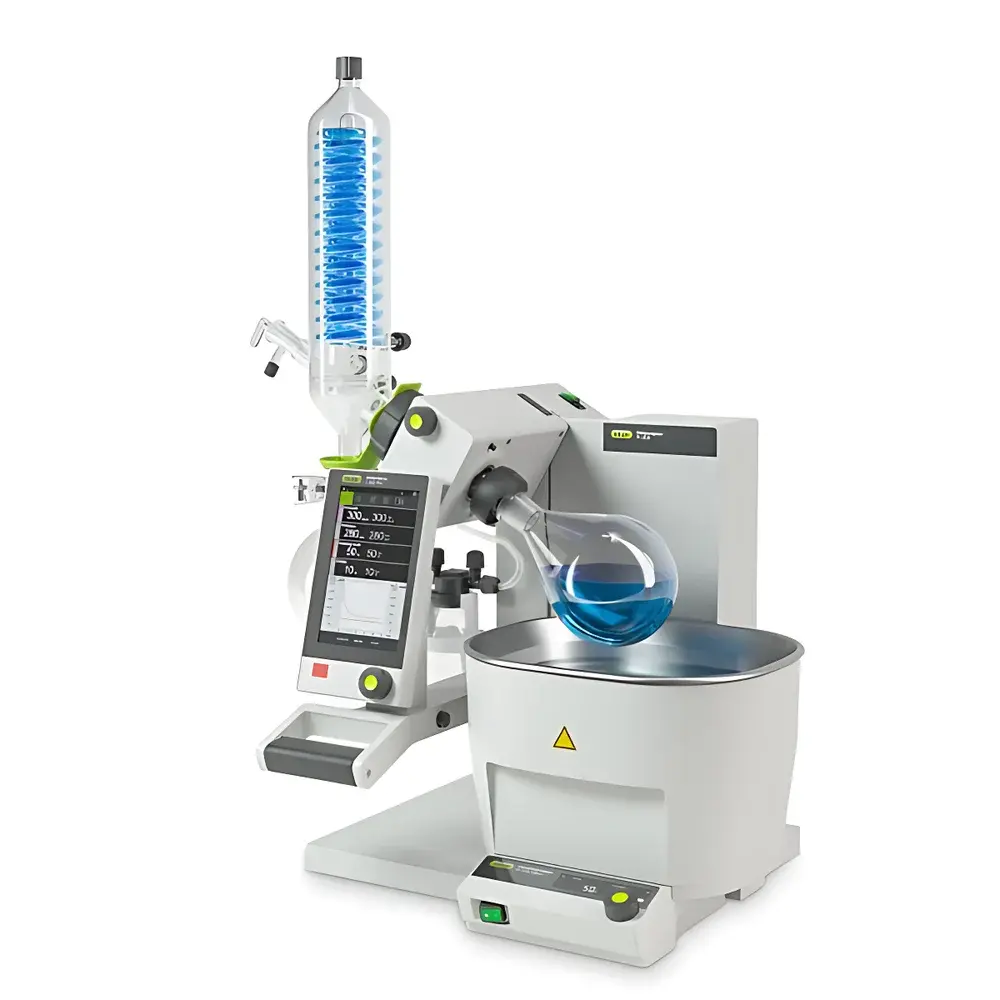
BUCHI R-300 Rotary Evaporator
| Brand | BUCHI |
|---|---|
| Origin | Switzerland |
| Manufacturer Type | Original Equipment Manufacturer (OEM) |
| Product Category | Imported Laboratory Instrument |
| Model | R-300 |
| Evaporation Flask Capacity | 5 L |
| Ultimate Vacuum | 2 mbar |
| Rotation Speed Range | 20–280 rpm |
| Heating Bath Temperature Range | 20–220 °C |
| Temperature Control Accuracy | ±1 °C |
| Condenser Cooling Surface Area | 1700 cm² |
Overview
The BUCHI R-300 Rotary Evaporator is an engineered solution for precise, reproducible, and safe solvent removal under reduced pressure. As the inventor of rotary evaporation technology, BUCHI has refined decades of thermal and vacuum process expertise into this platform—designed for high-throughput laboratories requiring robust automation, regulatory compliance, and operator safety. The R-300 operates on the principle of thin-film evaporation: rotation spreads sample across the inner surface of a heated flask, increasing surface area while vacuum lowers boiling points; vapors travel through a precisely angled steam tube into a cooled condenser, where phase transition yields condensed distillate collected in a receiving flask. Its modular architecture supports integration with vacuum controllers (e.g., V-800), circulating chillers (F-305), and digital interfaces (LabX®), enabling full system orchestration aligned with GLP/GMP workflows.
Key Features
- Safety-engineered design: P+G (polymer + glass) coated condensers and collection flasks prevent implosion and retain solvent even if breakage occurs; integrated vacuum release valve enables instant atmospheric venting with one press—and automatic venting during power failure.
- Dual overtemperature protection: Independent electronic and mechanical cut-offs deactivate heating when setpoint or absolute limit (95 °C / 180 °C / 220 °C) is exceeded.
- Power-loss responsive lift mechanism: Upon interruption, motorized升降 automatically raises the flask to prevent thermal degradation or bumping-induced contamination.
- Ergonomic operation: Horizontal bath handles reduce strain during media refilling; Combi-Clip™ single-hand flask coupling ensures rapid, secure attachment; variable-speed lift decelerates within 2 cm of endpoint to avoid impact damage.
- Intelligent control interface: High-contrast LCD displays real-time values for rotation speed, bath setpoint/actual temperature, lift position (motorized models), and lock status; supports parameter locking and multi-level access control.
- Optimized thermal efficiency: Dual-bath compatibility (1 L and 5 L) allows application-specific selection—1 L reaches 50 °C in ≤4 min; 5 L achieves same in ≤8 min—while insulated lid minimizes radiant heat loss.
Sample Compatibility & Compliance
The R-300 accommodates standard ground-glass jointed glassware (ISO 29550), including 50–5000 mL evaporation flasks, multiple condenser types (vertical, diagonal, coil), and optional secondary cold traps. Its construction meets IP21 ingress protection standards for laboratory environments. All electrical components comply with IEC 61010-1 for laboratory equipment safety. When configured with LabX® software and compatible vacuum sensors, the system supports audit trails, electronic signatures, and data integrity per FDA 21 CFR Part 11 requirements—making it suitable for regulated pharmaceutical, food, and environmental testing labs operating under ISO/IEC 17025, USP , or ASTM E2656 protocols.
Software & Data Management
Integrated via BUCHI’s LabX® platform, the R-300 enables centralized method management, real-time remote monitoring (including mobile app support), and automated reporting. Process parameters—including rotation speed, bath temperature, vacuum level, lift position, and duration—are continuously logged and timestamped. Data export to SD card in CSV format facilitates post-run statistical analysis, trend evaluation, and SOP validation. Optional add-ons include AutoDest™ for endpoint detection, Foam Sensor™ for anti-bumping intervention, and Level Sensor™ for volume-based termination—enabling unattended operation validated for routine QC workflows.
Applications
- Concentration of thermolabile natural extracts (e.g., essential oils, plant alkaloids)
- Removal of organic solvents from reaction mixtures prior to NMR or MS analysis
- Lyophilization pre-concentration steps in biopharmaceutical development
- Powder drying of APIs under controlled residual moisture conditions
- Standardized distillation procedures compliant with pharmacopoeial monographs (e.g., EP 2.2.25, JP 2.05)
- Environmental sample preparation (e.g., pesticide residue extraction in soil/water matrices)
FAQ
What vacuum level is required for optimal performance with heat-sensitive compounds?
The R-300 achieves stable operation down to 2 mbar, which enables gentle evaporation of low-boiling solvents (e.g., dichloromethane, ethyl acetate) at temperatures below 40 °C—critical for preserving labile functional groups.
Can the R-300 be used with corrosive solvents such as concentrated HCl or HF?
Standard glassware is not resistant to hydrofluoric acid or hot concentrated mineral acids; however, BUCHI offers optional PTFE-coated steam tubes and fluoropolymer-sealed condensers for select aggressive chemistries—consult technical documentation for material compatibility charts.
Is the 5 L bath compatible with all R-300 configurations?
Yes—the modular bath platform accepts both 1 L and 5 L vessels without hardware modification; switching requires only disengagement of the quick-release coupling and replacement of the bath insert.
How does the Analytic steam tube eliminate backflow during distillation?
Its patented geometry maintains consistent vapor path inclination and minimizes condensate re-entry by leveraging gravity-assisted drainage—ensuring quantitative recovery and eliminating carryover in trace residue analysis.
Does the R-300 support integration with third-party vacuum pumps or chillers?
While fully optimized with BUCHI’s V-800 vacuum controller and F-305 chiller, analog I/O (0–10 V) and RS232/USB interfaces allow interoperability with external devices meeting standard industrial communication protocols.



