
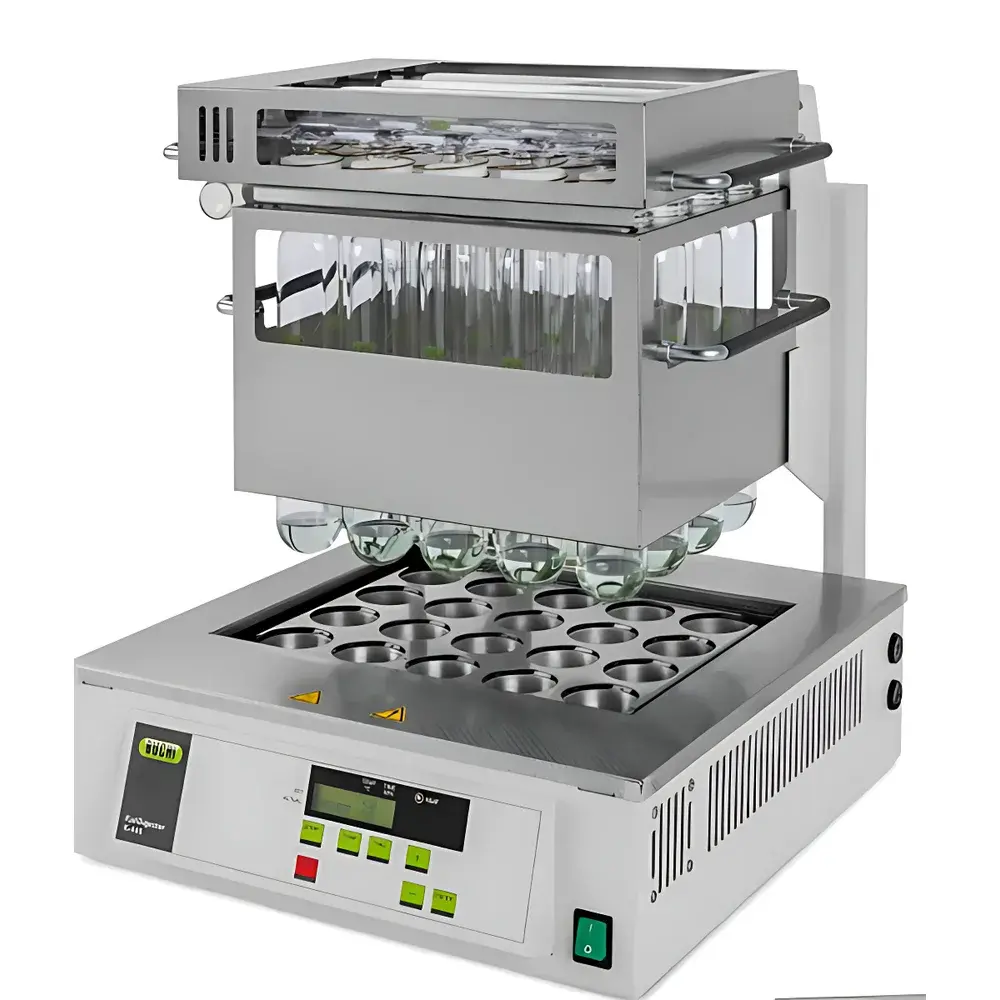
BUCHI K-446 Kjeldahl Digestion System
| Brand | BUCHI |
|---|---|
| Origin | Switzerland |
| Manufacturer | BUCHI AG |
| Type | Electric Heating Digestion Instrument |
| Automation Level | Semi-Automatic |
| Sample Capacity | 20 positions |
| Max. Heating Temperature | 420 °C |
| Temperature Control Accuracy | ±1 °C |
| Heating Block Material | Aluminum Alloy |
| Reagent Channels | 20 |
| Compliance | AOAC, ISO 8585, EN 13654-1 |
| Power Supply | 220–240 VAC, 50/60 Hz |
| Max. Power Consumption | 2300 W |
| Weight | 18.5 kg |
| Dimensions (W×H×D) | 435 × 524 × 764 mm |
| Temperature Range | 30–450 °C |
| Temp. Uniformity | ≤±7 °C at 420 °C |
| Sample Tube Size | 300 mL |
Overview
The BUCHI K-446 Kjeldahl Digestion System is a precision-engineered, semi-automatic electric heating digestion instrument designed for reliable and reproducible sample mineralization in Kjeldahl nitrogen analysis workflows. Based on controlled conductive heating via a high-thermal-mass aluminum block, the K-446 delivers uniform temperature distribution across all 20 digestion positions—critical for achieving consistent decomposition of organic matrices (e.g., food, feed, soil, wastewater sludge) into ammonium sulfate under acidic conditions. Unlike open-flame or infrared-based systems, the K-446’s aluminum heating block ensures stable thermal inertia, minimizing overshoot and enabling precise ramp-and-hold temperature programming. Its operational range of 30–450 °C—with factory-calibrated accuracy of ±1 °C and verified uniformity of ≤±7 °C at 420 °C—meets the stringent thermal requirements defined in AOAC Official Method 984.13, ISO 8585:2012, and EN 13654-1. The system is intended for use in regulated laboratories performing routine QC/QA testing where traceability, method compliance, and operator safety are non-negotiable.
Key Features
- 20-position aluminum digestion block with optimized thermal mass for rapid heat-up and stable dwell performance
- Semi-automatic operation: manual sample loading/unloading with programmable time/temperature profiles via front-panel interface
- Integrated reagent delivery system with 20 independent channels for synchronized acid addition (H₂SO₄, catalysts)
- Enhanced safety architecture: sealed fume transfer path to external absorption unit (e.g., K-415), drip tray protection against acid spillage, and ergonomic lift mechanism reducing operator contact with hot tubes
- Robust mechanical design compliant with IEC 61010-1 for laboratory electrical equipment safety
- Modular compatibility: seamless integration with BUCHI KjelSampler automatic samplers (K-375/K-377) and distillation units (K-350/K-355) for end-to-end Kjeldahl automation
Sample Compatibility & Compliance
The K-446 accommodates standard 300 mL digestion tubes (borosilicate glass, ASTM E438 Type I, Class A), supporting sample weights up to 5 g for solid matrices and up to 20 mL for liquid samples. It is validated for use with sulfuric acid (≥96%), selenium or copper catalyst tablets, and hydrogen peroxide—common reagents in AOAC-compliant digestion protocols. All thermal and timing parameters adhere to GLP documentation standards; audit trails (when paired with K-449 or LIMS-integrated controllers) support 21 CFR Part 11 readiness. The system meets CE marking requirements and conforms to ISO/IEC 17025 calibration traceability frameworks when operated with NIST-traceable reference thermometers.
Software & Data Management
While the K-446 operates via an intuitive local control panel with digital setpoint display and timer functionality, it supports optional digital connectivity through BUCHI LabX™ software (via RS-232 or USB). LabX enables centralized method storage, electronic signature capture, real-time monitoring of temperature profiles, and automated report generation—including raw temperature logs, run timestamps, and user IDs—for full data integrity. When deployed in GMP environments, LabX configurations can be configured to enforce role-based access control and enforce electronic audit trails aligned with FDA guidance on computerized system validation.
Applications
- Determination of total nitrogen in agricultural products (cereals, oilseeds, forage) per ISO 5983-1
- Protein quantification in dairy, meat, and infant formula according to USP <281> and EU Regulation (EC) No 882/2004
- Nitrogen content analysis in environmental samples (sludge, compost, wastewater) as specified in EPA Method 350.1
- Method development and validation studies requiring high inter-run reproducibility (RSD <2% for duplicate digestions)
- Reference laboratory use where ISO/IEC 17025 accreditation mandates documented thermal validation and calibration history
FAQ
Does the K-446 support fully automated digestion cycles?
No—the K-446 is semi-automatic. Full automation (e.g., timed reagent injection, delayed start, auto-lift) requires the K-449 model or integration with KjelSampler hardware.
Can the K-446 be used with mercury-based catalysts?
Mercury catalysts are not recommended due to regulatory restrictions (EU RoHS, EPA 710-R-15-001) and potential block corrosion; copper or selenium alternatives are preferred and fully supported.
Is third-party calibration certification available?
Yes—BUCHI-certified service technicians provide on-site temperature uniformity mapping and calibration verification reports traceable to national metrology institutes.
What maintenance is required for long-term thermal stability?
Annual cleaning of the aluminum block’s vent channels and inspection of the heating element insulation resistance (>10 MΩ) are recommended per BUCHI Maintenance Protocol MP-KJEL-01.
How does the K-446 ensure fume containment during digestion?
It features a dedicated vapor duct interface that routes acidic fumes directly to an external scrubber (e.g., K-415) via PTFE-lined tubing, eliminating ambient exposure and meeting OSHA PEL requirements for SO₂ and NOₓ.



