
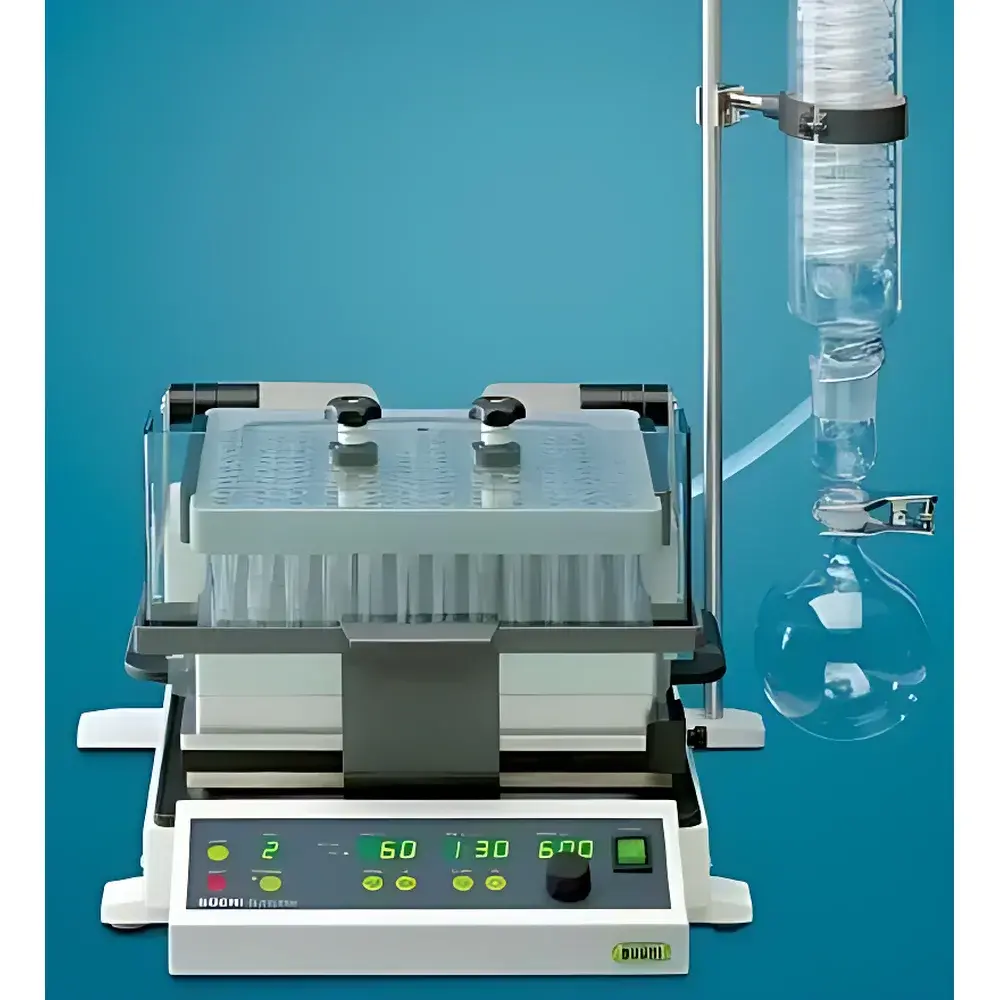
BUCHI Sepacore Modular Medium-Pressure Preparative Liquid Chromatography System
| Brand | BUCHI |
|---|---|
| Origin | Switzerland |
| Model | Sepacore |
| Pressure Range | Up to 50 bar (725 psi) |
| Flow Rate | 2.5–250 mL/min |
| Column ID Range | 15–100 mm |
| Max Sample Load | 100 g (glass columns) |
| Detector Wavelength | 190–745 nm |
| Gradient Capability | Binary to Quaternary, 0–100% B, linearity ±2% |
| Software | SepacoreControl (PC-based, optional 21 CFR Part 11 compliance) |
| Pump Type | Tri-piston, pulse-free, solvent-compatible with acids/bases/organics |
| Column Options | Glass (coated), polypropylene flash columns, cartridge-based packing systems |
| Fraction Collection Modes | Time-, volume-, or UV peak-triggered |
| Safety Features | Grounded metal fraction collector arm, transparent pressure-rated glass columns, integrated pressure sensors and level monitoring |
Overview
The BUCHI Sepacore Modular Medium-Pressure Preparative Liquid Chromatography System is an engineered solution for scalable, reproducible purification of organic compounds, natural products, peptides, and small-molecule biologics. Operating in the medium-pressure regime (up to 50 bar / 725 psi), it bridges the functional gap between low-pressure flash chromatography and high-pressure preparative HPLC—delivering enhanced resolution, speed, and method robustness without requiring ultra-high-pressure infrastructure. Its core architecture employs a tri-piston, pulse-free solvent delivery system that ensures stable flow across the full operational range (2.5–250 mL/min), critical for maintaining retention time reproducibility and peak shape integrity during gradient elution. Unlike fixed-configuration systems, Sepacore is built on a true modular platform: individual components—including pump modules (C-601/C-605), detector units (UV-Vis, RI), fraction collectors, column switching valves, and control hardware (C-620)—are interoperable and field-upgradable. This modularity supports both benchtop research-scale purification (e.g., 1–10 g isolations on 15–26 mm ID columns) and process-oriented development (e.g., 50–100 g loads on 70–100 mm ID coated-glass columns), all under unified software governance.
Key Features
- Tri-piston, maintenance-free pump design delivering pulse-free flow up to 250 mL/min at pressures up to 50 bar—optimized for consistent gradient formation and long-term solvent compatibility with acids, bases, and aggressive organics.
- Wide column compatibility: standardized glass columns (C-690 series, coated borosilicate, pressure-rated to 50 bar) and polypropylene flash columns (12–40 mm ID); column diameters span 15–100 mm, supporting sample loads from milligrams to 100 g.
- Integrated C-615 Pump Manager with graphical display: real-time monitoring of elapsed time, solvent consumption, system pressure, and gradient progress; supports binary to quaternary gradients with ±2% linearity across 0–100% B.
- UV-Vis detector with continuous wavelength scanning (190–745 nm), enabling precise peak identification and collection based on spectral characteristics—not just absorbance intensity.
- C-623/C-625 Sequential Control Module: automates sequential elution across up to five pre-packed columns, increasing throughput without manual intervention—ideal for parallel screening or multi-step purifications.
- Grounded metal-arm fraction collector with programmable trigger logic (time, volume, or UV threshold); accommodates standard rack formats and supports user-defined tube layouts for seamless integration into downstream workflows.
Sample Compatibility & Compliance
The Sepacore system is validated for use with silica-based stationary phases in both normal-phase (hexane/EtOAc, DCM/MeOH) and reversed-phase (water/acetonitrile, water/methanol) modes. Its chemically resistant fluidic path—including PTFE, sapphire, and ceramic components—ensures compatibility with corrosive modifiers (e.g., TFA, formic acid, ammonium acetate) and high-pH mobile phases (pH 2–12). All glass columns feature ISO-standard threading and certified pressure ratings per EN 13480-3, while pump modules comply with IEC 61000-6-2/6-3 for electromagnetic compatibility. For regulated environments, optional 21 CFR Part 11-compliant audit trails, electronic signatures, and role-based access control are implemented via SepacoreControl software—supporting GLP and GMP-aligned documentation requirements. Column hardware meets USP and ASTM D4792 guidelines for packed column integrity and flow uniformity.
Software & Data Management
SepacoreControl is a Windows-based application designed for intuitive method development, execution, and post-run analysis—requiring minimal training for routine operation. It provides full instrument control across all hardware modules (pumps, detectors, fraction collectors, valves) and enables real-time parameter adjustment—including on-the-fly gradient reprogramming during active runs. Method templates support rapid setup for flash, medium-pressure, and semi-preparative protocols. Raw chromatographic data (absorbance vs. time/volume) are stored in vendor-neutral .csv and .dx formats; peak integration uses second-derivative baseline correction and customizable threshold detection. Electronic lab notebook (ELN) export is supported via PDF report generation with embedded chromatograms, method parameters, and fraction mapping. When configured with the C-620 Control Unit, SepacoreControl delivers full audit trail functionality—including user login logs, parameter change history, and electronic signature capture—meeting FDA 21 CFR Part 11 and EU Annex 11 validation expectations.
Applications
The Sepacore platform serves as a primary purification tool across academic, pharmaceutical, and industrial laboratories. In natural product isolation, it enables rapid fractionation of crude plant extracts using step-gradient silica elution, followed by reversed-phase polishing of terpenoids or alkaloids. For synthetic chemistry, it supports parallel purification of Suzuki or Buchwald-Hartwig reaction mixtures—particularly where thermally labile intermediates preclude distillation or crystallization. In peptide synthesis, its low-shear pumping and bio-inert column options (e.g., C-695 column with cooling jacket) preserve conformational integrity during desalting or protecting-group removal. Biopolymer applications include buffer exchange of oligonucleotides and size-based separation of PEGylated proteins using specialty resins. Its scalability—from 10 mg analytical prep to 100 g batch processing—makes it suitable for route scouting, impurity isolation for structural elucidation (NMR/MS), and early-stage material supply for toxicology studies.
FAQ
What pressure range does the Sepacore system support?
The system operates up to 50 bar (725 psi), optimized for medium-pressure chromatography—sufficient for high-resolution separations on silica and C18 media without requiring HPLC-grade hardware.
Can Sepacore perform both normal-phase and reversed-phase separations?
Yes. Its wide pressure and flow range, combined with solvent-resistant fluidics and configurable gradient programming, supports seamless transition between normal-phase (e.g., hexane/EtOAc) and reversed-phase (e.g., water/acetonitrile) methods.
Is PC connectivity required for operation?
No. Basic operation—including pump control, UV monitoring, and fraction triggering—is fully functional via front-panel controls and the C-615 Pump Manager. A PC is required only for advanced method development, data archiving, or 21 CFR Part 11 compliance.
What column sizes and materials are available?
Glass columns (C-690 series) range from 15 mm to 100 mm internal diameter, rated to 50 bar; polypropylene flash columns (12–40 mm ID) are offered for rapid screening; stainless-steel and bio-compatible column options (C-695) are available for specialized applications.
Does the system support automated sequential chromatography?
Yes. With the C-623/C-625 Sequential Control Module and C-620 Control Unit, up to five columns can be automatically cycled through a single method—enabling unattended multi-step purification or library fractionation.
Related Products




