
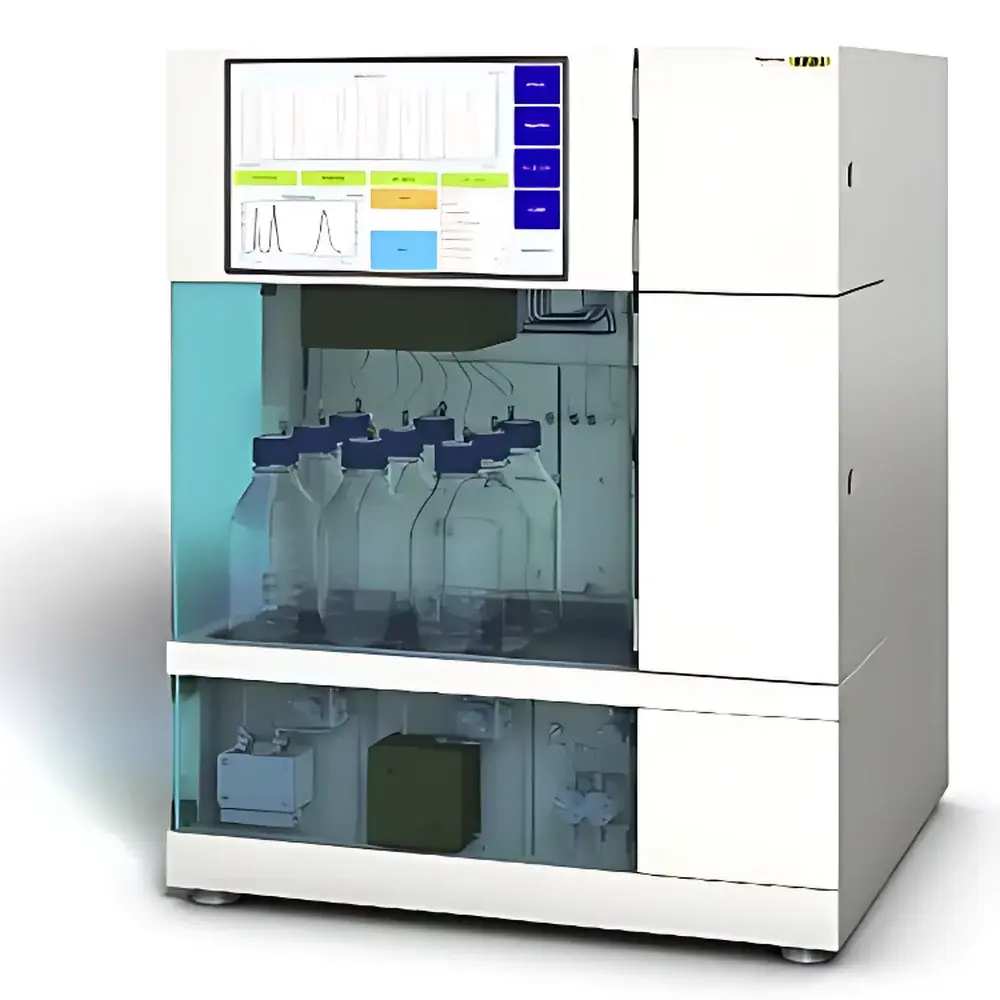
BUCHI Sepiatec SFC-250 Supercritical Fluid Chromatography System
| Brand | BUCHI |
|---|---|
| Origin | Switzerland |
| Manufacturer Type | Original Equipment Manufacturer (OEM) |
| Instrument Type | Preparative SFC System |
| Model | SFC-250 |
| Flow Rate Range | 0–250 mL/min (including up to 40% modifier) |
| Maximum Operating Pressure | 400 bar (CO₂ and modifier pumps) |
| Detector Options | Diode Array Detector (DAD), Mass Spectrometer (MS), Evaporative Light Scattering Detector (ELSD) |
| Modifier Channels | 4 |
| Injection Loop Volume | 2.5 mL |
| Column Capacity | Up to 10 columns (2 mounted simultaneously) |
| Column Dimensions | ID 15–30 mm, max. length 250 mm |
| Column Oven Temperature Range | Ambient to 70 °C |
| Gradient Capability | Isocratic, binary linear, or step gradients |
Overview
The BUCHI Sepiatec SFC-250 is a high-performance preparative supercritical fluid chromatography (SFC) system engineered for scalable chiral and achiral separation of thermally labile, non-volatile, and polar compounds. It leverages carbon dioxide (CO₂) as the primary mobile phase—offering low viscosity, high diffusivity, and rapid mass transfer—combined with precise modifier delivery to tune selectivity without thermal degradation. Unlike conventional liquid chromatography, SFC enables faster elution, higher resolution per unit time, and significantly reduced solvent consumption (typically >80% less organic solvent vs. HPLC). The SFC-250 is designed for method development, analytical-to-preparative translation, and multi-gram purification under fully controlled pressure, temperature, and composition conditions—making it integral to pharmaceutical process R&D, natural product isolation, and fine chemical synthesis workflows.
Key Features
- Independent dual-pump architecture: Stainless-steel piston CO₂ pump and four-channel modifier pump operate synchronously, enabling real-time composition modulation without pre-mixing—critical for robust gradient reproducibility.
- Full-gradient flexibility: Supports isocratic, binary linear, and discrete step gradients across the entire flow range (0–250 mL/min), with total flow including up to 40% organic modifier by volume.
- High-pressure integrity: Dual 400 bar-rated pumping systems ensure stable operation under dense-phase CO₂ conditions, accommodating backpressure regulation from subcritical to near-critical regimes.
- Modular detector integration: Standard DAD with 190–720 nm spectral acquisition and 8-wavelength simultaneous monitoring; optional ELSD for non-UV-absorbing analytes; optional mass spectrometry interface for structural confirmation and fraction-triggered collection.
- Automated column management: Dual-column mounting station with optional expansion to 10-column carousel; column oven maintains precise temperature control (ambient to 70 °C) with uniform axial heating profile.
- Robust sample introduction: 2.5 mL fixed-loop injector with standard stacking capability for enhanced loading capacity and improved peak shape in overloaded separations.
Sample Compatibility & Compliance
The SFC-250 accommodates a broad polarity spectrum—from highly lipophilic steroids to moderately polar alkaloids and acidic/basic pharmaceuticals—through intelligent modifier selection (e.g., methanol, ethanol, isopropanol, acetonitrile, or amine-modified variants). Its inert fluid path minimizes adsorption and catalytic decomposition, especially critical for enantiomerically sensitive APIs. The system meets core regulatory expectations for GMP-aligned environments: hardware supports audit trail-enabled software (via optional BUCHI LabX™ SFC module), electronic signatures compliant with FDA 21 CFR Part 11, and full traceability of pressure, temperature, flow, and composition parameters. All wetted materials conform to USP Class VI biocompatibility standards, and column oven design complies with ISO 17025 environmental stability requirements for calibration consistency.
Software & Data Management
Control and data acquisition are managed via BUCHI’s LabX™ SFC software platform—a validated, role-based application supporting method creation, sequence definition, real-time monitoring, and automated fraction collection triggered by UV, MS, or ELSD signals. Raw data files adhere to ASTM E1960-22 (Chromatographic Data Exchange Format) and are exportable in open formats (e.g., .cdf, .mzML). Audit trails record all user actions, parameter changes, and instrument events with immutable timestamps. For enterprise integration, LabX™ provides OPC UA-compliant interfaces to LIMS and MES systems, enabling batch record generation aligned with ICH Q7 and WHO TRS 986 Annex 4 documentation standards.
Applications
- Chiral purification of active pharmaceutical ingredients (APIs) at gram-to-kilogram scale under ICH Q5A/Q5B guidelines.
- Rapid separation of natural product extracts—including terpenoids, flavonoids, and glycosides—without derivatization or thermal stress.
- Stability-indicating method development for forced degradation studies where hydrolytic or oxidative products co-elute in reversed-phase LC.
- Green chemistry process optimization: Replacement of hexane/isopropanol mixtures in lipid fractionation and carotenoid isolation.
- Support of continuous manufacturing: Seamless integration with BUCHI’s C-500 continuous crystallizer for inline SFC–crystallization coupling.
FAQ
What is the maximum allowable modifier concentration during gradient runs?
The system supports up to 40% (v/v) organic modifier in the total mobile phase flow without compromising pump integrity or backpressure stability.
Can the SFC-250 be operated under GLP conditions?
Yes—when configured with LabX™ SFC software, 21 CFR Part 11 compliance package, and documented IQ/OQ protocols, it satisfies GLP audit requirements for nonclinical laboratory studies.
Is column switching automated?
Standard configuration includes dual-column mounting with manual valve actuation; automated 10-position column selector is available as an optional accessory.
Does the DAD support spectral library matching?
Yes—LabX™ SFC includes integrated spectral search against NIST and custom-built libraries, with peak purity assessment via absorbance ratio analysis.
How is CO₂ phase behavior controlled during method transfer?
The system uses real-time density calculation algorithms based on measured pressure, temperature, and CO₂ compressibility factor (Z), ensuring consistent solvation power across instruments and scales.
Related Products





