
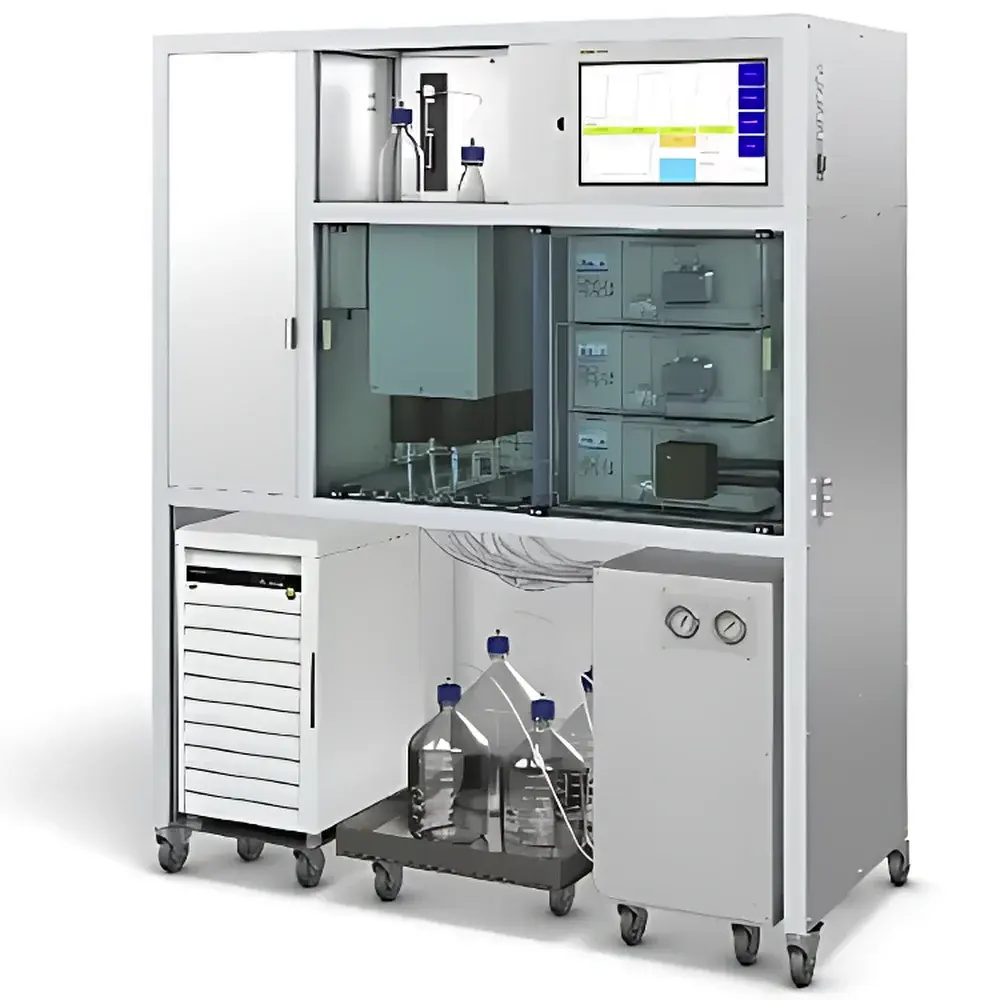
BUCHI Sepiatec SFC-660 Supercritical Fluid Chromatography System
| Brand | BUCHI |
|---|---|
| Origin | Switzerland |
| Manufacturer Type | Original Equipment Manufacturer (OEM) |
| Product Category | Imported Instrument |
| Model | SFC-660 |
| Instrument Type | Preparative |
| Flow Rate Range | 0–660 mL/min (including up to 40% modifier) |
| Maximum Operating Pressure | 400 bar |
| Detector Options | Diode Array Detector (DAD), Electrospray Light Scattering Detector (ELSD), Mass Spectrometer (MS) |
Overview
The BUCHI Sepiatec SFC-660 is a fully integrated, preparative-scale supercritical fluid chromatography (SFC) system engineered for high-efficiency chiral and achiral separation of thermally labile, non-volatile, or moderately polar compounds. It leverages carbon dioxide (CO₂) as the primary mobile phase—modified in real time with organic solvents—to deliver superior selectivity, faster elution kinetics, and significantly reduced solvent consumption compared to traditional liquid chromatography (LC) or flash purification systems. The system operates on the principle of tunable solvent strength via pressure- and temperature-dependent density modulation of supercritical CO₂, enabling precise control over retention and resolution across diverse compound classes. Designed for laboratories requiring scalable purification—from milligram to multi-gram quantities—the SFC-660 supports method development, process optimization, and GMP-aligned production workflows without compromising analytical fidelity.
Key Features
- Two independent, high-pressure stainless-steel piston pumps: one dedicated to supercritical CO₂ delivery (0–400 bar), the other to modifier solvent(s), enabling true binary gradient formation without pre-mixing.
- Real-time, programmable gradient modes: isocratic, linear binary gradients, and step-gradient profiles—fully compatible with method transfer from analytical to preparative scale.
- Integrated CO₂ recirculation unit reduces CO₂ consumption by >80%, lowering operational cost and environmental footprint while maintaining consistent fluid density and viscosity.
- Compact, modular architecture occupies ≤0.8 m² floor space; all critical components—including pump heads, back-pressure regulator (BPR), column oven, and detector interface—are housed within a single, vibration-damped chassis.
- Active cooling of pump heads via external recirculating chiller ensures thermal stability during extended high-flow operation (up to 660 mL/min total flow, including ≤40% modifier).
- Standardized 10 mL loop injector with auto-sampling capability and optional stacking injection mode for enhanced throughput in repetitive fractionation tasks.
Sample Compatibility & Compliance
The SFC-660 accommodates a broad range of sample matrices—including pharmaceutical intermediates, natural product extracts, synthetic polymers, and peptide derivatives—without derivatization or thermal degradation. Column compatibility spans internal diameters of 20–50 mm and lengths up to 800 mm, supporting both packed and monolithic stationary phases (e.g., polysaccharide-based chiral columns, C18, silica, diol). The system meets essential regulatory requirements for quality-controlled environments: hardware and software architecture support audit trails, electronic signatures, and user-access controls aligned with FDA 21 CFR Part 11 and EU Annex 11 guidelines. All pressure transducers, temperature sensors, and flow meters are traceably calibrated per ISO/IEC 17025 standards, and documentation packages are provided for GLP/GMP validation (IQ/OQ/PQ).
Software & Data Management
Control and data acquisition are managed via BUCHI’s proprietary Sepiatec Control Software v3.x—a Windows-based platform compliant with IEC 62304 Class B medical device software standards. The interface enables synchronized parameter logging (pressure, temperature, flow, UV absorbance), real-time spectral acquisition (DAD: 190–720 nm, 8-channel simultaneous wavelength monitoring), and automated fraction triggering based on peak threshold, time window, or UV spectral similarity. Raw data files adhere to ANDI/NetCDF format for third-party processing (e.g., Chromeleon, Empower, OpenLab). Full metadata embedding—including instrument configuration, method history, and operator ID—is enforced at acquisition. Optional integration with LIMS via ASTM E1578-compliant API ensures seamless data lineage from instrument to enterprise database.
Applications
- Chiral purification of active pharmaceutical ingredients (APIs) under ICH Q5A/Q5B guidelines, supporting clinical trial material synthesis.
- Isolation of minor alkaloids and flavonoids from botanical extracts where thermal sensitivity precludes HPLC or distillation.
- Removal of catalyst residues (e.g., Pd, Rh) from cross-coupling reaction mixtures using orthogonal SFC–ICP-MS workflows.
- Preparative separation of oligonucleotide impurities (n−1, n−2) prior to LC–MS characterization and biological activity testing.
- Rapid method scouting for green chemistry initiatives—replacing >90% of chlorinated or high-boiling solvents traditionally used in flash chromatography.
FAQ
What is the maximum allowable modifier concentration during operation?
The system supports up to 40% (v/v) organic modifier (e.g., methanol, ethanol, isopropanol) in CO₂ at full flow (660 mL/min), with dynamic adjustment across gradient segments.
Can the SFC-660 be operated in analytical mode for method development?
Yes—by installing narrow-bore columns (e.g., 4.6 mm ID) and reducing flow rates via software limits, the system functions as a validated analytical SFC platform compliant with USP and ASTM D7597.
Is ELSD or MS detection validated for quantitative use under GMP?
Both detectors support GMP-compliant quantitation when configured with appropriate calibration standards, system suitability tests, and documented detector linearity ranges (per USP ); MS requires additional 21 CFR Part 11-compliant data handling modules.
How is column temperature controlled, and what is the stability specification?
The integrated column oven maintains setpoints from ambient to 50 °C with ±0.5 °C accuracy and ≤0.1 °C drift over 8-hour runs, verified per ISO 17025-accredited thermal mapping protocol.
Does the system include provisions for CO₂ supply monitoring and safety interlocks?
Yes—integrated CO₂ level sensors, high-pressure rupture discs (rated at 450 bar), and automatic shutdown logic activate upon pressure deviation >±5% of setpoint or coolant flow interruption.
Related Products




