
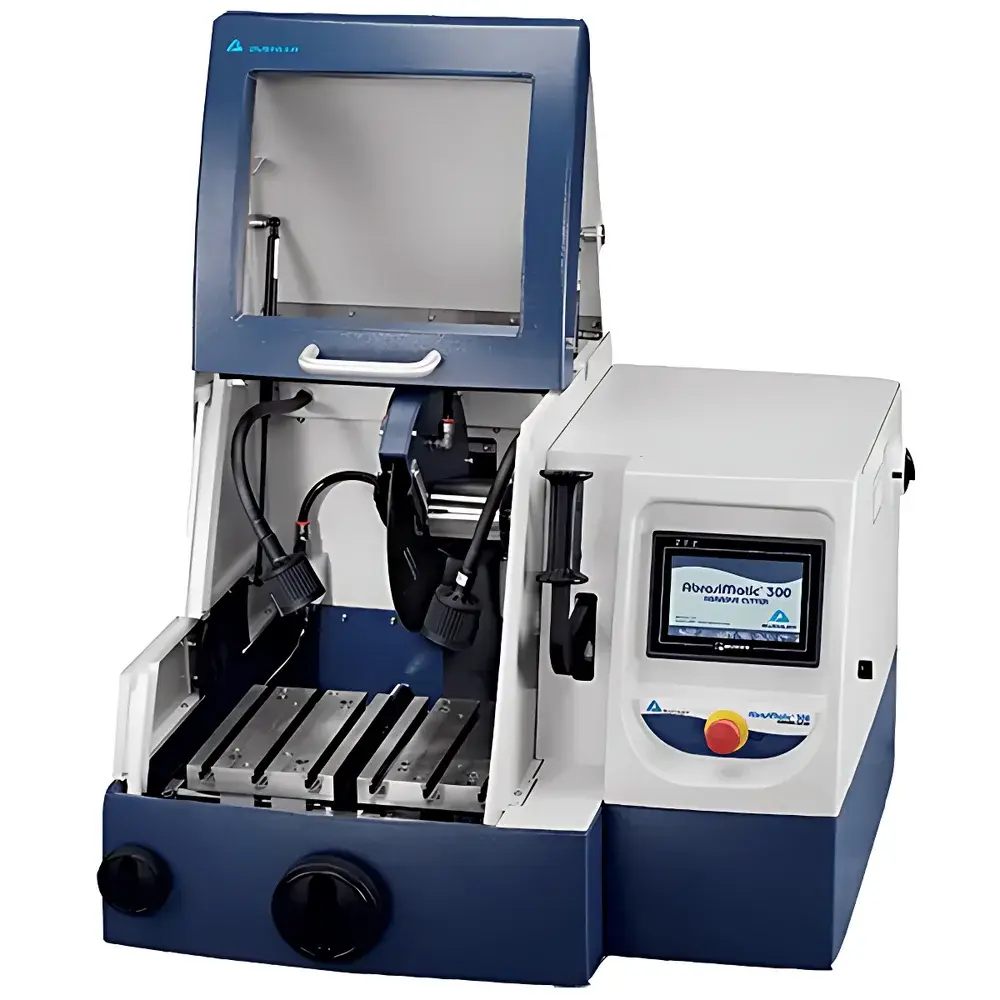
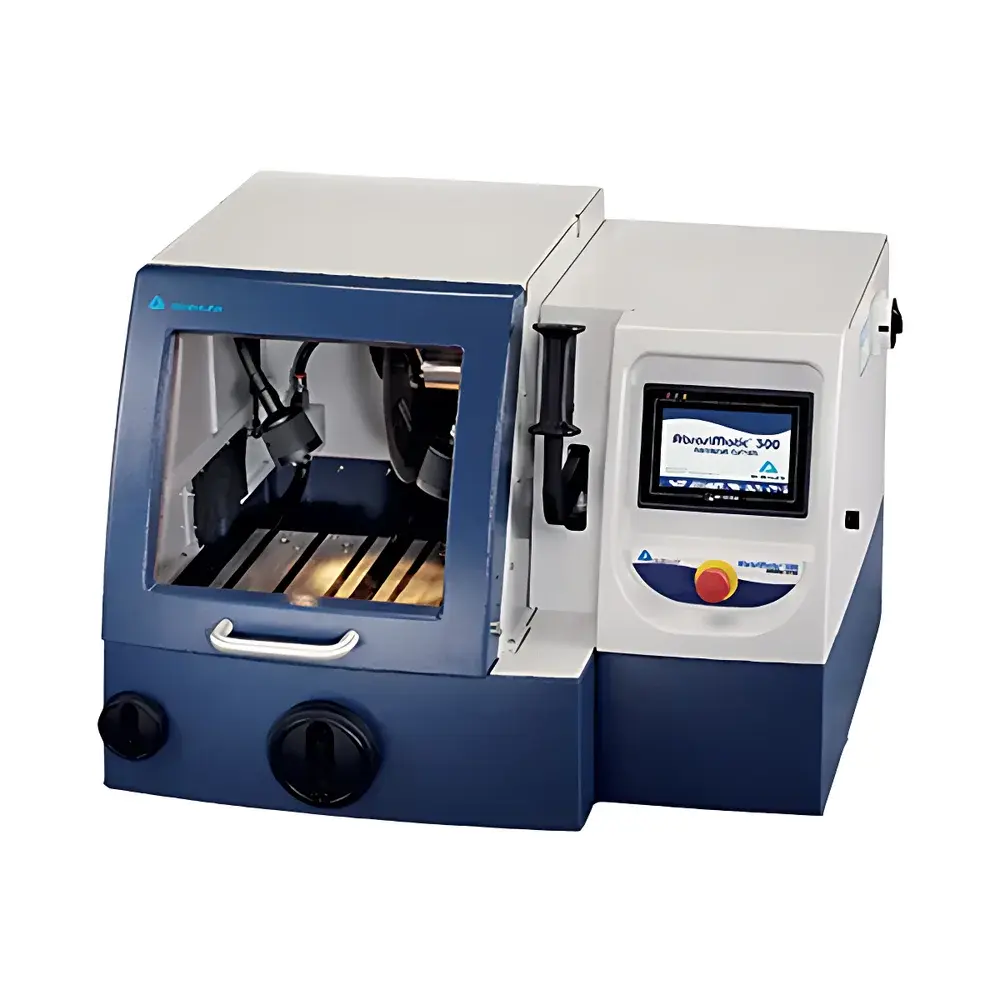
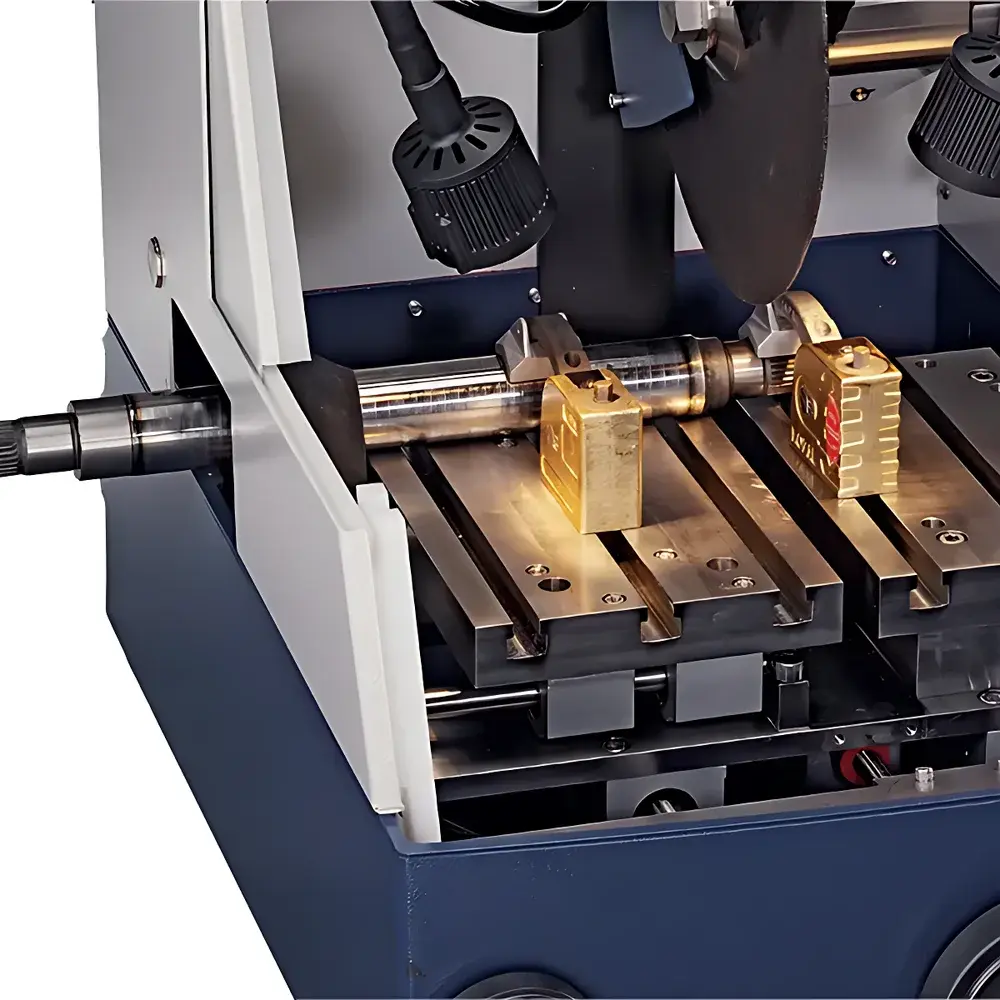
Buehler AbrasiMatic™ 300 Abrasive Cutting Machine
| Brand | Buehler |
|---|---|
| Origin | USA |
| Model | AbrasiMatic™ 300 |
| Cutting Wheel Diameter | Up to 305 mm (12") |
| Max Sample Diameter | 110 mm (4.375") |
| Z-Axis Travel | 150 mm |
| Y-Axis Travel | 260 mm |
| X-Axis Travel | 70 mm |
| Motor Power | 3.7 kW (5 HP) |
| Rotational Speed | 2600 rpm |
| Peripheral Speed | 2700 m/min |
| Touchscreen Interface | 7" LCD, 320×240 px, NEMA 4/IP65 rated |
| Worktable | 365 × 254 mm with 12 mm T-slots |
| Coolant Tank Capacity | 83 L (22 gal) |
| Input Voltage Options | 220–460 VAC, 3-phase, 50/60 Hz |
Overview
The Buehler AbrasiMatic™ 300 is a precision-engineered abrasive cutting machine designed for high-reproducibility sectioning of metallic, ceramic, composite, and geological specimens in metallurgical laboratories, quality control environments, and R&D facilities. It operates on the principle of controlled abrasive wheel cutting under continuous coolant flow—ensuring thermal stability, minimal deformation, and clean, planar cuts suitable for subsequent mounting, grinding, polishing, and microstructural analysis. Unlike high-speed saws optimized for throughput alone, the AbrasiMatic™ 300 integrates mechanical rigidity, programmable feed logic, and ergonomic accessibility to support both routine production sampling and demanding research-grade specimen preparation. Its modular architecture accommodates diverse sample geometries—including rods, bars, weldments, turbine blades, and irregularly shaped components—without requiring custom fixturing for most standard applications.
Key Features
- Three-axis manual positioning (X/Y/Z) with fine-thread lead screws and calibrated vernier scales for repeatable alignment and precise cut placement.
- Automated Y-axis feed with adjustable speed range (0.1–2.5 mm/sec), enabling consistent material removal rates across varying hardnesses and cross-sections.
- SmartCut™ intelligent feed algorithm, which dynamically modulates feed rate based on real-time torque feedback to prevent wheel stalling, reduce kerf loss, and extend abrasive wheel life.
- 7-inch NEMA 4/IP65-rated color touchscreen interface supporting multilingual operation (English, Chinese, Spanish, German, French), metric/imperial unit toggling, and intuitive icon-driven workflow navigation.
- Robust 3.7 kW (5 HP) induction motor delivering high starting torque and stable rotational speed (2600 rpm) under load—critical for sectioning hardened steels, carbides, and nickel-based superalloys.
- Large-capacity coolant system (83 L) with dual LED gooseneck illumination, integrated filtration, and quick-connect fittings compliant with ISO 14122-3 for safe maintenance access.
- Spacious cutting chamber (914 × 558 × 203 mm) featuring a full-height polycarbonate observation window (355 × 300 mm), side-access T-slot worktable (365 × 254 mm), and standardized 32 mm arbor compatibility for industry-standard 305 mm wheels.
Sample Compatibility & Compliance
The AbrasiMatic™ 300 accepts specimens up to 110 mm in diameter and accommodates lengths exceeding 300 mm via side-loading configuration. Its open-frame design supports oversized or asymmetric parts—such as castings, heat-treated forgings, and additively manufactured components—that cannot be processed in enclosed precision saws. All operational parameters—including feed rate, cut depth, and coolant flow—are documented and auditable per GLP and GMP requirements. The system complies with CE marking directives (2006/42/EC Machinery Directive and 2014/30/EU EMC Directive) and meets electrical safety standards IEC 61000-6-2/6-4. Optional accessories—including vacuum chucks, low-speed diamond wheels, and automated clamping modules—extend compliance into ASTM E3, ISO 14487, and USP specimen preparation protocols.
Software & Data Management
While the AbrasiMatic™ 300 operates via embedded firmware without external PC dependency, its touchscreen HMI logs all user-initiated actions—including date/time stamps, selected parameters, operator ID (via optional RFID badge integration), and cycle completion status. Audit trails are exportable via USB to CSV format for traceability in regulated environments. Firmware updates are delivered through secure Buehler Service Portal credentials and validated against SHA-256 checksums. No data transmission occurs over public networks; local storage adheres to NIST SP 800-88 guidelines for media sanitization. For labs implementing Laboratory Information Management Systems (LIMS), the device supports RS-232 serial output for integration with middleware platforms handling instrument-to-LIMS handshaking per ASTM E1578.
Applications
- Preparation of tensile, Charpy, and creep test specimens from wrought alloys and weld joints.
- Sectioning of failure analysis samples—including fracture surfaces, corrosion coupons, and fatigue crack propagation zones.
- Routine QC slicing of incoming raw materials (ingots, billets, powder metallurgy compacts) prior to metallographic evaluation.
- High-precision cross-sectioning of electronic packaging substrates, PCB laminates, and semiconductor interconnects for SEM/FIB site-specific analysis.
- Geological core splitting for petrographic thin-section preparation under ASTM D3740 supervision.
- Serial sectioning of biomedical implants (e.g., Ti-6Al-4V orthopedic devices) for porosity and coating adhesion assessment per ISO 13779-2.
FAQ
What types of abrasive wheels are compatible with the AbrasiMatic™ 300?
Standard 305 mm (12″) resin-bonded silicon carbide or aluminum oxide wheels with 32 mm center holes are supported. Diamond-impregnated wheels up to 305 mm diameter and 3 mm thickness may be used with optional low-speed spindle kits.
Is remote diagnostics or service support available?
Yes—Buehler’s authorized service engineers can initiate secure remote sessions via encrypted TeamViewer endpoints after customer authorization, provided the unit is connected to a corporate LAN with firewall exceptions configured per ITW Global Security Policy v4.2.
Can the machine be integrated into an automated sample prep line?
The AbrasiMatic™ 300 features dry-contact I/O terminals (24 VDC) for start/stop signaling and cycle-complete feedback, enabling synchronization with robotic loaders and conveyor systems compliant with ISO/IEC 15067-2 industrial communication profiles.
What maintenance intervals are recommended for daily operation?
Daily: Coolant level check, wheel guard inspection, and debris removal from T-slots. Quarterly: Bearing lubrication (ISO VG 68 oil), belt tension verification, and touchscreen calibration. Annually: Full motor insulation resistance testing and encoder position validation per Buehler Maintenance Bulletin MB-AM300-2023.
Does the system meet FDA 21 CFR Part 11 requirements for electronic records?
While the standalone unit does not include full Part 11 functionality (e.g., biometric login or electronic signatures), its audit trail capabilities—when paired with validated Buehler LabManager™ software and networked authentication infrastructure—can satisfy predicate rule requirements for electronic record retention in pharmaceutical and medical device manufacturing environments.
Related Products



