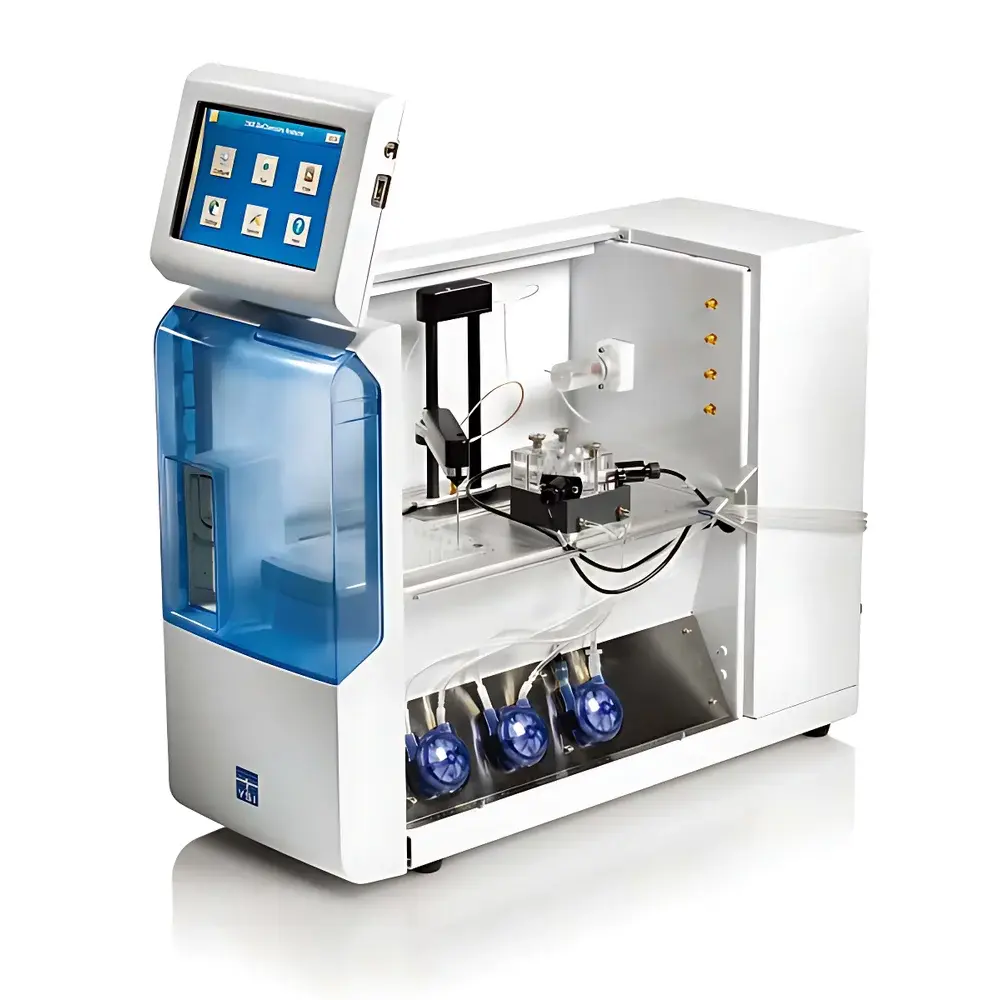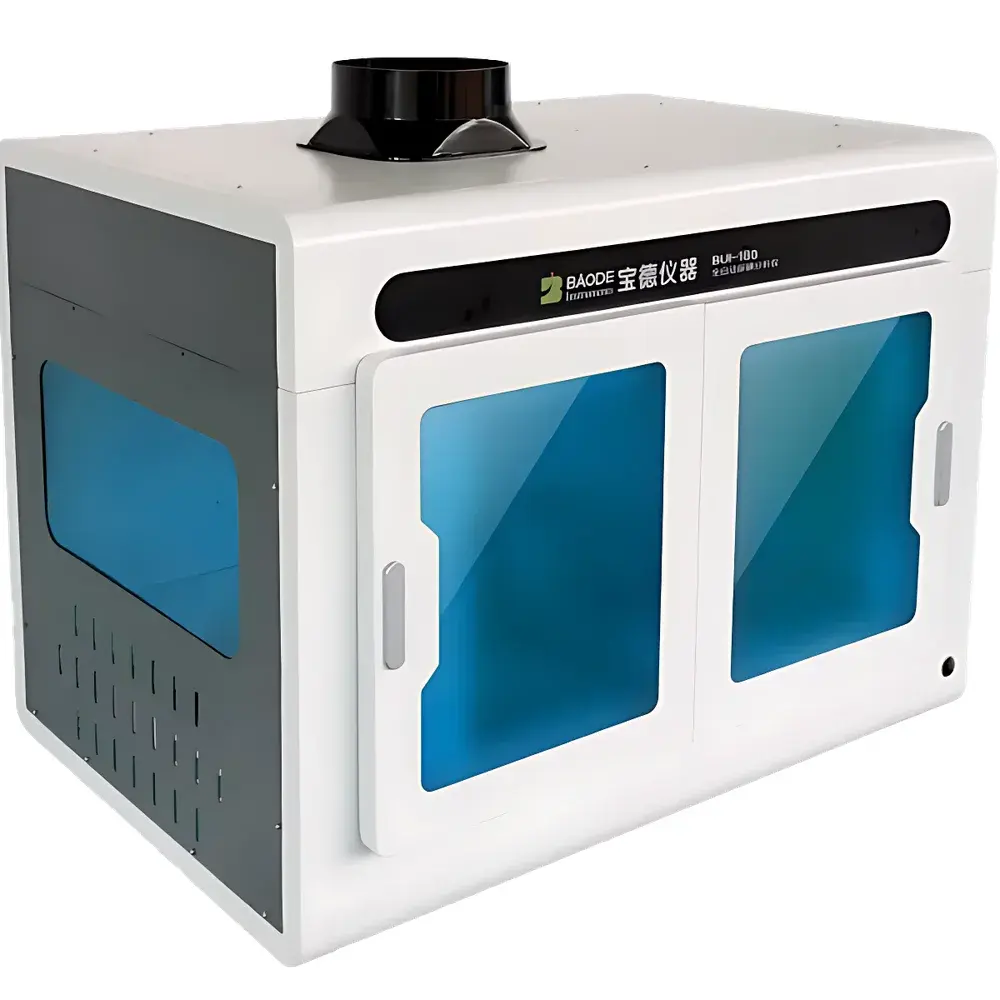
Buide BUI Series Fully Automated Urinary Iodine Analyzer
| Brand | Buide |
|---|---|
| Origin | Beijing, China |
| Manufacturer Type | Direct Manufacturer |
| Regional Classification | Domestic (China) |
| Model | BUI |
| Pricing | Available Upon Request |
Overview
The Buide BUI Series Fully Automated Urinary Iodine Analyzer is a dedicated clinical biochemistry instrument engineered for precise, high-throughput quantification of iodine concentration in human urine samples. It operates strictly in accordance with the Chinese National Health Industry Standard WS/T 107–2016, “Determination of Iodine in Urine by Arsenic-Catalyzed Spectrophotometry.” This method relies on the catalytic oxidation of arsenious acid (H₃AsO₃) by ceric ammonium sulfate [(NH₄)₄Ce(SO₄)₄] in the presence of iodide ions (I⁻), where iodide acts as a rate-determining catalyst. The resulting change in absorbance—measured spectrophotometrically at dual wavelengths (typically 405 nm and 420 nm)—is directly proportional to iodine concentration. The BUI system fully automates the entire analytical workflow: reagent dispensing, vortex-assisted mixing without physical contact, temperature-controlled digestion, wavelength-switching photometry, sequential cuvette-based colorimetric detection, and post-run cleaning—all within a single integrated platform. Its design eliminates manual intervention, minimizes inter-operator variability, and ensures metrological consistency across extended operational cycles.
Key Features
- Fully automated sample-to-report workflow compliant with WS/T 107–2016, including reagent addition (ammonium persulfate, arsenious acid, ceric ammonium sulfate), non-contact vortex mixing, and timed color development.
- High-precision intelligent robotic arm with sub-microliter liquid handling accuracy and positional repeatability ≤ ±0.1 mm.
- Dual-zone temperature control architecture: a high-stability digestion module (maintained at 95 ± 0.3 °C) and a super-circulating constant-temperature water bath (37 ± 0.2 °C) for reaction incubation.
- Low-noise, high-sensitivity dual-wavelength photometric detection system with automatic wavelength selection (405 nm / 420 nm) based on sample absorbance range, enabling dynamic linear response across 10–1200 μg/L iodine.
- Integrated auto-cleaning protocol with multi-stage rinse (deionized water, dilute acid wash, air purge) between assays to prevent carryover and ensure cross-contamination < 0.05%.
- Robust mechanical architecture designed for continuous 24/7 operation in clinical laboratory environments, with thermal drift compensation algorithms that maintain calibration stability over ambient temperature fluctuations of 15–30 °C.
Sample Compatibility & Compliance
The BUI analyzer accepts standard 1.5 mL or 2.0 mL urine collection tubes (with or without preservatives such as sodium azide). It supports both random-access and batch-mode processing, accommodating up to 80 samples per run without manual reloading. All internal fluidic pathways are chemically resistant to strong oxidants and acidic media used in the arsenic-catalyzed method. The instrument complies with ISO 15195:2018 (requirements for reference measurement laboratories) for traceable calibration, and its operational documentation supports GLP and hospital-based QA/QC requirements under CNAS-CL02:2023 (equivalent to ISO 15189). While not FDA-cleared, its methodology aligns with WHO/UNICEF iodine deficiency disorder (IDD) surveillance protocols and is routinely validated against NIST SRM 2670a (Toxic Elements in Urine).
Software & Data Management
The embedded control software provides real-time monitoring of all critical parameters—including digestion temperature, mixing torque, photometric baseline stability, and reagent consumption—via an intuitive touchscreen interface. Data output conforms to HL7 v2.5.1 and ASTM E1384 standards for seamless integration into LIS (Laboratory Information Systems) and hospital EMR platforms. Audit trails record user actions, calibration events, maintenance logs, and result modifications with time stamps and operator IDs—fully satisfying requirements for 21 CFR Part 11-compliant electronic records when deployed with optional network authentication and digital signature modules. Raw absorbance data, kinetic curves, and QC charts (Levey-Jennings, Westgard rules) are exportable in CSV, PDF, and XML formats.
Applications
- Population-level iodine nutrition assessment in public health programs and national IDD monitoring initiatives.
- Routine clinical screening for iodine status in pregnant women, children, and patients with thyroid disorders.
- Method validation and reference measurement support in certified clinical chemistry laboratories.
- Research applications requiring high-reproducibility iodine quantification in epidemiological cohort studies and nutritional intervention trials.
- Quality assurance testing of iodized salt programs and food fortification compliance.
FAQ
Does the BUI analyzer require daily recalibration?
No. The system performs automatic optical and thermal self-checks at startup and between runs; full calibration is recommended every 72 hours or after 50 samples, using two-point iodine standard solutions traceable to NIST.
Can it process frozen or refrigerated urine samples directly?
Yes—samples are automatically equilibrated to 37 °C in the water bath prior to analysis, eliminating manual thawing or pre-warming steps.
Is method verification documentation available for regulatory submission?
Yes. Buide provides a comprehensive Method Verification Report (MVR) including precision (within-run CV ≤ 2.1%, between-day CV ≤ 3.4%), linearity (r² ≥ 0.9995), limit of quantitation (LOQ = 8.2 μg/L), and interference studies per CLSI EP17-A2 guidelines.
What maintenance is required for long-term reliability?
Scheduled maintenance includes quarterly replacement of digestion heater seals, biannual photometer lamp calibration, and annual full fluidic pathway inspection—documented in the onboard service log.