
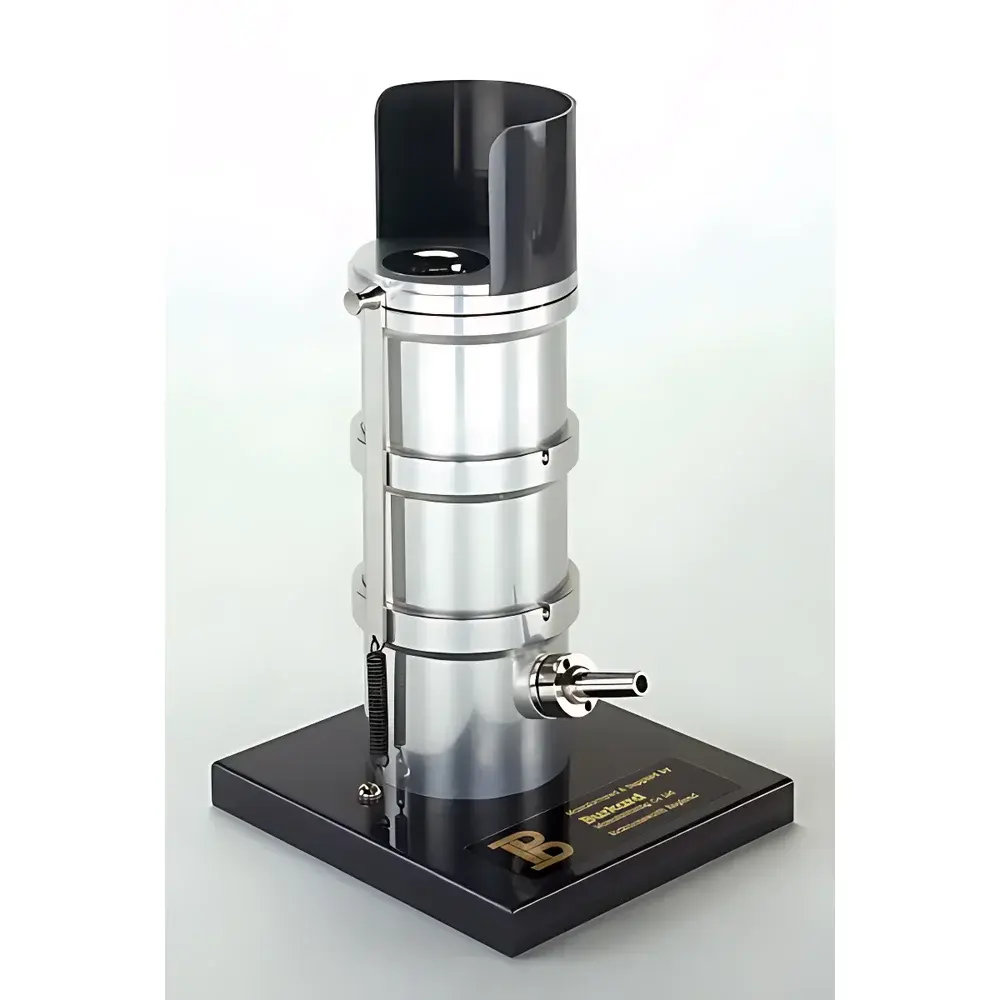
Burkard Multi-Stage Liquid Impaction Aerosol Sampler
| Brand | Burkard |
|---|---|
| Origin | United Kingdom |
| Manufacturer Status | Authorized Distributor |
| Origin Category | Imported |
| Model | Not Specified |
| Price | Upon Request |
| Sampling Flow Rate | 20 L/min |
| Stage 1 Cut-Off Size | >10 µm |
| Stage 2 Cut-Off Size | 10–4 µm |
| Stage 3 Cut-Off Size | <4 µm |
| Collection Liquid Volume per Stage | 6 mL |
| Vacuum Hose Port Diameter | 6 mm |
| Dimensions (L×W×H) | 115 × 100 × 145 mm |
| Net Weight | 670 g |
Overview
The Burkard Multi-Stage Liquid Impaction Aerosol Sampler is a precision-engineered, gravity-fed, multi-stage inertial impactor designed for the quantitative collection and size-fractionated recovery of viable airborne microorganisms—including bacteria, fungi, yeasts, and spores—from ambient or controlled environments. Based on the foundational principles established by Dr. J. May in the 1960s, this sampler employs sequential liquid impaction across three vertically aligned stages to separate aerosol particles according to aerodynamic diameter. Each stage features a precisely calibrated critical orifice that governs flow distribution and enforces defined cut-off diameters—Stage 1 (>10 µm), Stage 2 (10–4 µm), and Stage 3 (<4 µm)—in close alignment with ISO 21501-4 and WHO-recommended respiratory deposition models. Unlike dry-plate impactors, liquid-based collection minimizes desiccation stress, preserving microbial viability for subsequent culturing, enumeration, and identification. The device operates at a nominal flow rate of 20 L/min, requiring a vacuum source capable of sustaining ≥180 mmHg (≈24 kPa) pressure differential across the system to maintain laminar, reproducible flow profiles through all orifices.
Key Features
- Three-stage inertial liquid impaction architecture with certified cut-point fidelity per ISO 14644-1 and ASTM D6325-19 guidelines
- Robust anodized aluminum (or optional stainless steel) construction ensures dimensional stability, corrosion resistance, and compatibility with autoclaving (121 °C, 20 min)
- Vertical compression sealing mechanism provides leak-tight integrity during operation; rapid disassembly enables full access to all internal surfaces for cleaning and sterilization
- Integrated stagnation point shield enhances aspiration efficiency under dynamic airflow conditions (e.g., HVAC ducts, livestock barns, cleanrooms)
- Critical orifice located at Stage 3 regulates total system flow—eliminating need for external flow meters while ensuring traceable, repeatable volumetric sampling
- Optimized collection depth: 6 mL sterile liquid (e.g., neutralizing broth, peptone water, or saline) per stage maintains consistent impaction velocity and prevents splash-back or overflow
Sample Compatibility & Compliance
This sampler is validated for use with standard microbiological media—including tryptic soy broth (TSB), Sabouraud dextrose broth (SDB), and phosphate-buffered saline (PBS)—and supports downstream analysis via colony-forming unit (CFU) enumeration, MALDI-TOF MS identification, qPCR quantification, and culture-independent sequencing. It complies with key regulatory frameworks governing environmental monitoring in pharmaceutical manufacturing (EU GMP Annex 1, FDA Aseptic Processing Guidance), hospital infection control (CDC/HICPAC), and occupational health (OSHA Method PV2121). Data generated meet GLP/GMP documentation requirements when paired with auditable vacuum pump logs and calibrated flow verification records. All wetted components are non-reactive and free of leachables that could inhibit microbial growth or interfere with molecular assays.
Software & Data Management
While the Burkard Multi-Stage Liquid Impactor is a standalone mechanical instrument without embedded electronics or firmware, it integrates seamlessly into digital environmental monitoring ecosystems. Users routinely pair it with calibrated vacuum pumps equipped with analog/digital pressure transducers and data loggers compliant with FDA 21 CFR Part 11 (electronic signatures, audit trails, user access controls). Sample metadata—including date/time, location, operator ID, flow verification results, and media lot numbers—is recorded in LIMS or ELN platforms using standardized SOP templates aligned with ISO/IEC 17025. Optional barcode labeling of collection vessels enables automated sample tracking from acquisition through incubation and analysis.
Applications
- Viability-resolved bioaerosol profiling in pharmaceutical cleanrooms (Grade A–D), isolators, and RABS
- Longitudinal monitoring of airborne fungal loads in hospitals, laboratories, and immunocompromised patient wards
- Assessment of pathogen dispersion dynamics in agricultural settings (poultry houses, swine barns, dairy facilities)
- Evaluation of HVAC filtration efficiency and air disinfection system performance (UVGI, bipolar ionization, photocatalytic oxidation)
- Baseline characterization and routine surveillance of indoor air quality (IAQ) in schools, offices, museums, and archives
- Method validation studies supporting ISO 14698-1 (biocontamination control) and ISO 21501-4 (aerosol particle sizing)
FAQ
What vacuum pump specifications are required to operate this sampler reliably?
A pump capable of generating and sustaining ≥180 mmHg (24 kPa) pressure differential at 20 L/min is mandatory. Oil-free diaphragm or scroll pumps with integrated pressure regulation and thermal overload protection are recommended for GMP environments.
Can the sampler be used with viscous or protein-rich collection media?
Yes—however, media viscosity must remain below 10 cP at 20 °C to prevent orifice clogging. Pre-filtration of media through 0.45 µm membranes is advised when using enriched broths containing serum or yeast extract.
Is sterilization of the entire unit possible between sampling events?
Full disassembly allows steam sterilization (autoclaving) of all metal components. Seals and O-rings should be replaced after every 10 autoclave cycles to maintain sealing integrity.
How frequently should flow calibration be performed?
Prior to each sampling campaign and after any maintenance event—verified using a NIST-traceable dry-calibration meter (e.g., Gilibrator, Bios Defender) per ISO 17025-accredited procedures.
Does this sampler meet ISO 14644-1 classification requirements for cleanroom monitoring?
It does not provide real-time particle counts but delivers size-resolved, cultivable bioaerosol data essential for ISO 14644-1 Annex B risk assessment and EU GMP Annex 1 §8.42 environmental control strategy validation.







