
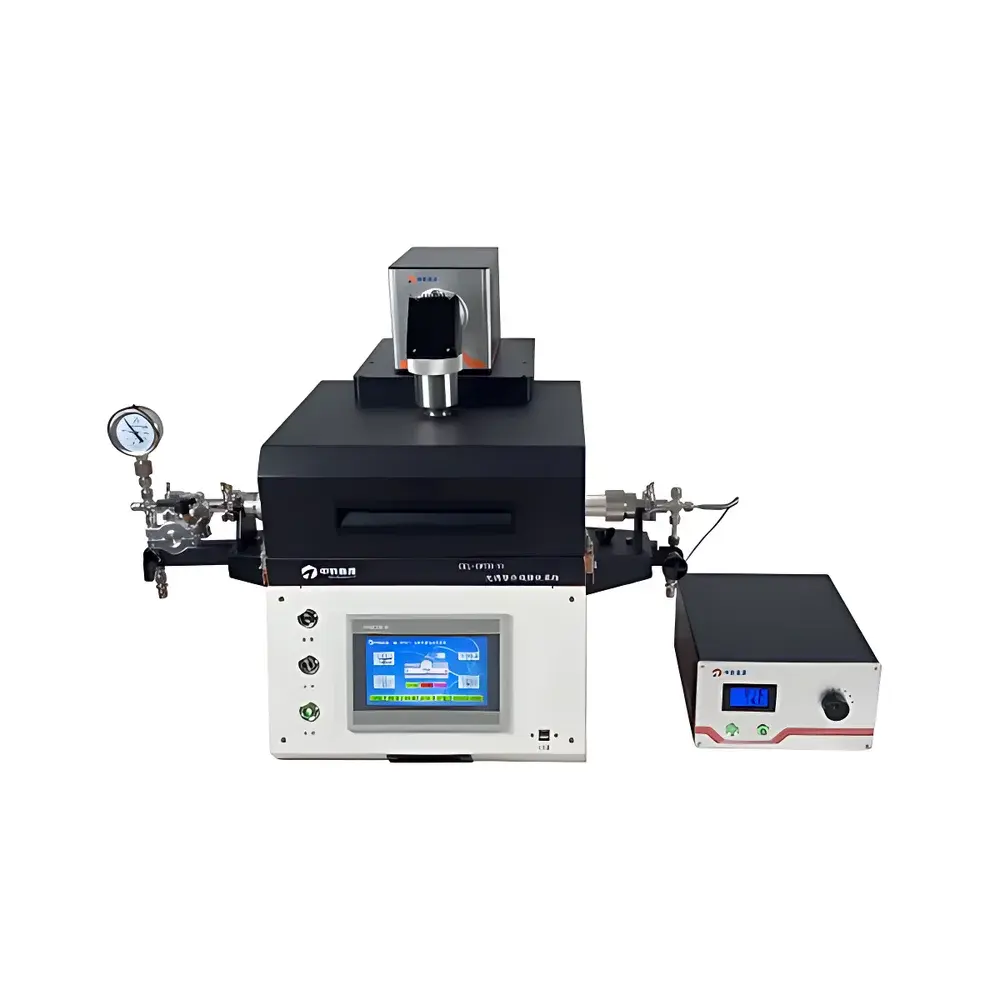
CEL-OPTH-VI Photothermal Synergistic Catalytic Synthesis System (Optional Light Source)
| Brand | CEAULIGHT |
|---|---|
| Origin | Beijing, China |
| Manufacturer Type | Direct Manufacturer |
| Region Classification | Domestic (China) |
| Model | CEL-OPTH-VI |
| Price Range | USD 14,000 – 28,000 |
| Reaction Pressure | Ambient (Atmospheric) |
| Maximum Reaction Temperature | < 800 °C |
| Catalyst Loading Capacity | 1–10 g |
| Heating Power | 1000 W (220 V, 50 Hz) |
| Temperature Control Range | Room Temp. to 800 °C (±0.1 °C accuracy) |
| Programmable Ramp | 64-segment PID control |
| Uniformity Zone | >30 mm axial length, ΔT ≤ ±1 °C |
| Quartz Tube ID | 30 mm, UV-grade fused silica |
| Illumination Port Diameter | 30 mm |
| Catalyst Bed Dimensions | 28 mm × 22 mm |
| Gas Flow Interface | 3 mm stainless steel tubing with Swagelok compression fittings & KF16 quadruple flange |
| Vacuum Capability (Optional) | High vacuum module down to 10⁻³ Pa (turbo-molecular pump) or low vacuum (<10 Pa) with oil-sealed rotary vane pump |
| Control Interface | 7-inch industrial touchscreen HMI (MCGS software), integrated thermocouple inputs (3×), external heating zone interfaces (2×), optical coupling port (1×) |
Overview
The CEL-OPTH-VI Photothermal Synergistic Catalytic Synthesis System is an engineered platform for controlled, in situ light-assisted high-temperature catalytic synthesis and activity evaluation under precisely regulated thermal and photonic stimuli. It operates on the principle of simultaneous photon absorption and thermal activation within a defined catalyst bed—enabling true photothermal synergy rather than sequential or decoupled irradiation and heating. The system integrates a high-precision resistive furnace, UV-transmissive fused silica reaction tube (30 mm ID), coaxial optical coupling via quartz light guide, and modular gas handling architecture. Unlike conventional photochemical reactors limited to ambient or moderate temperatures, the CEL-OPTH-VI maintains strict thermal uniformity (±1 °C over >30 mm axial zone) while permitting broadband illumination—UV, visible, and near-infrared—from externally mounted xenon arc sources (e.g., CEL-PF300-T3/T8/T9/T10 series). This design ensures photons penetrate radially into the catalyst bed, maximizing volumetric photon flux delivery and minimizing surface-only excitation artifacts common in top-irradiated fixed-bed configurations.
Key Features
- Integrated photothermal reactor architecture with coaxial optical access through a 30 mm diameter quartz viewport, enabling direct radial illumination of the catalyst bed inside a 30 mm ID UV-grade fused silica tube.
- High-temperature programmable furnace (RT–800 °C, ±0.1 °C setpoint accuracy) with 64-segment ramp-soak PID control and active air-cooling insulation for rapid thermal cycling and stable isothermal operation.
- Optimized reaction geometry: catalyst bed volume (28 mm × 22 mm) ensures full gas-phase contact—reactant flow passes *through* the catalyst matrix rather than over its surface—supporting kinetic studies compliant with ASTM D3222 and ISO 10678 standards for heterogeneous catalysis.
- Modular gas management interface: triple 3 mm Swagelok ports and KF16 quadruple flange accommodate vacuum lines, mass flow controllers (e.g., CEL-GPPCN), and inert gas purging—enabling controlled atmospheres (N₂, Ar, O₂, CO₂, synthetic air) or reactive mixtures under atmospheric pressure.
- Industrial-grade control system featuring a 7-inch MCGS-based HMI touchscreen, real-time temperature logging, over-temperature cutoff, dual-stage power protection, and standardized communication protocols (Modbus RTU) for integration into lab-wide automation networks.
- Expandable architecture supporting optional modules: high-vacuum turbo-molecular pumping (10⁻³ Pa), in-line GC sampling loops (with GC7920 compatibility), automated valve sequencing, and electrochemical or spectroscopic probe integration via auxiliary feedthroughs.
Sample Compatibility & Compliance
The CEL-OPTH-VI accommodates powdered, pelletized, or supported catalysts (1–10 g loading) across diverse material classes—including metal oxides (TiO₂, WO₃, BiVO₄), perovskites, plasmonic nanoparticles (Au, Ag), MOFs, and doped semiconductors. Its quartz reaction chamber complies with ASTM E1190 (optical transmission of fused silica at 200–2500 nm) and withstands thermal shock up to 800 °C under continuous illumination. The system supports GLP-compliant experimental documentation when paired with validated data acquisition software (e.g., MCGS audit trail extension), and its gas-tight construction meets ISO 10678 requirements for catalytic testing reproducibility. Optional high-vacuum configuration satisfies UHV-compatible pre-treatment protocols per ASTM D7212 for catalyst surface cleaning prior to activity measurement.
Software & Data Management
The embedded MCGS control software provides real-time visualization of furnace temperature profiles, ramp rates, dwell times, and thermocouple feedback from up to three independent sensor zones. All operational parameters—including gas flow rates (when interfaced with mass flow meters), illumination timing (via TTL-triggered light source sync), and alarm logs—are timestamped and exportable in CSV format. For regulatory environments, optional firmware upgrades support 21 CFR Part 11-compliant electronic signatures, audit trails, and user-level access controls. Data interoperability is ensured via Modbus TCP/RTU and OPC UA drivers, facilitating seamless ingestion into LIMS platforms or MATLAB/Simulink-based kinetic modeling workflows.
Applications
- Synthesis and annealing of photocatalytically active semiconductor materials (e.g., g-C₃N₄, SrTiO₃, Cu₂O) under simultaneous UV–vis irradiation and thermal treatment to modulate crystallinity, defect density, and phase composition.
- Photothermocatalytic evaluation of CO₂ hydrogenation, water splitting (H₂/O₂ evolution), VOC oxidation (formaldehyde, toluene), NOₓ abatement, and selective ammonia synthesis under simulated solar irradiance.
- Kinetic parameter extraction (apparent activation energy, quantum yield, turnover frequency) using steady-state and transient response protocols under controlled gas composition and irradiance intensity.
- In situ catalyst conditioning: photo-assisted calcination, reduction, or sulfidation to generate metastable active sites inaccessible via thermal routes alone.
- Method development for ASTM E3152 (standard test method for evaluating photocatalytic air purification performance) and ISO 22197-1 (NO removal efficiency under UV-A).
FAQ
What light sources are compatible with the CEL-OPTH-VI?
The system accepts all CEL-PF300-series xenon lamps (T3, T8, T9, T10) with integrated power supplies and cooling; custom collimated LED arrays (365 nm, 405 nm, 450 nm, 520 nm, 850 nm) may be coupled via the standard 30 mm optical port.
Can the system operate under vacuum or inert atmosphere?
Yes—standard configuration includes KF16 flanges and Swagelok ports for vacuum evacuation (down to 10⁻¹ Pa with optional oil pump) or inert gas purging; high-vacuum option (10⁻³ Pa) adds turbo-molecular pumping and vacuum gauging.
Is catalyst bed temperature measured directly, or inferred from furnace setpoint?
Three independently wired thermocouples (K-type) are configurable: one embedded in the furnace wall, one inserted axially into the catalyst bed via a dedicated port, and one monitoring the quartz tube outer surface—enabling differential thermal analysis and validation of thermal gradients.
How is gas flow distribution ensured across the catalyst bed?
The reaction tube features a precision-machined quartz sample holder with radial perforations and graded porosity, ensuring laminar, plug-flow-like distribution and minimizing channeling—validated by computational fluid dynamics (CFD) modeling per ISO/TR 16380.
Does the system support automated long-duration experiments?
Yes—64-segment programmable temperature profiles, timed light-source triggering, and event-driven gas switching (via optional solenoid valve manifold) enable unattended 72+ hour runs with full data logging and thermal safety interlocks.



