
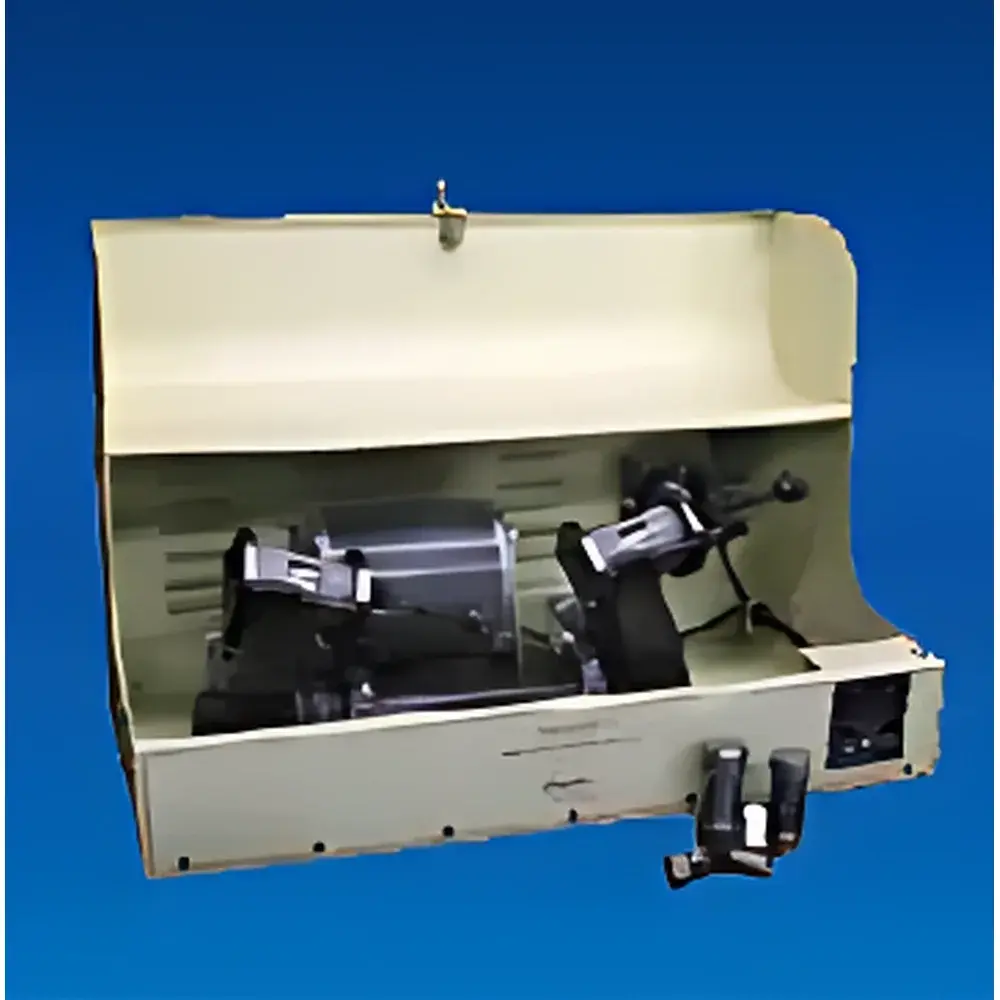
Chemplex SpectroMill 1100 High-Energy Ball Mill
| Brand | Chemplex |
|---|---|
| Origin | USA |
| Model | 1100 |
| Instrument Type | High-Energy Ball Mill |
| Sample Compatibility | Soft to moderately hard materials |
| Feed Size | < 2 mm |
| Final Particle Size | < 1 µm (typical), down to ≤ 0.01 mm (10 µm) achievable |
| Batch Capacity | 60 mL |
| Motor | 1/3 HP, Single-Phase 230 V / 50 Hz |
| Compliance | Designed for GLP-compliant laboratories |
Overview
The Chemplex SpectroMill 1100 is a high-energy planetary ball mill engineered for reproducible, contamination-controlled mechanical activation and particle size reduction in research and quality control laboratories. It operates on the principle of impact-driven attrition: stainless steel or ceramic grinding jars undergo controlled eccentric orbital motion while internally rotating, accelerating grinding media (balls) to high velocities. This dual-motion mechanism imparts intense kinetic energy—via repeated collisions between balls and sample—enabling efficient comminution, homogenization, and solid-state mechanochemical reactions. Unlike conventional tumbling mills, the 1100 achieves rapid energy transfer with minimal thermal buildup, making it suitable for processing thermally sensitive, soft, or ductile materials without significant degradation. Its design supports both dry and inert-atmosphere milling (with optional glovebox integration), addressing critical requirements in nanomaterial synthesis, amorphous phase formation, and mechanical alloying.
Key Features
- Robust cast-aluminum housing with vibration-dampening base and integrated safety interlock system
- Precision-engineered eccentric drive mechanism delivering consistent orbital frequency and angular acceleration
- Sealed, interchangeable grinding jars (60 mL capacity) available in stainless steel, agate, tungsten carbide, and PTFE-lined variants to minimize cross-contamination
- Programmable digital timer (0–99 min) with auto-shutoff and pause/resume functionality
- Adjustable jar rotation speed (relative to orbital motion) to optimize impact energy distribution for diverse material classes
- Low-noise operation (< 72 dB(A)) and passive cooling design for extended unattended runs
- Compliance-ready architecture: supports audit trails, user access levels, and timestamped run logs when paired with optional SpectroMill Control Suite software
Sample Compatibility & Compliance
The SpectroMill 1100 is validated for soft and moderately hard samples—including polymers, pharmaceutical excipients, organic crystals, clays, and metal powders—with feed sizes up to 2 mm. Final particle distributions routinely achieve D90 < 1 µm under optimized conditions (e.g., 30 min, 200 rpm, stainless steel media). The system meets essential prerequisites for regulated environments: jar sealing integrity aligns with USP particulate matter testing protocols; grinding performance is traceable per ASTM E2904 (Standard Guide for Mechanical Alloying and Milling); and operational parameters are documented in accordance with ISO/IEC 17025 clause 7.7 (control of equipment records). Optional argon-purged jar lids enable oxygen-sensitive processing compliant with ISO 8502-9 (surface cleanliness assessment).
Software & Data Management
While the base 1100 operates via standalone digital controls, integration with the optional SpectroMill Control Suite (v3.2+) enables full data governance. The software provides real-time monitoring of rotational speed, elapsed time, and cycle count; exports CSV-formatted milling logs with metadata (operator ID, date/time stamp, jar ID, parameter set); and supports 21 CFR Part 11–compliant electronic signatures and audit trail generation. All data files are stored locally with SHA-256 checksum validation and support automated backup to network drives or LIMS interfaces via RESTful API. Raw log files retain millisecond-resolution timestamps for forensic traceability during GLP/GMP audits.
Applications
- Mechanical alloying of elemental powders to produce metastable solid solutions, nanocrystalline alloys, and intermetallic compounds
- Top-down synthesis of nanomaterials (e.g., graphene oxide exfoliation, MOF crystallite size reduction)
- Pharmaceutical solid-state screening: amorphization of APIs, co-grinding for solubility enhancement, and excipient compatibility studies
- Geochemical sample preparation for XRF and ICP-MS analysis requiring sub-10 µm homogeneity
- Catalyst precursor activation via surface defect engineering and lattice strain induction
- Recycling R&D: de-alloying of scrap metals and composite material disintegration
FAQ
What jar materials are recommended for soft organic samples to avoid contamination?
Stainless steel jars are standard; however, for organics or halogen-sensitive compounds, agate or PTFE-lined jars are preferred to eliminate metallic leaching and electrostatic interference.
Can the 1100 be used under inert gas atmosphere?
Yes—optional sealed jar lids with Schrader valve ports allow evacuation and backfilling with Ar or N₂; full glovebox integration is supported via custom mounting brackets.
Is calibration required before first use?
No routine calibration is needed; however, users must verify orbital speed accuracy annually using a certified optical tachometer per ISO 17025 clause 6.5.2.
How does the 1100 compare to planetary ball mills with higher nominal RPM?
Energy input depends on kinetic impact force—not just RPM. The 1100’s eccentric orbit geometry delivers superior specific energy density per revolution compared to purely rotational systems, particularly below 1 µm target sizes.
Does Chemplex provide method development support for new applications?
Yes—application engineers offer remote protocol optimization services, including jar-to-ball mass ratio recommendations, speed/time profiling, and post-mill particle analysis guidance aligned with ISO 13320 laser diffraction standards.



