
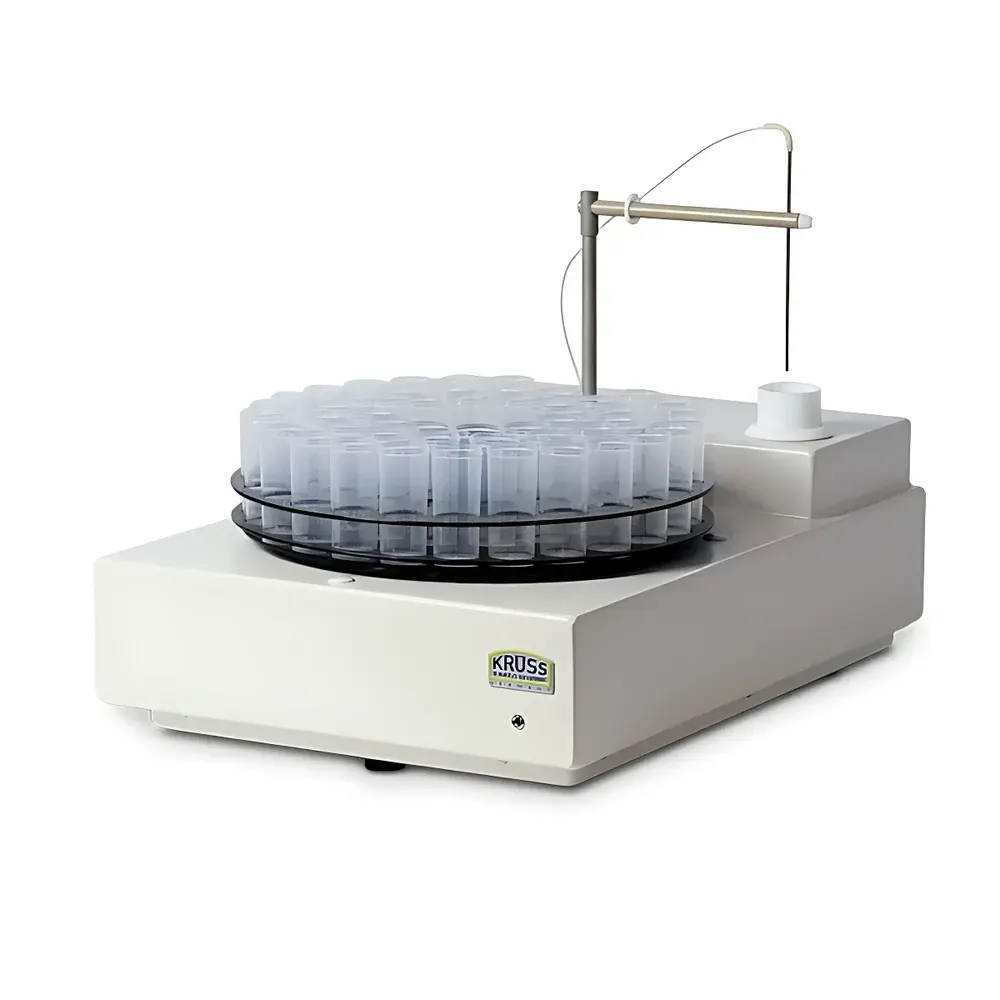
ChemTron AS80 and AS90 Automated Continuous Sample Injectors
| Brand | ChemTron |
|---|---|
| Origin | Germany |
| Model | AS80, AS90 |
| Sample Capacity | AS80 — 18 or 36 samples |
| Sample Vial Options | PP vials (6–50 mL) or borosilicate glass vials (16–30 mL) |
| Dimensions (W×H×D) | 270 × 380 × 200 mm (base) |
| Weight | ~9 kg each |
| Interface | RS-232 serial control |
| Compatibility | Designed for integration with Krüss laboratory instruments and third-party analyzers via configurable serial protocol |
Overview
The ChemTron AS80 and AS90 Automated Continuous Sample Injectors are precision-engineered laboratory automation platforms designed for unattended, high-throughput liquid sample introduction in analytical workflows. Built in Germany and validated for robust operation in regulated environments, these injectors operate on a peristaltic-driven fluid handling principle—leveraging the ChemTron DS7070 peristaltic pump module to deliver precise, pulse-free aspiration and dispensing across heterogeneous sample matrices. Unlike syringe-based autosamplers, the AS-series employs gravity-assisted sample positioning combined with programmable valve sequencing and integrated rinse manifolds to minimize carryover and ensure measurement integrity across consecutive analyses. The system is not a standalone analyzer but a modular, hardware-level sample delivery interface—optimized for seamless integration into multi-instrument measurement stations where reproducibility, traceability, and minimal operator intervention are critical requirements.
Key Features
- Modular sample tray architecture supporting four interchangeable configurations: AS80-T18 (18 × 50 mL), AS80-T36 (36 × 35 mL), AS90-T53 (53 × 16 mL), and AS90-T89 (89 × 6 mL)—enabling flexible method adaptation without hardware replacement.
- Integrated rinse port with dedicated wash manifold and customizable rinse cycle timing, ensuring <0.01% cross-contamination between samples under routine use conditions.
- RS-232 serial interface compliant with standard Krüss instrument protocols; supports ASCII command sets for method-triggered sample injection, tray indexing, and status reporting—enabling direct control from third-party LIMS or custom LabVIEW/Python scripts.
- Compact footprint (270 × 380 × 200 mm) and tool-free mechanical mounting simplify integration into existing fume hoods, benchtop analyzers, or automated test cells.
- Chemically resistant fluid path components—including silicone tubing compatible with DS7070, PTFE-coated valves, and inert polypropylene or borosilicate glass vials—validated for use with corrosive aqueous solutions, organic solvents, and low-viscosity calibration standards (e.g., ISO 8503-2 reference oils, ASTM D445 kinematic viscosity fluids).
Sample Compatibility & Compliance
The AS80 and AS90 support sample volumes ranging from 0.5 mL to 50 mL, accommodating both narrow-bore and wide-mouth vial geometries. Vial compatibility includes standard DIN 12551/ISO 837-1 thread specifications for 16 mm, 22 mm, 28 mm, and 42 mm diameters. All wetted materials comply with USP Class VI biocompatibility requirements and EU Regulation (EC) No 1935/2004 for food contact materials. While the injector itself does not perform analysis, its deterministic sample delivery sequence—paired with timestamped command logging—supports GLP/GMP-aligned workflows when deployed with instruments meeting FDA 21 CFR Part 11 data integrity requirements. Audit trail generation depends on host software implementation; the AS-series provides raw event timestamps and status codes (e.g., “valve_open”, “rinse_complete”, “vial_empty”) via RS-232 for external capture.
Software & Data Management
No proprietary software is bundled with the AS80/AS90. Instead, the devices operate as transparent peripherals governed by host-controlled instruction sets. A documented ASCII command protocol enables full operational control—including tray rotation, pump activation, valve actuation, and error acknowledgment—via any serial terminal or scriptable environment. For laboratories implementing electronic lab notebooks (ELNs) or chromatography data systems (CDS), the injector’s state transitions can be logged alongside analytical results using middleware such as LabArchives API hooks or Agilent OpenLab CDS event triggers. Optional firmware updates—distributed via ChemTron’s authorized service partners—introduce enhanced timeout handling and extended error-code reporting for improved diagnostic traceability during 24/7 operation.
Applications
These injectors are routinely deployed in quality control laboratories performing routine physicochemical testing—including surface tension (ASTM D971), interfacial tension (ISO 6295), density (ASTM D1298), and dynamic viscosity (ASTM D445) measurements on Krüss tensiometers, densimeters, and rheometers. Their reliability in unattended operation makes them suitable for environmental testing labs analyzing wastewater effluents (EPA Method 1664), pharmaceutical formulation screening (USP surface activity assays), and petrochemical QC (IP 365 acid number titration support). In research settings, the AS90-T89 configuration is frequently used for combinatorial surfactant screening across 89 formulations in single-run kinetic studies.
FAQ
Can the AS80/AS90 operate independently without a host instrument?
No. These are peripheral sample-handling modules requiring real-time serial commands from a host device (e.g., Krüss tensiometer, custom DAQ system) to initiate sampling, rinsing, or tray movement.
Is the DS7070 peristaltic pump included with the AS80/AS90?
No. The DS7070 is sold separately and must be configured with compatible tubing and flow calibration for the target sample matrix.
What maintenance intervals are recommended for long-term reliability?
Tubing replacement every 3–6 months under continuous operation; quarterly verification of valve seal integrity and rinse manifold alignment using distilled water flush validation.
Are custom tray layouts or OEM integration options available?
Yes—ChemTron offers mechanical and firmware customization services through authorized German engineering partners, subject to minimum order quantities and NRE agreements.
Does the AS-series support barcode or RFID vial identification?
Not natively. Integration with external readers requires custom host-side logic to map scanned IDs to vial positions in the tray definition file.



