
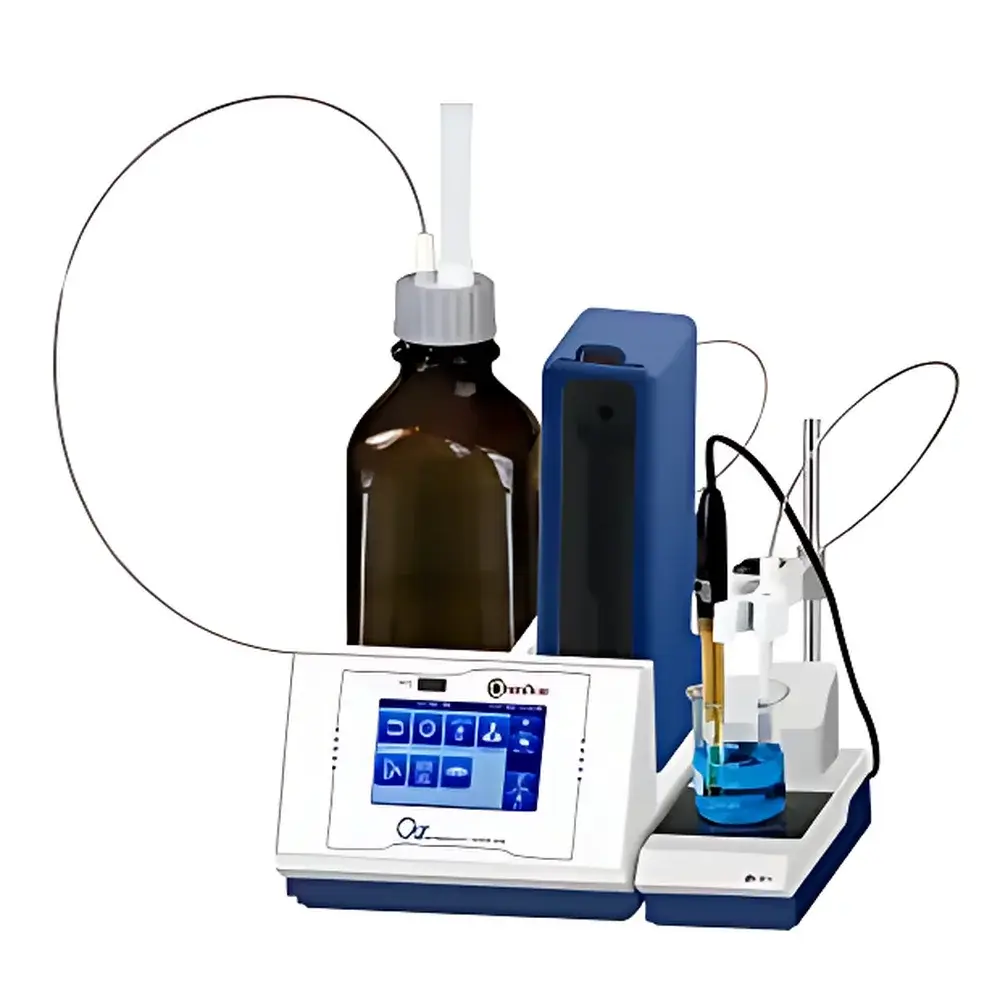
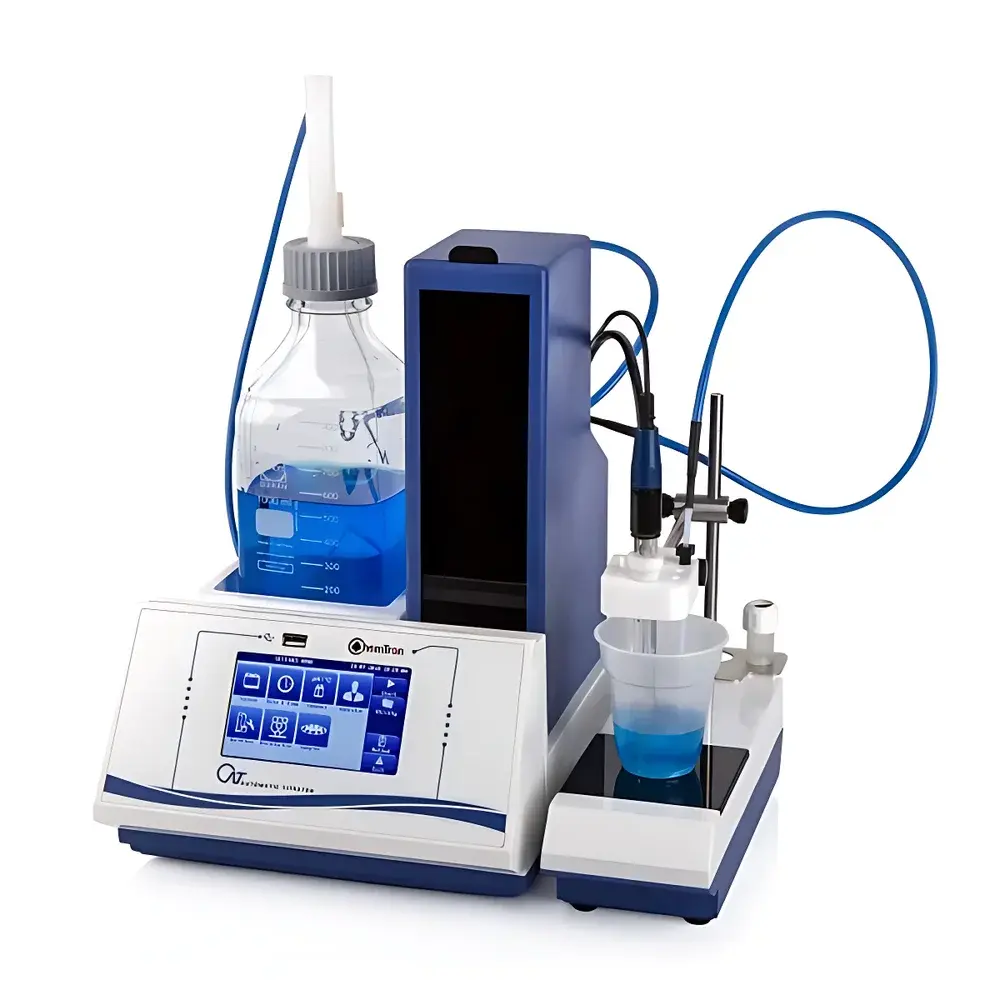
ChemTron CAT1-1 Series Automatic Potentiometric Titrator
| Brand | ChemTron |
|---|---|
| Origin | Italy |
| Model | CAT1-1 Series |
| Instrument Type | General-Purpose Potentiometric Titrator |
| pH Range | 0–14 |
| mV Range | ±2000 mV |
| Current Range | ±10 µA |
| pH Accuracy | ±0.02 pH |
| mV Accuracy | ±2 mV |
| Current Accuracy | ±2 µA |
| Temperature Range | 0–100 °C |
| Temperature Accuracy | ±1 °C |
| Titration Tube Capacity | 10 mL (dual-mountable) |
| Titration Resolution | 12,000 steps |
| Titration Accuracy | <0.2% (2 µL for 10 mL tube) |
| Titration Repeatability | ±0.2% |
| Pump Flow Rate | 1 mL/s (up to 3 peristaltic pumps) |
| Display | 4.3″ capacitive touchscreen |
| Built-in Methods | 30 (including EP, EQ, Free SO₂, Total SO₂, Double SO₂) |
| Data Storage | 50 titration results + 10 calibration records |
| Interface | pH/mV/µA electrode ports, USB-A, USB-B, RS232, Bluetooth |
Overview
The ChemTron CAT1-1 Series Automatic Potentiometric Titrator is an engineered solution for routine and regulated potentiometric titrations in quality control laboratories, academic research settings, and food & beverage production environments. Based on classical potentiometric endpoint detection—measuring potential difference (mV) or pH shifts across a redox, acid-base, precipitation, or complexometric reaction—the CAT1-1 delivers traceable, reproducible quantification of analytes without reliance on visual indicators. Its architecture integrates a high-resolution 10 mL burette (12,000-step motorized drive), precision peristaltic reagent delivery (1 mL/s flow rate, ±2 µL volumetric accuracy), and real-time electrochemical signal acquisition at up to 10 Hz sampling frequency. Designed and manufactured in Italy, the instrument complies with fundamental metrological requirements for volumetric analysis as defined in ISO 8655-3 (burettes) and ISO 5725 (accuracy and precision of measurement methods). The system operates under ambient laboratory conditions (15–30 °C, ≤80% RH) and supports GLP-compliant workflows through audit-ready data handling and method versioning.
Key Features
- 4.3″ high-brightness capacitive touchscreen interface with icon-driven navigation—no keyboard or mouse required; all method editing, calibration, and report generation performed directly on-device
- Modular titration head supporting dual 10 mL burettes and up to three independently controlled peristaltic pumps for multi-reagent protocols (e.g., sequential acid/base and oxidant addition)
- Integrated temperature compensation via Pt100 sensor input (0–100 °C, ±1 °C accuracy), enabling automatic correction of electrode response and activity coefficients per Nernst equation
- Real-time visualization of titration curves (E vs. V or pH vs. V) and first-derivative (dE/dV) plots during analysis—critical for identifying inflection points in weak-acid or multi-step titrations
- Automated liquid-level balancing: peristaltic pump synchronized with level sensor to maintain constant reagent head height—minimizing hydrostatic error across extended batch runs
- Optional auto-aeration module triggered pre-titration for oxygen-sensitive assays (e.g., iodometric determination of sulfite), ensuring consistent deoxygenation prior to endpoint detection
- Preloaded method templates conforming to official standards: European Pharmacopoeia (EP), AOAC Official Methods®, OIV (International Organisation of Vine and Wine) protocols for free/total SO₂, and ASTM D1498 for chloride by argentometry
Sample Compatibility & Compliance
The CAT1-1 accepts standard reference electrodes (Ag/AgCl, calomel), indicator electrodes (glass pH, platinum, silver, double-platinum), and ion-selective sensors compatible with BNC or DIN connectors. It accommodates samples in standard 50–250 mL beakers or custom vessels mounted on optional magnetic stirrer bases (M1–M5 configurations). The instrument meets mechanical and electrical safety requirements per IEC 61010-1:2010 and electromagnetic compatibility per EN 61326-1:2013. While not certified for FDA 21 CFR Part 11 out-of-the-box, its software architecture supports electronic signature implementation and audit trail configuration when deployed with validated CAT Software v3.x on Windows-based host systems. All stored data—including raw sensor traces, calibration logs, and final reports—are exportable via USB flash drive in CSV or PDF format, facilitating integration into LIMS or ELN platforms compliant with ISO/IEC 17025:2017 documentation requirements.
Software & Data Management
The CAT Software suite (Windows-compatible, USB/Bluetooth-linked) provides centralized method management, remote instrument control, and advanced curve fitting (e.g., Gran plot, second-derivative peak detection). Each titration session automatically timestamps and assigns unique identifiers to raw data files, calibration records, and final reports—segregated in dedicated memory partitions to prevent cross-contamination of datasets. The system stores the most recent 50 titrations and 10 calibration events onboard; older entries are archived externally upon USB insertion. Calibration history includes buffer recognition logs (automated pKa matching for pH 4.01/7.00/10.01), slope/offset validation, and electrode impedance diagnostics. For regulated environments, optional software validation packages support IQ/OQ documentation and periodic performance verification against certified reference materials (e.g., NIST SRM 186c for pH, potassium hydrogen phthalate for acid-base equivalence).
Applications
- Acid-base titrations: total acidity in wines, dairy products, and pharmaceutical excipients using standardized NaOH/HCl solutions with glass electrode detection
- Precipitation titrations: chloride quantification in water samples per Mohr or Volhard methods using AgNO₃ and silver indicator electrodes
- Oxidation-reduction titrations: iron(II) determination in supplements via cerimetric titration, or ascorbic acid assay using iodine-based redox couples
- Redox endpoint detection in sulfur dioxide analysis: free SO₂ in must and wine via Aeration-Oxidation (AO) method with double-platinum electrode pair
- Continuous pH monitoring: standalone use as a high-stability pH/mV logger (0.01 pH resolution, 0.1 mV resolution) when paired with the optional 16- or 35-position autosampler
- Method development: dynamic titration mode enables variable dosing increments based on real-time slope thresholds—ideal for optimizing titrant addition in heterogeneous or viscous matrices
FAQ
Does the CAT1-1 support Good Laboratory Practice (GLP) documentation requirements?
Yes—when used with validated CAT Software and configured with timestamped audit trails, electronic signatures, and secure user access levels (admin/operator), it fulfills core GLP data integrity principles per OECD Principles of GLP.
Can the instrument perform back-titrations or multi-step titrations?
Yes—via programmable sequence logic in method editor: e.g., initial reagent addition → pause → secondary titrant delivery → endpoint detection, all within a single method file.
Is temperature-controlled titration possible?
The CAT1-1 accepts Pt100 input for automatic temperature compensation but does not integrate Peltier or water-jacketed cell holders; external thermostatted vessels must be used for isothermal studies.
What electrode types are natively supported?
Standard BNC/DIN-compatible electrodes: combination pH, Ag, Pt, double-Pt, and redox electrodes—with automatic recognition of electrode type via configurable input settings.
How is calibration traceability maintained?
All calibration events record date/time, operator ID, buffer lot numbers, measured mV/pH values, and calculated slope/offset—exportable as CSV for metrological review against accredited reference standards.
Related Products





