
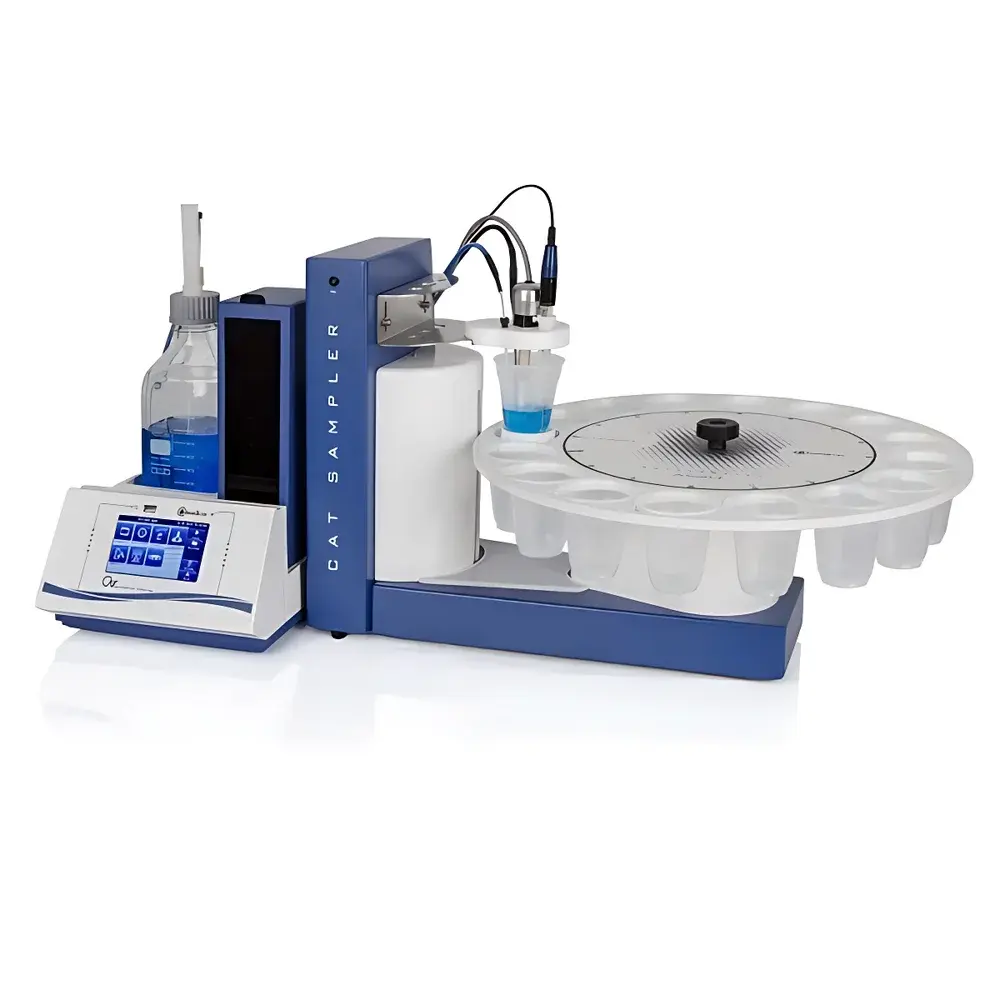
Chemtron CAT1-16 Series Automatic Potentiometric Titrator
| Brand | JULABO-Chemtron |
|---|---|
| Origin | Italy |
| Model | CAT1-16 Series |
| Instrument Type | General-purpose Automatic Potentiometric Titrator |
| pH Range | 0–14 |
| mV Range | ±2000 mV |
| Current Range | ±10 µA |
| Temperature Range | 0–100 °C |
| pH Accuracy | ±0.02 pH |
| pH Resolution | ±0.01 pH |
| mV Accuracy | ±2 mV |
| mV Resolution | ±0.1 mV |
| Current Accuracy | ±2 µA |
| Current Resolution | ±0.1 µA |
| Temperature Accuracy | ±1 °C |
| Temperature Resolution | ±0.1 °C |
| Burette Volume | 10 mL (dual configurable) |
| Burette Precision | <0.2% (2 µL @ 10 mL) |
| Burette Repeatability | ±0.2% |
| Pump Flow Rate | 1 mL/s |
| Display | 4.3″ capacitive touchscreen |
| Method Storage | 30 preloaded templates (EP, EQ, Free SO₂, Total SO₂, Double SO₂) |
| Data Storage | 50 titration reports + 10 calibration records |
| Interface | pH/mV/µA electrode ports, USB-A, USB-B, RS232, Bluetooth |
Overview
The Chemtron CAT1-16 Series Automatic Potentiometric Titrator is an engineered solution for routine and high-throughput potentiometric titrations in quality control, research, and regulatory-compliant laboratories. Based on classical potentiometric endpoint detection—measuring potential difference (mV) or pH shift across a redox, acid-base, precipitation, or complexometric reaction—the CAT1-16 delivers reproducible, traceable results under defined electrochemical conditions. Its architecture integrates a precision burette drive system with high-resolution analog signal conditioning for pH, mV, µA, and temperature inputs, enabling simultaneous multi-parameter monitoring during titration. Designed for compliance-ready workflows, the instrument supports method validation protocols aligned with ISO 8655 (burette performance), ASTM E2087 (potentiometric titration), and USP (acid-base titrimetry). The system operates as both a dedicated titrator and a continuous pH/mV monitoring station when paired with the optional 16-position autosampler carousel.
Key Features
- 4.3-inch high-contrast capacitive touchscreen with icon-driven navigation—no keyboard or mouse required; all method setup, execution, and review performed via intuitive touch gestures
- Modular titration engine: supports up to two independent 10 mL burettes (12,000-step resolution) and three removable peristaltic pumps (1 mL/s flow rate), enabling sequential reagent addition, back-titration, or multi-step titration protocols
- Multi-electrode compatibility: native support for glass pH electrodes, silver/silver chloride reference electrodes, platinum indicator electrodes, dual-platinum redox electrodes, and Pt100 temperature sensors with automatic temperature compensation (ATC)
- Real-time visualization: synchronized display of titration curve (E vs. volume), first derivative (dE/dV), second derivative (d²E/dV²), and integrated charge (µA·s) plots during analysis
- Automated auxiliary functions: programmable liquid-level balancing via peristaltic pump + level sensor, pre-titration nitrogen sparging (for oxygen-sensitive assays), and auto-rinse/clean cycles between samples
- Robust mechanical design: compact footprint (W × D × H: 320 × 380 × 420 mm), vibration-damped base, and chemically resistant housing suitable for fume hood or benchtop deployment
Sample Compatibility & Compliance
The CAT1-16 accommodates aqueous, alcoholic, and low-conductivity matrices typical in food & beverage (e.g., wine SO₂ analysis), pharmaceutical excipient testing, water treatment chemistry, and industrial chemical QC. Electrode input circuitry complies with IEC 61000-4-3 (EMC immunity) and IEC 61010-1 (safety for laboratory equipment). All stored methods—including EP (endpoint), EQ (equivalence point), Free/Total SO₂, and Double SO₂—are structured to meet GLP documentation requirements: each titration record contains timestamped operator ID, electrode serial number, calibration history, raw sensor data, and audit-trail metadata. Optional CAT Software enables full 21 CFR Part 11 compliance with electronic signatures, role-based access control, and immutable data archiving.
Software & Data Management
The standalone CAT Software (Windows-based, USB/Bluetooth/RS232 connectivity) provides method development, remote instrument control, and advanced data post-processing. Users may import/export CSV or PDF reports, overlay multiple titration curves, apply polynomial smoothing to derivative peaks, and export raw time-series data (pH, mV, µA, temp, volume) at 100 ms intervals. Internal memory retains the last 50 titration results and 10 calibration logs; all data are exportable via USB flash drive in encrypted binary format or plain-text CSV. Firmware updates are delivered through signed .hex packages verified by SHA-256 checksum to ensure integrity.
Applications
- Acid-base titrations: total acidity in wines, dairy products, and soft drinks using pH-stat mode with automatic buffer recognition
- Redox titrations: determination of iron(II), iodine, or cerium(IV) using platinum or dual-platinum electrodes
- Precipitation titrations: chloride quantification via argentometry with Ag electrode and KNO₃ salt bridge
- Complexometric titrations: calcium/magnesium hardness in water using EDTA and ion-selective electrodes
- Sulfur dioxide analysis: free and total SO₂ in must and wine per OIV methods, including automated sparging and dual-endpoint differentiation
- Continuous pH monitoring: long-term stability studies of formulations, dissolution kinetics, or enzymatic reactions (requires optional autosampler carousel)
FAQ
Does the CAT1-16 support GLP-compliant audit trails?
Yes—each titration event logs operator ID, timestamp, electrode calibration status, environmental temperature, and raw sensor outputs. When used with CAT Software and enabled security settings, it satisfies core GLP and FDA 21 CFR Part 11 requirements.
Can I use non-Chemtron electrodes with this titrator?
All standard BNC-terminated pH, mV, and µA electrodes with compatible impedance ranges (≤10¹² Ω for pH, ≤10⁶ Ω for redox) are supported. Calibration and slope verification remain user-configurable.
What is the minimum detectable volume increment per step?
With 12,000-step resolution on a 10 mL burette, the theoretical minimum dispensing increment is 0.83 µL. Actual delivery precision is validated per ISO 8655-3 at <0.2% RSD (2 µL @ 10 mL).
Is temperature control integrated or external?
The CAT1-16 reads Pt100 sensors for automatic temperature compensation but does not include active heating/cooling. External thermostatted cells (e.g., JULABO F25-HE) may be interfaced via analog output or digital protocol.
How many methods can be stored internally without software?
The instrument stores up to 30 preconfigured methods onboard. Additional custom methods require CAT Software for creation and download.




