
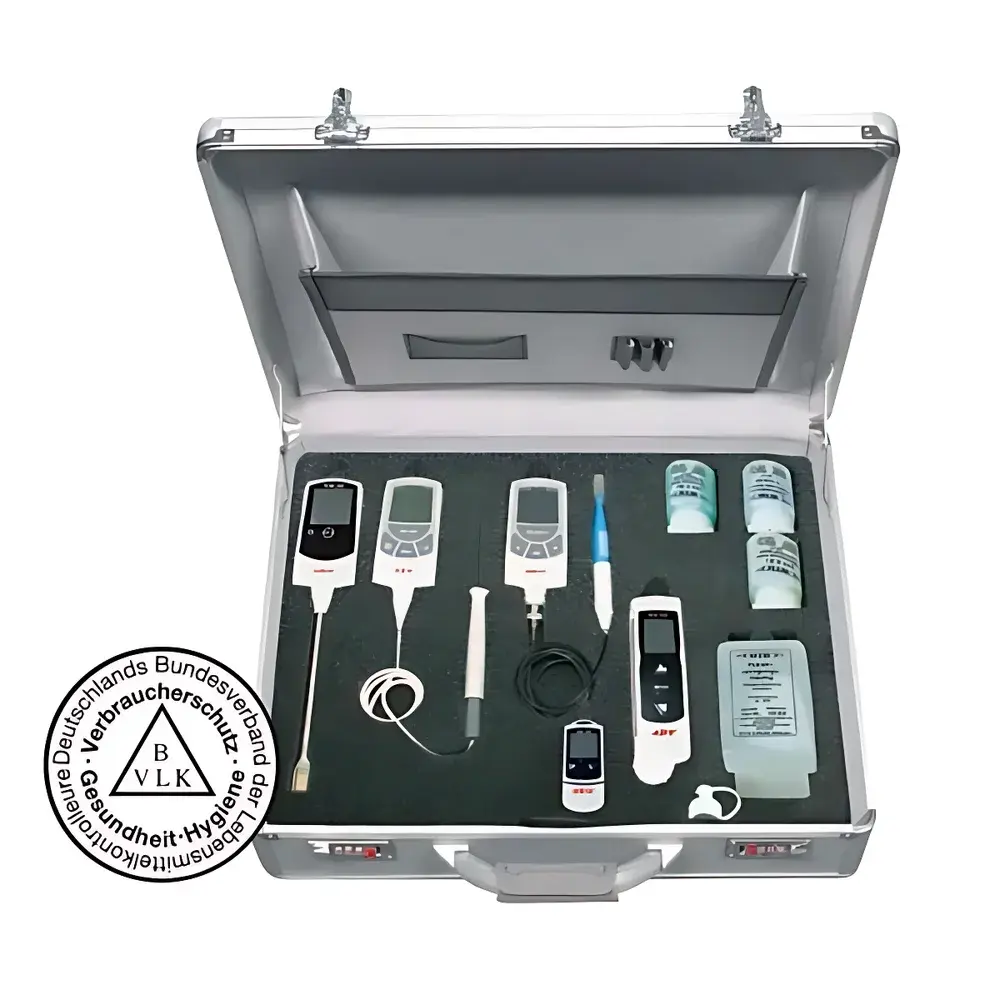
ChemTron EB 4401 Food Quality Assurance Kit
| Brand | ChemTron |
|---|---|
| Origin | Germany |
| Model | EB 4401 |
| Temperature Range (FOM 320) | 50 °C to 220 °C |
| TPM Measurement Range (FOM 320) | 0 % to 40 % |
| Temperature Range (TFX 422C) | −50 °C to 200 °C |
| pH Range (pHT 810) | 0.0 to 14.0 pH |
| Temperature Range (TLC 730) | −30 °C to 70 °C |
| Temperature Range (EBI 300USB) | −30 °C to 70 °C |
| Data Output | USB-exportable PDF reports |
Overview
The ChemTron EB 4401 Food Quality Assurance Kit is an integrated, field-deployable instrumentation system engineered for compliance-driven food production, catering, and cold chain logistics environments. Designed in accordance with HACCP principles and aligned with ISO 22000 and Codex Alimentarius hygiene frameworks, the kit consolidates five independently validated instruments—each calibrated to traceable national standards—to deliver concurrent monitoring of critical control points (CCPs) across thermal processing, oil degradation, acidity, surface temperature, and time-temperature history. Unlike modular or single-parameter solutions, the EB 4401 provides coordinated metrological continuity: FOM 320 applies dielectric constant analysis to quantify total polar compounds (TPM) in frying oils—a direct indicator of oxidative and hydrolytic degradation; TFX 422C employs a needle-type PT1000 sensor with ≤0.15 °C accuracy (per IEC 60751 Class A) for core temperature validation in meats, doughs, and frozen products; pHT 810 utilizes a robust gel-filled pH electrode optimized for semi-solid matrices including cured meats and soft cheeses; TLC 730 implements dual-wavelength infrared thermometry (8–14 µm spectral band) to minimize emissivity-related error during rapid non-contact screening; and EBI 300USB logs temperature at user-defined intervals (1 s to 24 h) with NIST-traceable calibration and GLP-compliant audit trails.
Key Features
- Multi-instrument interoperability: All devices share common battery platform (AA/AAA), IP65-rated housings, and intuitive icon-based interfaces—reducing operator training burden in high-turnover food service settings.
- HACCP-ready documentation: EBI 300USB generates timestamped, digitally signed PDF reports compliant with FDA 21 CFR Part 11 requirements for electronic records and signatures.
- Thermal stability validation: FOM 320 incorporates active temperature compensation algorithms to correct TPM readings across its full 50–220 °C operating range, eliminating manual correction tables.
- Hygienic probe design: TFX 422C’s stainless-steel PT1000 probe features a 1.5 mm tip diameter and autoclavable construction (up to 134 °C), meeting EN 13485 medical device cleanliness criteria.
- Calibration traceability: Each instrument ships with individual calibration certificates issued by DAkkS-accredited laboratories (Germany), covering all specified ranges and uncertainties.
Sample Compatibility & Compliance
The EB 4401 kit supports direct measurement across diverse food matrices without sample preparation: FOM 320 accepts hot liquid oils (including palm, soybean, sunflower, and blended frying media); TFX 422C penetrates viscous pastes (e.g., dough, batter), dense proteins (whole muscle cuts, sausages), and cryogenic solids (IQF vegetables, blast-frozen seafood); pHT 810 accommodates low-moisture cheeses (Cheddar, Gouda), emulsified dressings, and chilled deli salads; TLC 730 measures emissivity-corrected surface temperatures on glossy packaging films, stainless steel conveyors, and polyethylene-wrapped pallets. All components conform to EU Regulation (EC) No 1935/2004 for food contact materials and carry CE marking under the Low Voltage Directive (2014/35/EU) and EMC Directive (2014/30/EU).
Software & Data Management
EBI 300USB operates via embedded firmware with no external software dependency—data export occurs through standard USB-Mass Storage Class protocol. Upon connection, the device mounts as a removable drive containing a read-only PDF report (generated in real time), a CSV file with raw timestamped values, and an XML metadata file encoding calibration ID, serial number, and user-defined batch ID. Optional ChemTron LogView™ desktop application (Windows/macOS) enables comparative trend analysis across multiple loggers, automatic alarm threshold mapping against EU Commission Regulation (EU) No 2073/2015 cold chain limits, and export to LIMS-compatible formats (ASTM E2500-22 Annex A). Audit logs record every configuration change, including date/time, operator ID, and firmware version—supporting ISO/IEC 17025 internal audits.
Applications
- Commercial kitchens and central production units: Real-time TPM monitoring to schedule oil replacement per EU Regulation (EU) No 1169/2011 labeling requirements.
- Meat processing facilities: Validation of post-chill core temperatures (TFX 422C) and pH stabilization in fermented sausages (pHT 810) per USDA-FSIS Directive 7120.1.
- Third-party logistics providers: Continuous cold chain verification during intermodal transport (EBI 300USB) with tamper-evident logging intervals synchronized to GPS timestamps.
- Retail quality assurance: Spot-checking refrigerated display case surfaces (TLC 730) and ready-to-eat salad bar temperatures (pHT 810) against UK Food Standards Agency guidelines.
- Food safety training labs: Hands-on instruction in CCP identification, calibration verification, and corrective action documentation using a unified hardware platform.
FAQ
Is the FOM 320 suitable for measuring TPM in biodiesel-contaminated frying oil?
No—the FOM 320 algorithm is validated exclusively for edible vegetable and animal-based frying oils. Biodiesel introduces dielectric properties outside the instrument’s calibration matrix and may yield non-representative TPM values.
Can the EBI 300USB be reconfigured in the field without proprietary software?
Yes—configuration (sampling interval, start delay, high/low alarms) is performed via three-button navigation on the device itself; no PC or vendor software is required.
Does the pHT 810 require buffer calibration before each use?
A two-point calibration (pH 4.01 and 7.00) is recommended prior to first use each shift, especially when transitioning between high- and low-acid food matrices, to maintain ±0.05 pH accuracy per ISO 2173:2003.
What is the maximum distance for accurate measurement with the TLC 730?
Optimal performance is achieved at 15 cm to 30 cm (6″ to 12″) from target surface; emissivity compensation remains effective up to 50 cm for matte, non-reflective foods (e.g., bread crust, cooked rice).
Are spare probes and calibration standards available through ChemTron’s global distribution network?
Yes—PT1000 probe replacements (TFX-PROBE-1.5), pH electrode refills (pHT-REFILL-GEL), and certified TPM reference oils (FOM-CAL-05, FOM-CAL-25) are stocked in Hamburg, Chicago, and Singapore fulfillment centers with 48-hour air freight availability.






