
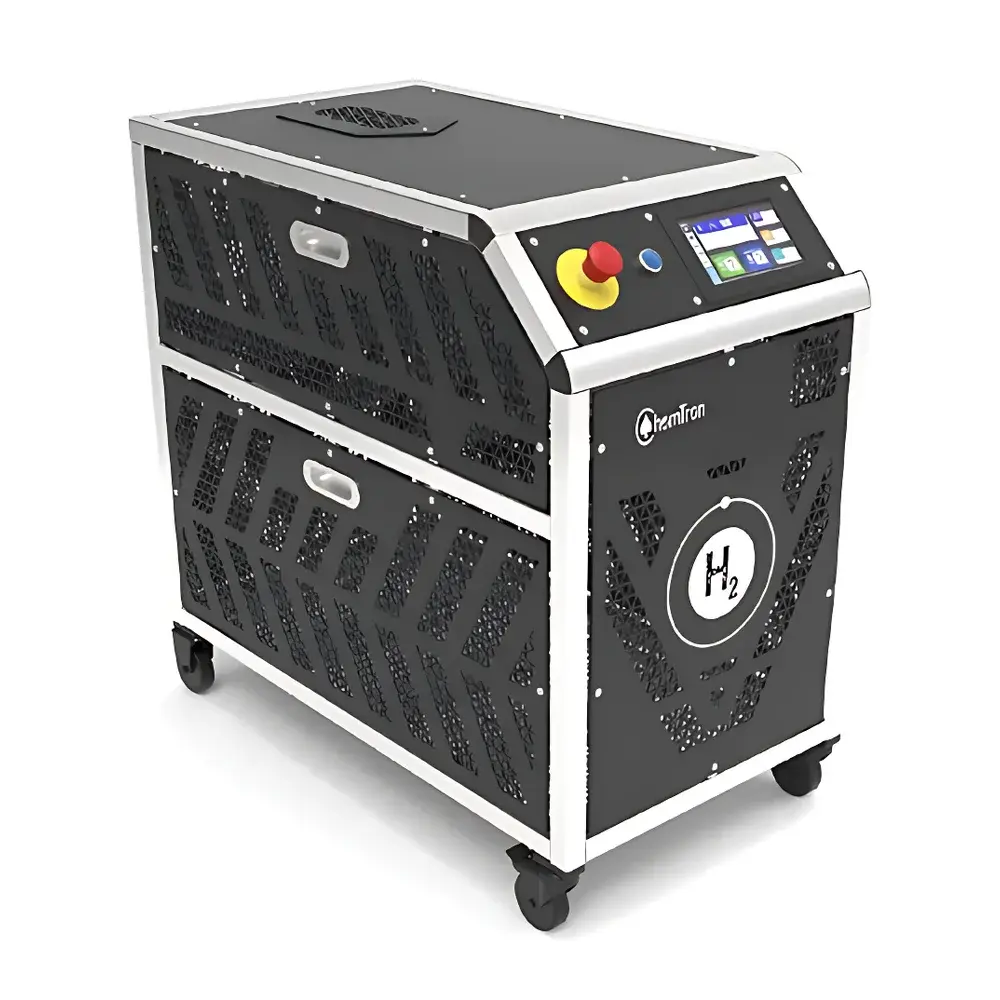
ChemTron HV Expert High-Flow Ultra-High-Purity Hydrogen Generator
| Brand | ChemTron |
|---|---|
| Origin | Germany |
| Model | HV |
| Hydrogen Generation Principle | Proton Exchange Membrane (PEM) Electrolysis of Deionized Water |
| Output Pressure | 1.0–20 bar (15–290 psi) |
| Hydrogen Purity | 99.9999% (with PSA), 99.95% (without PSA) |
| Dew Point | −78°C (with PSA), −30°C (without PSA) |
| Feed Water Conductivity Requirement | <1 µS/cm (ASTM Type I), recommended <0.2 µS/cm (ASTM Type III) |
| Power Consumption | 1.7–6.4 kW |
| Dimensions (W×H×D) | 496×846×880 mm |
| Weight | 109–190 kg |
| Operating Temperature | 10–35°C |
| Noise Level | <72 dB(A) |
| Ingress Protection | IP20 |
| Communication Interface | RS-232 / Ethernet (optional) |
Overview
The ChemTron HV Expert High-Flow Ultra-High-Purity Hydrogen Generator is an engineered solution for laboratories requiring continuous, on-demand hydrogen supply at industrial-grade flow rates and analytical-grade purity. It employs a solid polymer electrolyte (SPE) architecture—commonly referred to as CPEM (Catalyst-Coated Proton Exchange Membrane)—to electrolyze ultrapure deionized water without alkaline electrolytes or consumable drying agents. Unlike traditional KOH-based systems, the HV series utilizes platinum- and platinum-iridium-coated membrane electrodes housed in corrosion-resistant, all-metal CCELL electrolytic cells, ensuring long-term electrochemical stability and eliminating metallic leaching or organic contamination pathways. The system integrates three-stage purification: primary PEM-selective separation, secondary cryo-drying, and tertiary dual-bed cold-regenerative adsorption—enabling certified hydrogen purity of ≥99.9995% (v/v), validated per ISO 8573-1 Class 1:1:1 for gaseous contaminants (O₂, H₂O, total hydrocarbons). Designed for integration with gas chromatography (GC), fuel cell testing, and catalytic research platforms, the HV generator operates continuously under GLP-compliant conditions and meets CE marking requirements for electrical safety and electromagnetic compatibility.
Key Features
- True high-purity hydrogen generation: 99.9999% (v/v) with integrated pressure swing adsorption (PSA), independently verified by third-party certification against ISO 8573-1 Annex B protocols
- CCELL electrolyzer core constructed entirely from high-grade stainless alloys—no polymeric seals or elastomers in wetted paths—to prevent outgassing and maintain trace-level purity integrity
- FPGA-based real-time safety architecture with 12 independent fault detection channels, including H₂ concentration monitoring in ambient air, seismic/vibration shutdown, dual-pressure leak detection (internal/external), and conductivity-controlled feedwater interlock
- Intelligent cold-regenerative purification system replacing palladium-based purifiers—eliminates hydrogen embrittlement risk and extends service life beyond 15,000 operating hours
- 7-inch capacitive touchscreen interface with multilingual support, displaying live parameters (flow rate, pressure, dew point, cell voltage, coolant temperature), event logs, and predictive maintenance alerts
- Modular scalability across four capacity tiers (HV4.5 to HV18), each calibrated to deliver stable flow within ±1.5% of setpoint across full pressure range (1–20 bar)
Sample Compatibility & Compliance
The HV generator is compatible with all major GC manufacturers’ carrier gas specifications—including Agilent, Thermo Fisher, Shimadzu, and PerkinElmer—meeting ASTM D6299 and USP requirements for hydrogen carrier gas in chromatographic analysis. Its output complies with ISO 8573-1:2010 Class 1 for particulate content, Class 1 for water, and Class 1 for oil aerosols when equipped with PSA. All firmware and operational logic adhere to IEC 61508 SIL 2 functional safety principles. Full audit trail capability—including user access logs, parameter change history, and alarm timestamps—is available for FDA 21 CFR Part 11 compliance when paired with optional secure network configuration. CE marking covers Directive 2014/30/EU (EMC), 2014/35/EU (LVD), and 2012/19/EU (WEEE).
Software & Data Management
The embedded control firmware supports remote monitoring via Ethernet or RS-232, enabling integration into centralized laboratory infrastructure management (LIMS) platforms. Data export formats include CSV and XML, with timestamped records for flow, pressure, purity verification cycles, and safety event triggers. Firmware updates are delivered through encrypted OTA (over-the-air) channels with SHA-256 signature validation. Optional ChemTron Remote Service Portal provides secure, read-only access for certified engineers to perform diagnostics, calibration verification, and predictive analytics—fully compliant with ISO/IEC 27001 information security standards.
Applications
- Carrier gas for capillary GC and GC-MS systems requiring ultra-low O₂ (<10 ppb) and moisture (<0.1 ppmv) content
- Fuel cell stack testing and catalyst evaluation under controlled H₂ partial pressures up to 20 bar
- Hydrogenation reaction monitoring in pharmaceutical process development labs
- Reference gas supply for FTIR and Raman spectroscopy calibration
- On-site hydrogen sourcing for semiconductor annealing and thin-film deposition pilot lines
- Continuous operation in fragrance & flavor analysis labs where volatile organic interference must be excluded from gas streams
FAQ
Does the HV generator require periodic electrolyte replacement or KOH refilling?
No. It uses only deionized water as feedstock; no caustic electrolytes, chemical scrubbers, or desiccants are consumed during operation.
Can the system be integrated with an existing lab pure water network?
Yes—equipped with automated feedwater control valves and conductivity sensors, it accepts inlet pressure between 0.5–4 bar and dynamically regulates intake based on real-time demand and resistivity feedback.
What maintenance intervals are recommended for the cold-regenerative purifier?
The dual-bed adsorbent system is designed for regeneration over >10,000 cycles; routine inspection is scheduled annually, with full cartridge replacement recommended every 36 months under continuous 24/7 operation.
Is external cooling water required for thermal management?
No. All heat dissipation is handled passively via convection and internal aluminum heat sinks; ambient air circulation at ≥150 L/min is sufficient for rated load.
How is hydrogen purity validated during operation?
Real-time purity assurance is achieved through redundant electrochemical O₂ sensors (dual-channel redundancy) and scheduled automated purity verification cycles per ISO 8573-8 Annex D, generating PDF reports with digital signatures.



