
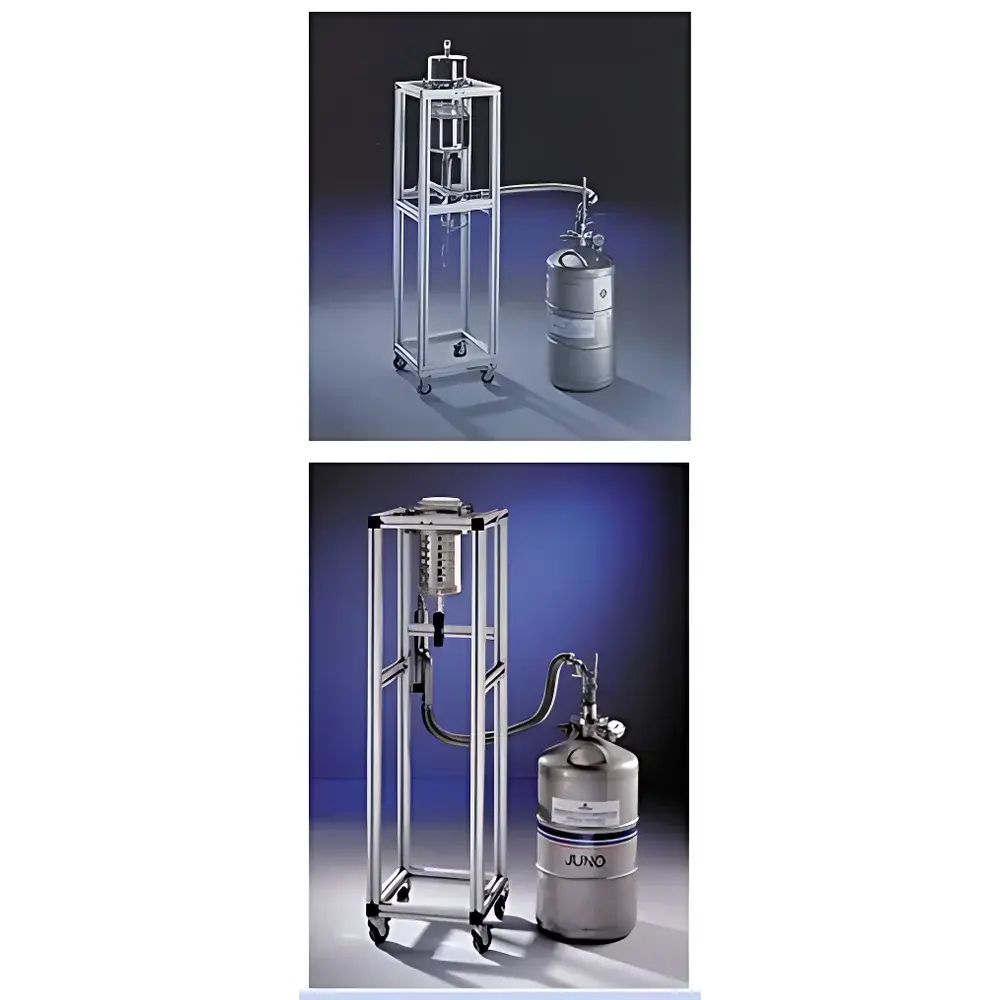
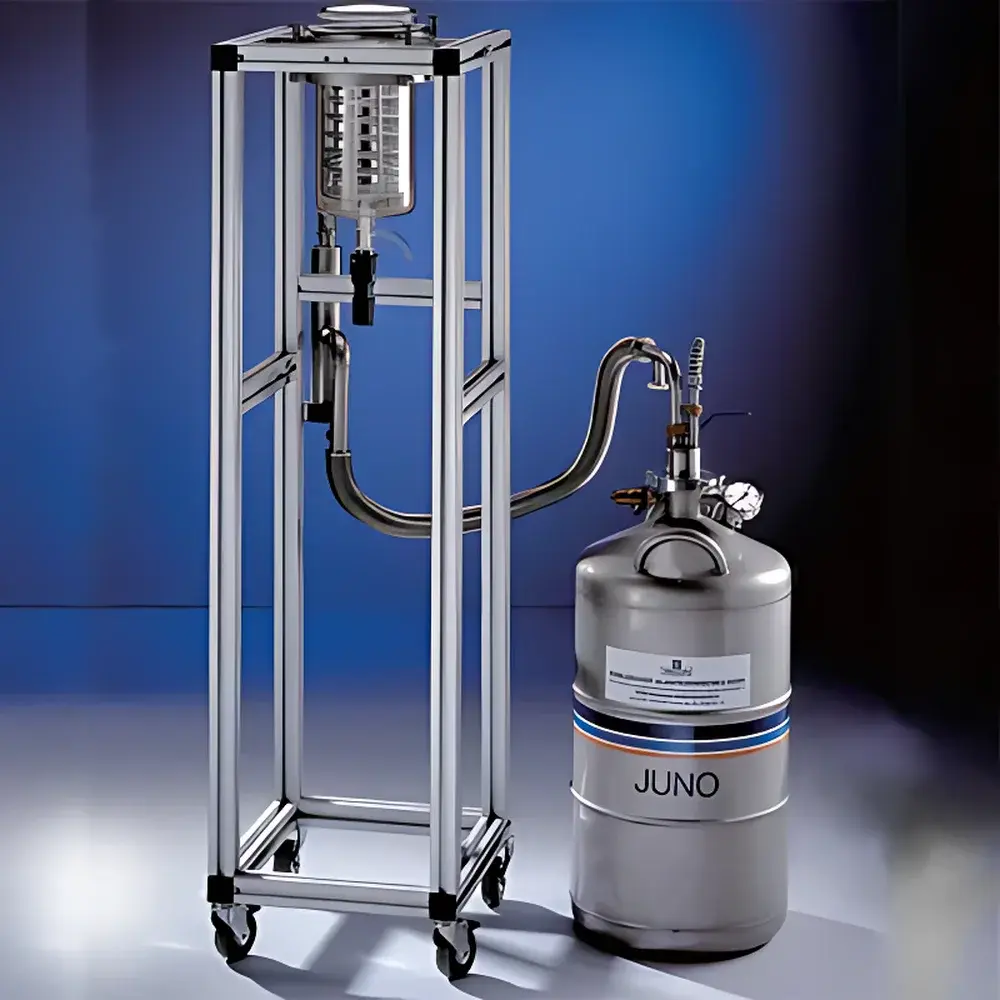
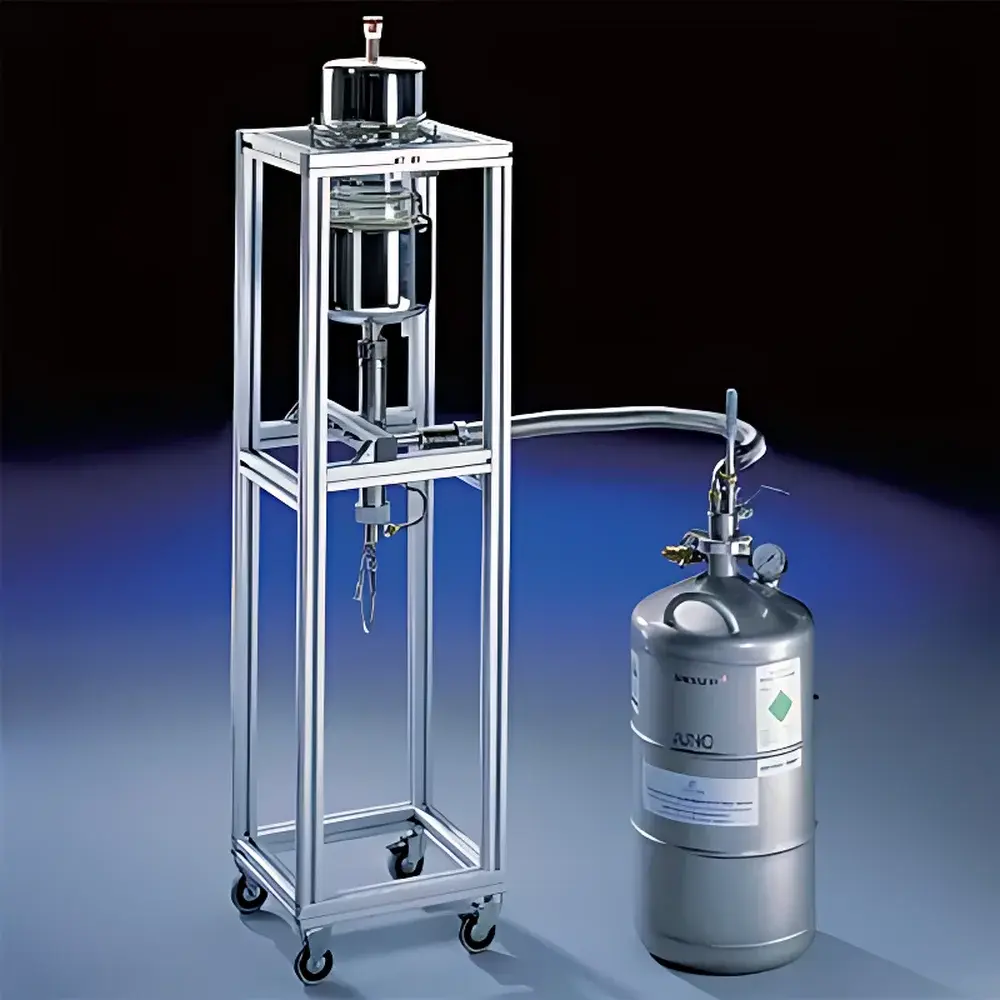
ChemTron KALTGAS TG-RD Ultra-Low-Temperature Reaction System
| Brand | ChemTron |
|---|---|
| Origin | Germany |
| Model | KALTGAS TG-RD |
| Vessel Capacity | 2 L (1.5 L usable) |
| Temperature Range | −170 °C to +120 °C |
| Temperature Stability | ±0.1 °C |
| Cooling Medium | Liquid Nitrogen (LN₂) |
| LN₂ Consumption | 2.2–22 L/h |
| Vaporization Heater Power | 500 W |
| Heating Power | 400 W |
| Pressure Rating | High-Pressure Compatible |
| Construction Materials | V2A Stainless Steel Tubing (1.5 m flexible), Aluminum Frame |
| Interface | KF NW 50 LN₂ Tank Connection |
| Compliance | Designed for GLP/GMP-aligned lab environments, compatible with ASTM E2869 and ISO 17025 traceability frameworks |
Overview
The ChemTron KALTGAS TG-RD Ultra-Low-Temperature Reaction System is an engineered solution for precise, dynamic thermal control in synthetic chemistry, organometallic catalysis, and low-temperature process development. Unlike conventional compressor-based cryogenic systems, the KALTGAS TG-RD employs direct-phase nitrogen gas cooling—leveraging controlled vaporization of liquid nitrogen (LN₂) to generate a stable, ultra-low-temperature gas stream capable of reaching −170 °C within minutes. This principle relies on rapid heat exchange between gaseous nitrogen and the reaction medium, enabling significantly faster cooldown rates and finer thermal resolution than mechanical refrigeration. The system integrates three proprietary subsystems: a pressure-regulated LN₂ siphon vaporizer, an intelligent flow-controlled gas distribution module, and the ICC (Intelligent Cryo Control) digital temperature regulation architecture. These components collectively ensure reproducible thermal profiles under both open-batch and sealed high-pressure reactor conditions.
Key Features
- Vacuum-insulated 2 L double-walled reactor vessel with integrated sight strip for real-time visual monitoring of phase behavior and crystallization events
- Dual cooling configurations: jacketed cooling for uniform external heat transfer, and internal coil cooling for enhanced mixing-integrated thermal response
- ICC digital temperature controller with PID tuning, real-time deviation logging, and ±0.1 °C stability across the full operating range (−170 °C to +120 °C)
- 500 W electrically heated vaporizer with precision mass-flow regulation ensures consistent N₂ gas temperature and flow rate (2.2–22 L/h, adjustable per process demand)
- High-integrity V2A stainless steel flexible cryo-line (1.5 m, KF NW 50 interface) rated for vacuum service and compatible with standard 20–300 L dewars
- Aluminum support frame with modular NS 29/32 ports (3 total: central + dual lateral) for auxiliary sensors, dosing lines, or inert gas purging
Sample Compatibility & Compliance
The KALTGAS TG-RD accommodates heterogeneous, viscous, and precipitating reaction mixtures typical in Grignard, lithiation, and cryo-photoredox applications. Its high-pressure-rated construction supports operation under inert atmosphere (N₂ or Ar) up to 10 bar(g), with optional pressure-sensing integration. All wetted surfaces are electropolished V2A stainless steel or borosilicate glass—ensuring compatibility with strong bases, organolithium reagents, and halogenated solvents. The system adheres to fundamental design principles aligned with ISO 17025 calibration traceability requirements and supports audit-ready documentation for GLP-compliant synthesis workflows. While not certified as intrinsically safe, it incorporates redundant overpressure venting, LN₂ flow interlocks, and automatic shutoff upon temperature excursion beyond user-defined thresholds—meeting essential risk-mitigation expectations for Class I, Division 2 laboratory environments.
Software & Data Management
The ICC controller provides native RS485/Modbus RTU communication for integration into centralized lab automation platforms (e.g., DeltaV, LabArchives, or custom SCADA). Logged parameters—including setpoint, actual vessel temperature, LN₂ flow rate, vaporizer power draw, and elapsed cooldown time—are timestamped with millisecond resolution and exportable in CSV or XML format. Audit trails retain operator ID, parameter changes, and system alarms in accordance with FDA 21 CFR Part 11–compatible data integrity guidelines when deployed with validated electronic signature modules. No cloud dependency: all data resides locally on the controller’s non-volatile memory with optional USB dump functionality.
Applications
- Kinetic studies of highly exothermic metal-halogen exchange reactions requiring sub−78 °C initiation
- Controlled crystallization of chiral intermediates where nucleation onset is sensitive to thermal ramp rate (±0.05 °C/min)
- Stabilization of reactive carbenes and nitrenes under continuous cryo-flow conditions
- Low-temperature hydrogenation screening using pyrophoric catalysts (e.g., Ni(0)/NHC complexes)
- Process safety testing (RC1e-style) under ultra-low thermal inertia conditions
- In situ FTIR or Raman sampling via standardized NS 29/32 optical ports
FAQ
What is the minimum achievable temperature with the KALTGAS TG-RD, and how quickly is it reached?
The system achieves −170 °C at the reactor wall within 3–5 minutes from ambient, verified using calibrated Pt100 sensors traceable to NIST standards.
Can the system operate under positive pressure while maintaining cryogenic temperatures?
Yes—the vessel is rated for sustained operation up to 10 bar(g) with appropriate pressure relief configuration; cooling performance remains unaffected under pressurized inert gas blanket.
Is remote monitoring supported, and what protocols are available?
RS485 Modbus RTU is standard; Ethernet/IP or OPC UA gateways may be added via third-party interface modules.
How is liquid nitrogen consumption optimized during extended runs?
The ICC controller dynamically modulates vaporizer power and N₂ flow based on real-time thermal load feedback, reducing average consumption by up to 35% compared to fixed-flow systems.
Are validation documents (IQ/OQ) provided with the system?
Factory-verified IQ/OQ templates compliant with ISO 17025 and ASTM E2500 are supplied; site-specific execution requires qualified personnel and calibrated metrology assets.



