
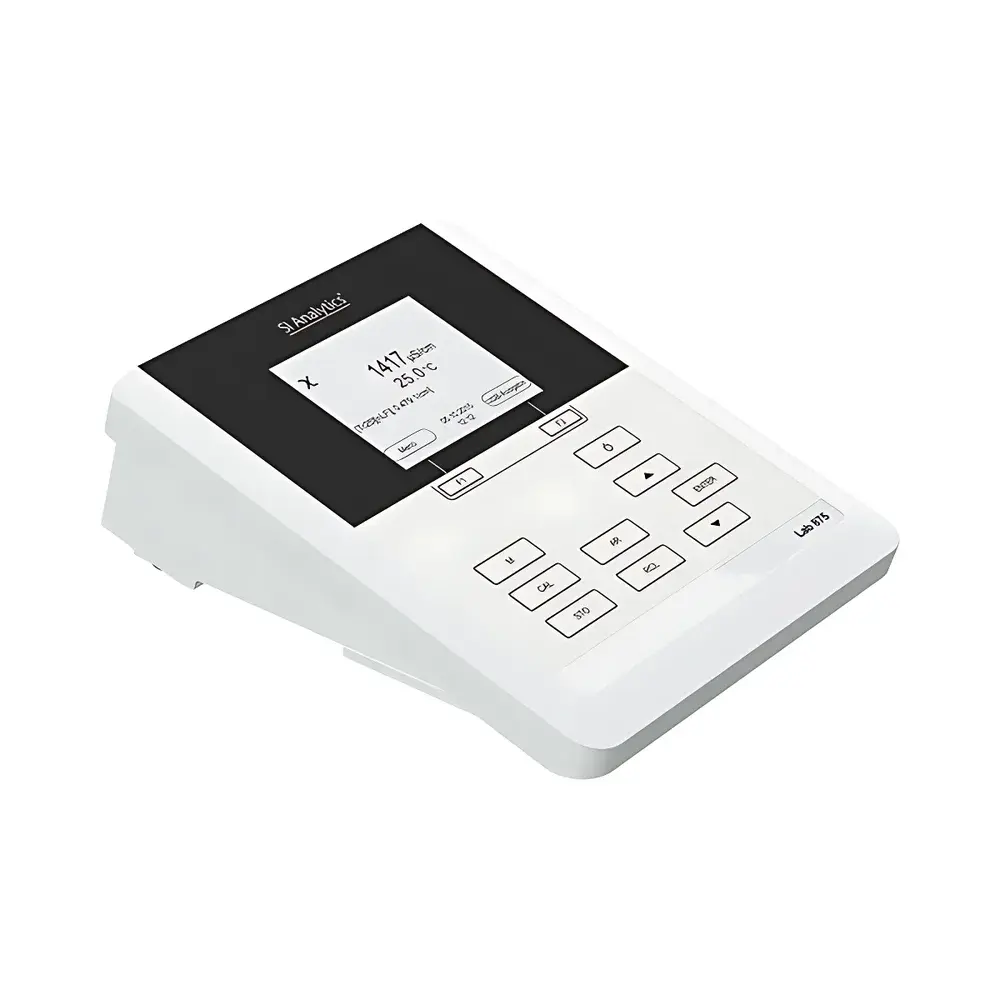
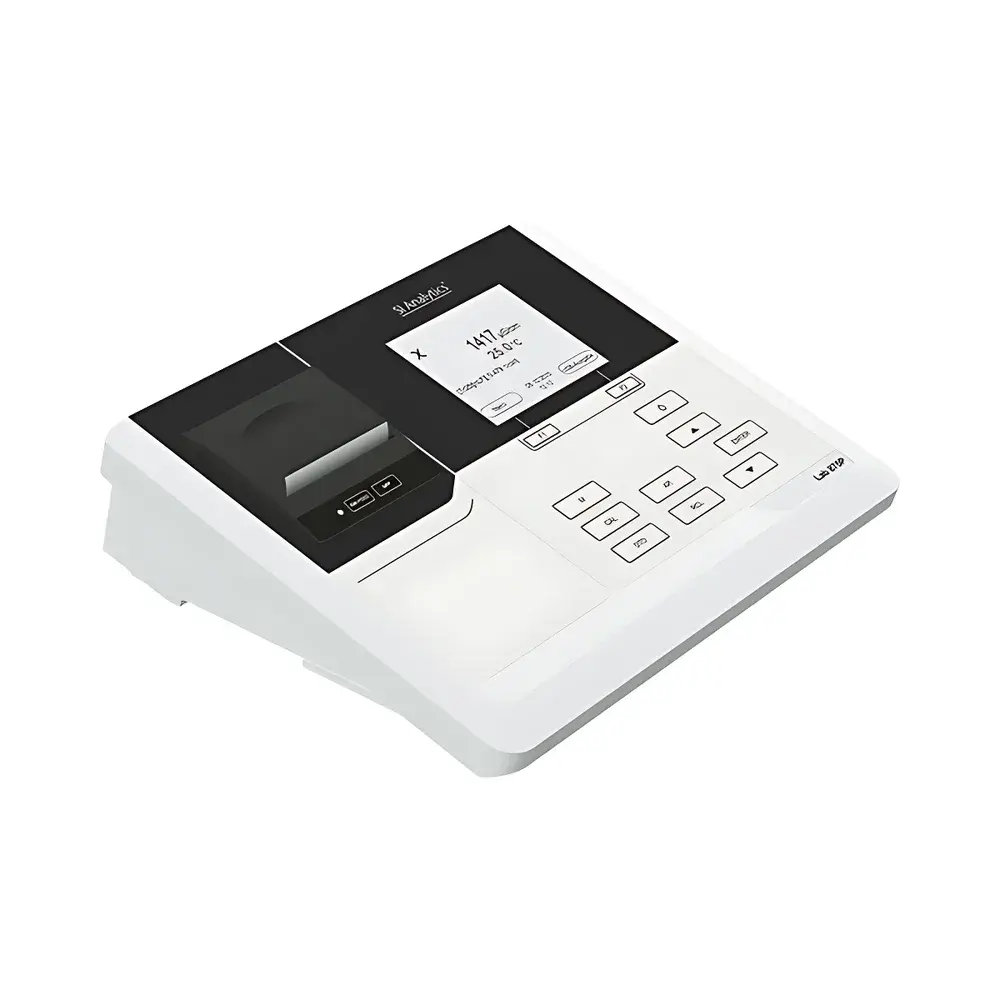
ChemTron Lab 875 / Lab 875P Benchtop Multi-Parameter Analyzer
| Brand | ChemTron |
|---|---|
| Origin | Germany |
| Model | Lab 875 / Lab 875P |
| Measurement Parameters | pH, mV, Dissolved Oxygen (DO) Saturation & Concentration & Partial Pressure, Conductivity, Resistivity, Salinity, TDS, Temperature |
| Electrode Compatibility | IDS (Intelligent Digital Sensor) electrodes |
| pH Calibration Points | 1–5 |
| DO Calibration | 1-point (air saturation or zero) |
| Conductivity Calibration | 1-point |
| Calibration Records Stored | ≤10 sets |
| Calibration Timer | 1–999 days |
| Data Storage | 500 manual + 4,500 automatic entries |
| Temperature Compensation | Automatic for all parameters except ORP |
| GLP/AQS Compliance | Yes |
| Printer Support | External printer (Lab 875P includes integrated thermal printer) |
| Communication Interface | Mini USB-B |
| Power Supply | 4 × 1.5 V AA batteries or AC adapter |
| Additional Features | CMC (Continuous Measurement Control), QSC (Quick Sensor Check) |
| Software Export Format | CSV |
Overview
The ChemTron Lab 875 and Lab 875P are precision-engineered benchtop multi-parameter analyzers designed for routine and regulated laboratory environments requiring high data integrity, traceability, and operational flexibility. Built upon ChemTron’s Intelligent Digital Sensor (IDS) platform, these instruments employ digital electrode communication to eliminate analog signal drift, ensure stable calibration retention, and enable plug-and-play sensor identification. The Lab 875 operates as a standalone analyzer with full USB connectivity and GLP/AQS-compliant data handling, while the Lab 875P integrates a built-in thermal printer for immediate hardcopy generation of measurements, calibrations, and audit trails—critical for quality control labs operating under ISO/IEC 17025, USP , or pharmaceutical GMP frameworks. Both models implement dual-mode temperature compensation (ATC and manual offset), support standardized calibration protocols per DIN EN ISO 17025, and utilize robust firmware architecture to maintain measurement stability across variable ambient conditions.
Key Features
- Digital IDS electrode interface ensuring automatic sensor recognition, serial number logging, and embedded calibration history retrieval
- Comprehensive parameter coverage: pH (0.00–14.00, ±0.01 resolution), redox potential (±1999.9 mV), dissolved oxygen (0.00–20.00 mg/L, % saturation, kPa partial pressure), conductivity (0.00 µS/cm–2000 mS/cm), resistivity (0.00 Ω·cm–100 MΩ·cm), salinity (0.00–80.00 ppt), TDS (0.00–1999.9 ppm), and temperature (−5.0 to 105.0 °C)
- GLP/AQS-compliant data management with time-stamped, user-logged entries, electronic signature support via password-protected user roles, and immutable calibration record storage (up to 10 sets)
- Extended memory capacity: 500 manually triggered readings plus 4,500 automatically logged entries with configurable interval timing (1 s–24 h)
- CMC (Continuous Measurement Control) function for real-time stability monitoring and automatic endpoint detection during titration-like protocols
- QSC (Quick Sensor Check) diagnostic mode verifying electrode response time, asymmetry potential, and reference junction integrity prior to calibration
- Mini USB-B interface enabling direct export of raw datasets in native CSV format compatible with LIMS, Excel, and statistical process control (SPC) software
Sample Compatibility & Compliance
The Lab 875/875P supports aqueous and mildly aggressive samples typical of environmental monitoring, wastewater treatment, beverage QA, and pharmaceutical water system validation (PW, WFI, Purified Water). IDS electrodes—including pH, ORP, DO, and conductivity variants—are certified to IP67 and rated for continuous immersion up to 1 bar. Conventional analog electrodes may be used with the optional Z600 IDS adapter, preserving legacy investment while enabling digital metadata capture. All instrument firmware and data structures comply with EU Annex 11 (Computerized Systems), FDA 21 CFR Part 11 (electronic records/signatures), and ISO/IEC 17025:2017 clause 7.7 (result reporting). Audit trails include operator ID, timestamp, parameter value, unit, electrode ID, calibration status, and environmental temperature at time of measurement.
Software & Data Management
No proprietary software installation is required: exported CSV files contain structured columns for Date, Time, Parameter, Value, Unit, Electrode ID, Operator ID, Calibration Status, and Temperature. Each entry is cryptographically timestamped using internal RTC with battery-backed memory. User administration supports up to 10 configurable roles (e.g., Analyst, Supervisor, QA Auditor) with hierarchical access rights to calibration functions, data deletion, and report printing. The Lab 875P’s integrated thermal printer generates tamper-evident reports including header metadata (instrument SN, firmware version), calibration certificates (with slope/mV, offset, ISFET drift), and raw measurement sequences—all formatted to meet internal SOPs and external auditor requirements.
Applications
- Pharmaceutical water system qualification (USP , EP 2.2.42): simultaneous monitoring of conductivity, TOC-correlated resistivity, and temperature gradients
- Environmental field lab analysis: DO profiling in wastewater effluent, salinity mapping in estuarine studies, and pH stability assessment in acid mine drainage
- Food & beverage QC: TDS verification in brine solutions, redox potential tracking during fermentation, and conductivity-based sugar concentration estimation
- Academic research labs: multi-parameter kinetic studies requiring synchronized acquisition across pH, DO, and conductivity channels
- Calibration laboratories: accredited verification of electrode performance per ISO 17025 technical scope using traceable standards and documented uncertainty budgets
FAQ
Does the Lab 875P support direct connection to laboratory information management systems (LIMS)?
Yes—via USB mass storage mode, exported CSV files can be ingested into LIMS platforms supporting flat-file import protocols without middleware.
Can calibration data be exported separately from measurement logs?
Yes—calibration records are stored independently and may be exported as discrete CSV files containing date, electrode ID, standard values, measured responses, slopes, offsets, and pass/fail flags per ISO 17025 clause 7.8.3.
Is temperature compensation applied during ORP measurement?
No—ORP is reported as raw millivolt output per ASTM D1129; temperature compensation is intentionally disabled to preserve thermodynamic comparability across laboratories.
What is the battery life under typical usage conditions?
With alkaline AA cells and 15-minute auto-off enabled, average runtime exceeds 200 hours; low-battery warning activates at 1.1 V per cell with graceful shutdown preserving unsaved data.
Are firmware updates available, and how are they deployed?
Firmware revisions are distributed as signed .bin files via ChemTron’s secure customer portal and installed via USB without external programming hardware.




