
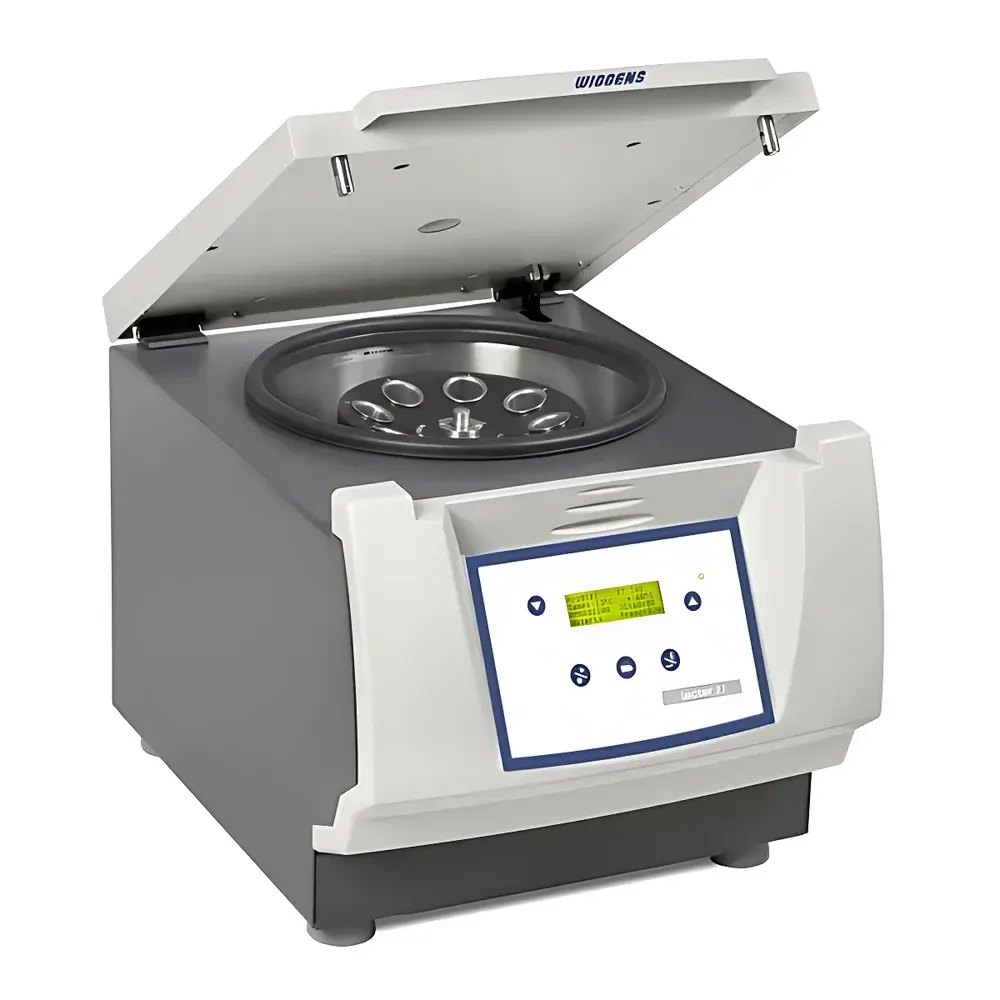
ChemTron Lacter21 Gerber-Method Milk Fat Centrifuge
| Brand | ChemTron |
|---|---|
| Origin | Germany |
| Model | Lacter21 |
| Instrument Type | Benchtop Low-Speed Centrifuge |
| Maximum Speed | 1200 rpm |
| Max RCF | 224 ×g |
| Capacity | 8 or 12 Gerber fat-testing tubes (Ø25 × 212 mm) |
| Dimensions (W × D × H) | 365 × 300 × 450 mm |
| Net Weight | 77 kg |
| Power Supply | 220–230 V, 50–60 Hz |
| Heating Range | Ambient to 80 °C |
| Noise Level | <60 dB(A) |
| Compliance | EN 61010-1, EN 61010-2-020, EN 61326-1, EN 61326-2-6, EN 61010-2-010 |
| Rotor Material | Stainless Steel (autoclavable) |
| Motor | Brushless, Maintenance-Free |
| Control | Microprocessor-based with LCD display (RPM/RCF, time, temperature), 16 programmable methods, PCBS acceleration/deceleration profiling (175 slope options) |
Overview
The ChemTron Lacter21 is a purpose-engineered benchtop centrifuge designed exclusively for standardized fat determination in dairy products according to the internationally recognized Gerber method (ISO 1211:2010, IDF 1a:2010, AOAC 920.119). Unlike general-purpose low-speed centrifuges, the Lacter21 integrates precise thermal control, calibrated angular rotor geometry, and optimized acceleration/deceleration profiles to ensure reproducible phase separation of milk fat from aqueous and protein phases. Its operation relies on sedimentation kinetics under controlled gravitational force (224 ×g at 1200 rpm) combined with maintained temperature (up to 80 °C) to liquefy fat globules and reduce interfacial tension—critical prerequisites for accurate volumetric fat quantification in Gerber tubes. The instrument meets essential safety and electromagnetic compatibility requirements for laboratory use in regulated environments, including compliance with EN 61010-1 for electrical safety and EN 61326-1 for measurement equipment in industrial settings.
Key Features
- Integrated heating system (ambient to 80 °C) enabling consistent fat liquefaction during centrifugation—eliminating manual water-bath preheating steps and minimizing operator variability.
- Dual interchangeable fixed-angle rotors (RT240: 8-place; RT241: 12-place), both with 20° tilt and identical radius (139 mm), ensuring identical RCF (224 ×g) and sedimentation path length across all tube positions.
- Progressive Control Braking System (PCBS) with 175 selectable acceleration/deceleration slopes—prevents remixing of separated fat layers by eliminating abrupt mechanical shock during spin-down.
- LCD interface displaying real-time RPM, RCF, elapsed time, remaining time, and temperature; programmable timer (1–99 min, 5-sec increments) with forward/backward counting modes.
- Brushless DC motor with rotor auto-recognition, speed regulation in 50 rpm / 50 ×g increments, and in-run parameter adjustment without stopping.
- Comprehensive safety architecture: automatic mechanical lid lock, emergency manual release, anti-drop lid guard, transparent viewing window, imbalance detection with immediate shutdown, and double-walled stainless-steel chamber with thermal insulation.
- Autoclavable stainless-steel rotors and adapters (121 °C, 15–20 min); smooth interior surfaces facilitate GLP-compliant cleaning and residue verification.
Sample Compatibility & Compliance
The Lacter21 accepts standard Gerber fat-testing tubes (maximum Ø25 × 212 mm), compatible with raw milk, pasteurized milk, cream, butter, yogurt, cheese whey, and fermented dairy products. Its performance aligns with ISO 1211 (Milk — Determination of fat content — Gerber gravimetric method), as well as national adaptations including DIN 10121 and AFNOR V04-101. All electrical and functional safety certifications—including CE marking under Directive 98/79/EC (IVDR-relevant for in vitro diagnostic use in quality control labs)—support deployment in accredited dairy testing laboratories operating under ISO/IEC 17025. The device’s design facilitates audit readiness for GMP and GLP environments, with non-volatile memory storing last-used parameters and full operational logging capability via optional RS232 or USB data export.
Software & Data Management
While the Lacter21 operates via embedded microcontroller without external software dependency, its 16-user-programmable methods support method traceability and repeatable execution across shifts. Each program stores setpoints for speed, time, temperature, acceleration slope, and braking profile—enabling strict adherence to SOPs. Optional serial communication (RS232) allows integration into LIMS or QC data archiving systems for electronic record retention compliant with FDA 21 CFR Part 11 when paired with validated third-party software. Audit trails—including start/stop timestamps, rotor ID, final RCF, and thermal deviation alerts—are retained in volatile memory and can be manually exported or visually verified on-screen.
Applications
- Routine fat quantification in dairy processing plants (incoming raw milk, intermediate blends, finished products).
- Quality assurance in cheese and butter manufacturing, where precise fat-in-dry-matter (FDM) ratios govern yield and texture consistency.
- Regulatory compliance testing for labeling accuracy (e.g., “4% milkfat”) per EU Regulation (EU) No 1169/2011 and US FDA 21 CFR §101.9.
- Research applications involving lipid phase behavior under controlled thermal-centrifugal stress, including studies on homogenization efficiency and fat globule aggregation kinetics.
- Training and education in food science curricula requiring hands-on instruction in standardized AOAC and ISO dairy analysis protocols.
FAQ
What standards does the Lacter21 comply with for dairy fat testing?
It conforms to ISO 1211:2010, IDF 1a:2010, AOAC 920.119, and national equivalents (DIN 10121, AFNOR V04-101), with full electrical safety certification per EN 61010-1 and EMC compliance per EN 61326-1.
Can the Lacter21 be used for non-dairy samples?
It is specifically engineered for Gerber-format tubes and dairy matrices; non-standard viscosities, densities, or particulate loads may compromise separation fidelity and are not validated.
Is rotor autoclaving supported?
Yes—both RT240 and RT241 rotors and adapters are constructed from AISI 304 stainless steel and rated for steam sterilization at 121 °C for 15–20 minutes.
Does the instrument support 21 CFR Part 11 compliance?
The base unit provides audit-ready operational logs; full Part 11 compliance requires validated external software for electronic signatures and secure data archiving.
What maintenance is required for long-term reliability?
The brushless motor is maintenance-free; routine tasks include weekly chamber wipe-down with ethanol, quarterly inspection of lid lock mechanism, and annual calibration verification of temperature and speed sensors by authorized service personnel.



