
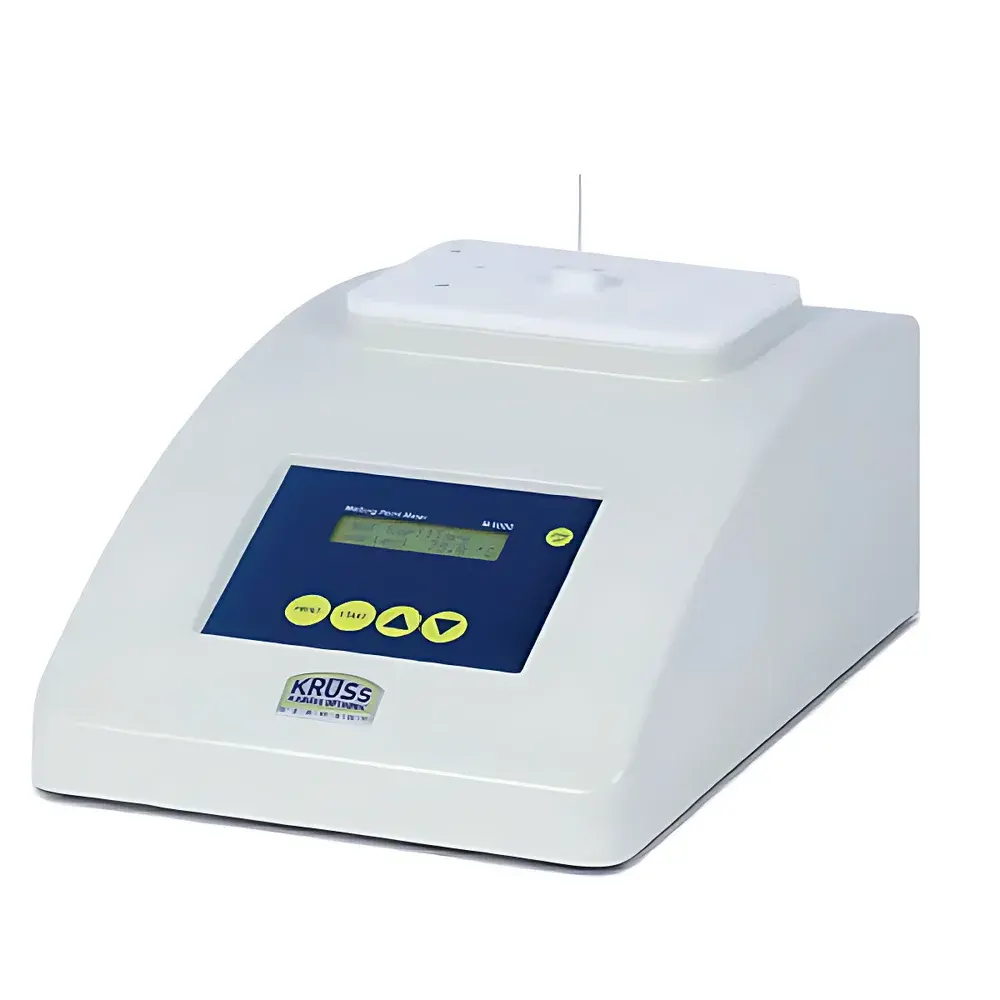
ChemTron M5000 Automated Melting Point Apparatus
| Brand | ChemTron |
|---|---|
| Origin | Germany |
| Model | M5000 |
| Temperature Range | 25–400 °C |
| Heating Time to 300 °C | 4 min |
| Heating Time to 400 °C | 7.5 min |
| Temperature Repeatability | ±0.2 °C |
| Temperature Accuracy | ±0.3 °C (25–200 °C), ±0.5 °C (200–400 °C) |
| Capillary Diameter | 1.4 mm |
| Capillary Measurement Port | 1 |
| Interface | RS232 |
| Ingress Protection Rating | IP20 |
| Power Supply | 85–264 V AC, 47–440 Hz |
| Dimensions (L×W×H) | 230 × 210 × 110 mm |
| Weight | 1.8 kg |
Overview
The ChemTron M5000 Automated Melting Point Apparatus is a precision thermal analysis instrument engineered for reliable, operator-independent determination of melting points in solid organic compounds and pharmaceutical intermediates. It employs the standardized capillary tube method—compliant with pharmacopoeial requirements including USP <741>, EP 2.2.17, and JP 2.60—wherein a tightly packed sample is sealed in a thin-walled glass capillary and subjected to a controlled linear heating ramp. Real-time optical detection via transmitted light monitors the onset and completion of phase transition, automatically identifying both the initial softening (onset) and complete liquefaction (clear point) temperatures. Designed for routine QC laboratories, R&D facilities, and academic teaching environments, the M5000 delivers traceable, auditable results without manual visual interpretation—eliminating observer bias and inter-operator variability.
Key Features
- Automated optical endpoint detection using high-contrast backlighting and digital image processing for unambiguous melt transition identification
- Programmable heating rate control with fine resolution (0.1 °C increments), enabling method-specific ramp profiles per pharmacopoeial monographs
- Integrated forced-air cooling system reduces cooldown time between measurements, supporting throughput of up to 12 samples per hour under standard operating conditions
- Sealed membrane keypad resistant to solvent splashes and powder residue, facilitating rapid decontamination in regulated lab environments
- Single-capillary measurement port with precision-aligned optical path ensures consistent illumination geometry and minimizes parallax error
- Robust aluminum chassis and thermally stabilized heating block provide long-term calibration stability and mechanical durability
- Comprehensive safety architecture: overtemperature cutoff, thermal fuse redundancy, and IP20-rated enclosure compliant with IEC 61010-1 for laboratory equipment
Sample Compatibility & Compliance
The M5000 accommodates crystalline or powdered organic solids with melting points up to 400 °C, including APIs, excipients, polymers, dyes, and fine chemicals. Samples must be loaded into standard 1.4 mm outer-diameter capillaries (length ≤100 mm), with optimal fill height of 3–5 mm. The instrument supports full compliance with GLP and GMP documentation workflows: all measurements are timestamped, user-ID logged, and raw optical data retained internally. Optional RS232 interface enables direct connection to validated printers (e.g., CBM910 series) for 21 CFR Part 11–compliant hardcopy output with audit trail metadata. Certified reference materials—including USP-grade vanillin (81–83 °C), benzoic acid (133–136 °C), sulfanilamide (164–166 °C), and caffeine (234–236.5 °C)—are available for daily system suitability verification and periodic recalibration.
Software & Data Management
While the M5000 operates as a standalone benchtop unit with embedded firmware, its RS232 serial interface allows integration into centralized LIMS or ELN platforms via ASCII protocol. Each measurement record includes: date/time stamp, operator ID (manually entered), sample ID, start/stop temperatures, onset/clear point values, heating rate applied, and status flag (e.g., “PASS”, “REPEAT_REQUIRED”). No proprietary software installation is required; raw data export is compatible with common spreadsheet and statistical analysis tools. All internal memory retains ≥500 measurement histories with cyclic overwrite protection. Firmware updates are delivered via USB-to-serial adapter and follow ICH Q5A change control protocols for analytical instrumentation.
Applications
- Pharmaceutical quality control: identity testing and purity assessment of active pharmaceutical ingredients per USP/EP monographs
- Chemical synthesis validation: monitoring reaction progress and confirming product crystallinity in fine chemical manufacturing
- Academic instruction: hands-on training in thermal behavior, polymorphism screening, and phase diagram fundamentals
- Regulatory submission support: generation of GLP-compliant melting data for ANDA, NDA, and CMC sections
- Raw material release testing in food additives, cosmetic actives, and agrochemical formulations
- Stability-indicating method development for accelerated degradation studies
FAQ
What capillary specifications are required for optimal performance?
Standard 1.4 mm OD borosilicate glass capillaries (wall thickness ~0.1 mm) are mandatory. Capillaries must be cut cleanly and sealed at one end prior to sample loading.
Does the M5000 support multi-point calibration verification?
Yes—users may perform three-point verification using certified standards across low-, mid-, and high-range intervals (e.g., vanillin, benzoic acid, caffeine) and log deviations against factory calibration certificates.
Is the instrument suitable for measuring decomposition-prone compounds?
The M5000 is not designed for decomposition temperature analysis; it assumes sharp, reversible solid–liquid transitions. Compounds exhibiting charring or sublimation require complementary techniques such as TGA or DSC.
Can measurement data be exported to Excel or LIMS without third-party software?
Yes—ASCII-formatted data streams via RS232 are natively readable by Excel, Python pandas, or LIMS middleware with minimal parsing logic.
What maintenance is recommended for long-term accuracy?
Annual verification using traceable reference standards and optical alignment check of the backlight module are advised. No user-serviceable heating elements or sensors are present; field service is performed by authorized ChemTron technicians.



