
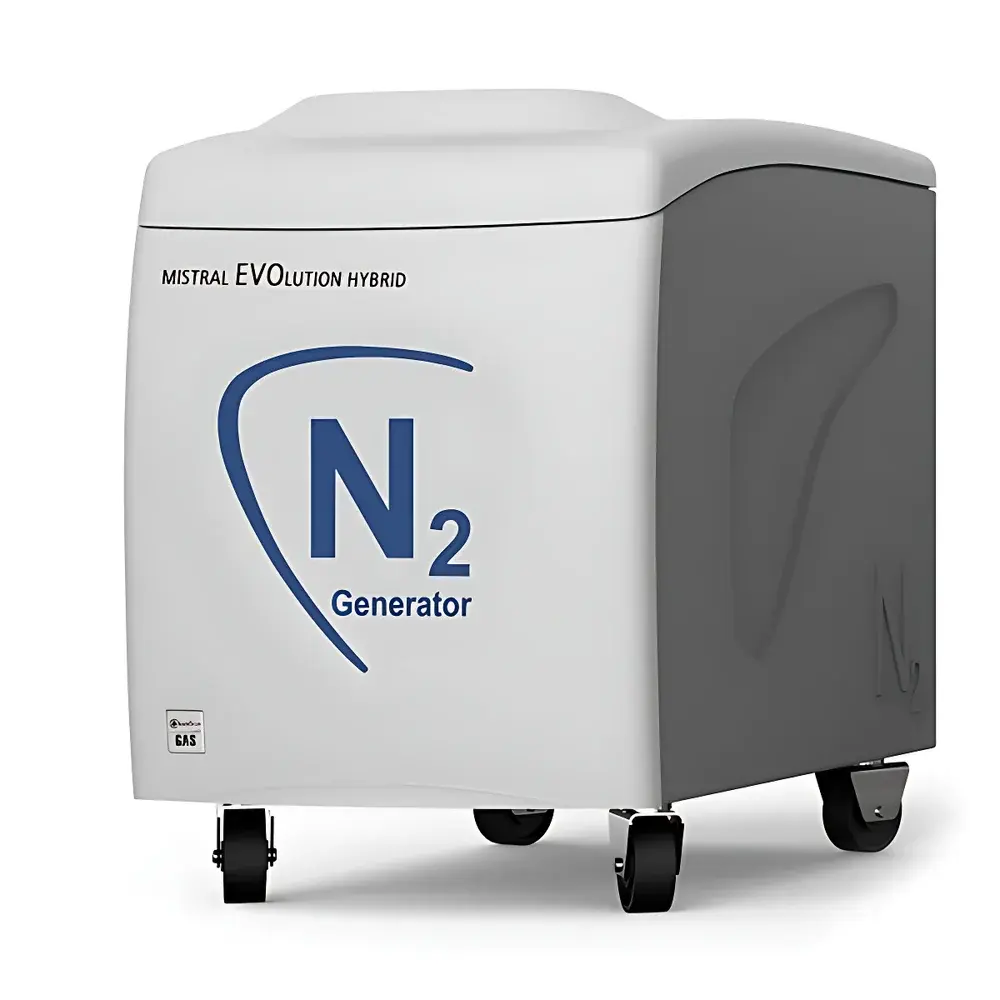
ChemTron MISTRAL EVO HYBRID Nitrogen-Air Combined Gas Generator
| Brand | ChemTron |
|---|---|
| Origin | Germany |
| Model | MISTRAL EVO HYBRID |
| Nitrogen Flow Rate | up to 12 L/min at 80 psi |
| Source Air Flow | up to 24 L/min at 100 psi |
| Exhaust Air Flow | up to 8 L/min at 60 psi |
| Nitrogen Purity | 98–99.9% |
| Dew Point | −40 °C |
| Operating Temperature | 15–35 °C |
| Power Supply | 110 V / 60 Hz or 230 V / 50 Hz |
| Power Consumption | 1800 W |
| Pressure Stability | ±0.5% (±0.1 bar) |
| Display | Graphical LCD (128 × 64 px) |
| Noise Level | 55 dB(A) |
| Protection Class | IP2X |
| Dimensions (L × D × H) | 482 × 835 × 641 mm |
| Weight | 90 kg |
| Certifications | CE |
| Output Fittings | 1/4" compression or 6 mm quick-connect |
Overview
The ChemTron MISTRAL EVO HYBRID Nitrogen-Air Combined Gas Generator is an engineered solution for laboratories requiring concurrent, on-demand supplies of high-purity nitrogen and instrument-grade compressed air—specifically optimized for demanding analytical applications such as AB SCIEX LC/MS systems. Unlike conventional single-gas generators, the MISTRAL EVO HYBRID integrates two parallel gas production pathways within a single compact chassis: one dedicated to nitrogen generation via dual-stage pressure swing adsorption (PSA), and the other delivering oil-free, particle- and moisture-controlled compressed air. The nitrogen module employs a proprietary Carbon Molecular Sieve (CMS) bed coupled with a pre-conditioning Compressed Air Purification System (CPSA) that removes oxygen, CO₂, and water vapor from ambient intake air. This multi-stage adsorption architecture ensures consistent output purity between 98% and 99.9%, with a certified dew point of −40 °C—meeting ISO 8573-1:2010 Class 2.2.2 requirements for compressed gases used in mass spectrometry. The system operates without liquid nitrogen, cryogenic components, or phthalate-containing materials, aligning with modern laboratory safety and regulatory expectations for trace-level analysis.
Key Features
- Dual-output architecture: Simultaneous, independent delivery of nitrogen (up to 12 L/min at 80 psi) and instrument air (up to 24 L/min at 100 psi), each with dedicated flow control and pressure regulation
- Integrated CPSA pre-filtration: Multi-stage coalescing, activated carbon, and desiccant filtration upstream of CMS beds ensures long-term sieve stability and minimizes maintenance intervals
- Real-time operational monitoring: Backlit graphical LCD (128 × 64 px) displays real-time N₂ pressure, flow rate, internal temperature, dew point status, and consumable life indicators
- Intelligent alarm management: Audible and visual alerts for pressure deviation (>±0.5%), temperature excursion (outside 15–35 °C), CMS saturation, and filter end-of-life—configured with relay outputs (250 VAC / 16 A max) for integration into lab-wide monitoring systems
- Robust mechanical design: Steel enclosure with IP2X ingress protection, castor-mounted base for under-bench installation (482 × 835 × 641 mm footprint), and vibration-damped internal layout for low-noise operation (≤55 dB[A])
- Fail-safe power recovery: Configurable auto-restart function following mains interruption—retains all setpoints and operational history without manual reinitialization
Sample Compatibility & Compliance
The MISTRAL EVO HYBRID is validated for continuous operation with AB SCIEX TripleTOF®, QTRAP®, and ZenoTOF™ platforms, where stable, ultra-dry nitrogen is critical for electrospray ionization (ESI) and atmospheric pressure chemical ionization (APCI) sources. Its gas composition meets ASTM D6352–22 specifications for hydrocarbon-free carrier and purge gases in chromatographic applications. All wetted materials—including stainless-steel manifolds, fluoropolymer-sealed valves, and CMS media—are certified non-leaching and compliant with USP for plastic components. The unit carries CE marking per Directive 2014/30/EU (EMC) and 2014/35/EU (LVD), and its firmware supports audit-trail-enabled operation when integrated with GLP/GMP-compliant LIMS environments. No external oil-lubricated compressors or dew-point chillers are required—eliminating cross-contamination risks inherent in legacy air-nitrogen separation setups.
Software & Data Management
While the MISTRAL EVO HYBRID operates autonomously via its embedded microcontroller, it provides analog (0–10 V) and digital (RS-485 Modbus RTU) interfaces for remote parameter readout and alarm triggering. Logged operational data—including cumulative runtime, CMS regeneration cycles, pressure transients, and temperature profiles—is stored onboard for ≥30 days and exportable via USB port in CSV format. Optional ChemTron Connect Gateway enables secure TLS 1.2–encrypted telemetry to centralized lab infrastructure, supporting predictive maintenance scheduling and alignment with FDA 21 CFR Part 11 requirements for electronic records and signatures when deployed in regulated QC/QA settings.
Applications
- LC/MS nitrogen supply for ESI/APCI source gas, nebulizer gas, and curtain gas—replacing high-pressure cylinders with zero downtime risk
- Instrument air for GC pneumatic actuators, autosampler carriers, and FTIR purge lines requiring oil-free, low-humidity airflow
- Controlled-atmosphere glove boxes requiring dual-gas feed with independent purity verification
- Automated sample preparation workstations (e.g., robotic liquid handlers) requiring synchronized N₂ blanketing and air-driven fluidics
- Environmental testing chambers where dew point stability and hydrocarbon absence are mandatory per ISO 17025 clause 5.9.2
FAQ
What is the maximum allowable ambient temperature for continuous operation?
The unit is rated for uninterrupted service between 15 °C and 35 °C. Operation outside this range may trigger thermal alarms and reduce CMS efficiency.
Does the generator require external cooling water or ventilation ducting?
No. It is air-cooled via internal axial fans with front-intake/rear-exhaust airflow; minimum 150 mm clearance at rear is recommended for thermal dissipation.
Can the nitrogen and air outputs be used simultaneously at full rated flow?
Yes—both streams operate independently with dedicated regulators. Full 12 L/min N₂ and 24 L/min air can be drawn concurrently without mutual pressure interference.
How often must the pre-filters and CMS cartridges be replaced?
Under typical lab conditions (8 h/day, ISO Class 8 ambient air), pre-filters require replacement every 6–12 months; CMS lifetime exceeds 20,000 hours with proper inlet conditioning.
Is the system compatible with third-party gas analyzers for real-time purity verification?
Yes—standard 1/4″ NPT ports are provided upstream of each outlet for inline O₂ and dew point sensors (e.g., Michell Easidew, Servomex 4100), with analog signal inputs supported via optional I/O expansion module.



