
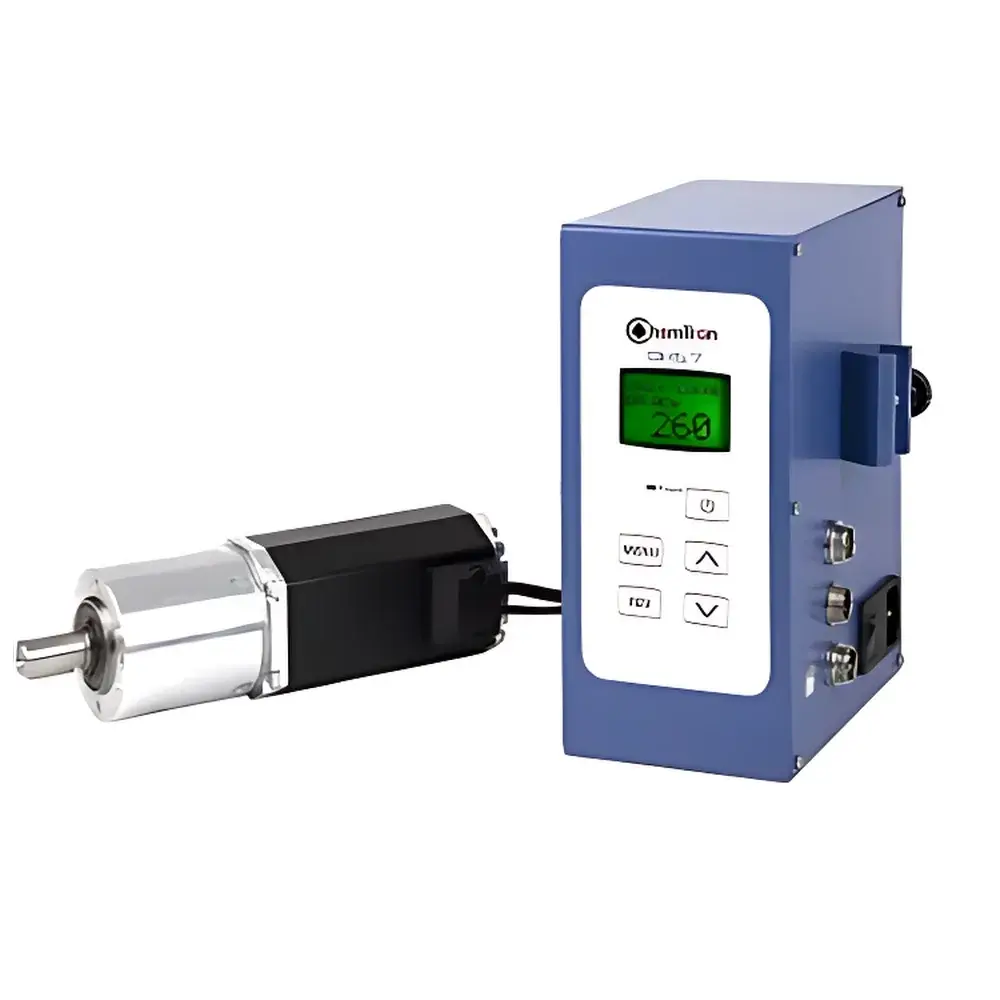
ChemTron OHS.6 / OHS.9 Split-Body High-Torque High-Speed Laboratory Stirrer
| Brand | ChemTron |
|---|---|
| Origin | Germany |
| Model | OHS.6 / OHS.9 |
| Maximum Stirring Volume | 100 L |
| Speed Range | 70–3000 rpm (OHS.9), 20–800 rpm (OHS.6) |
| Torque | up to 410 N·cm (OHS.9), 132 N·cm (OHS.6) |
| Continuous Rated Torque | 116 N·cm (OHS.9), 18 N·cm (OHS.6) |
| Max. Viscosity | 200,000 cP (OHS.9), 150,000 cP (OHS.6) |
| Motor Type | Brushless DC |
| Power Input | 450 W (OHS.9), 150 W (OHS.6) |
| Dimensions (Motor) | 165 × 75 × 75 mm (OHS.9), 216 × 65 × 65 mm (OHS.6) |
| Weight (Motor) | 2.8 kg (OHS.9), 2.3 kg (OHS.6) |
| Control Interface | LCD display with real-time torque & speed readout, USB digital interface, 0–10 V analog input/output, 0–20 mA analog input, footswitch port |
| Cable Length | Standard 3 m (optional: 1.5 / 6 / 10 m) |
Overview
The ChemTron OHS.6 and OHS.9 are industrial-grade split-body laboratory stirrers engineered for high-torque, high-speed mixing applications in demanding R&D, pilot-scale synthesis, and quality control environments. Unlike conventional integrated stirrers, the OHS series separates the motor head from the controller unit via a robust shielded cable—enabling flexible integration into jacketed reactors, gloveboxes, fume hoods, or custom-built reaction systems where thermal management, spatial constraints, or electromagnetic isolation are critical. The core actuation relies on a brushless DC motor coupled with a sealed planetary gear reduction system, delivering exceptional torque density, zero brush wear, and acoustic noise levels below 55 dB(A) at full load. Speed regulation is achieved through closed-loop current feedback: real-time monitoring of motor back-EMF and load-induced current draw allows dynamic adjustment of drive voltage to maintain setpoint speed within ±1 rpm—even under rapidly varying viscosity or sudden mechanical resistance (e.g., during polymer gelation or precipitate formation). This architecture ensures reproducible shear history across batches—a prerequisite for rheologically sensitive formulations such as adhesives, battery slurries, and pharmaceutical suspensions.
Key Features
- Split-body design enables remote mounting of motor head while retaining full digital control at the operator station—ideal for hazardous or temperature-controlled enclosures.
- Brushless DC motor with integrated planetary gearbox: maintenance-free operation, >20,000-hour service life, and consistent torque delivery across the full speed range.
- Real-time torque monitoring (0–410 N·cm) displayed numerically on LCD; torque data logged via USB to PC using ChemTron’s programmable control software (Windows-compatible, CSV export).
- Multi-mode analog I/O: 0–10 V speed setpoint input, 0–10 V torque/speed output, 0–20 mA process signal input—enables seamless integration into PLC-controlled lab automation workflows or SCADA systems.
- Bi-directional rotation control with programmable acceleration/deceleration ramps to prevent splashing or vortex instability during startup/shutdown.
- Footswitch compatibility for hands-free start/stop—essential in multi-tasking synthesis protocols or GLP-compliant documentation procedures.
Sample Compatibility & Compliance
The OHS series accommodates a broad spectrum of sample rheologies—from low-viscosity solvents (e.g., acetone, ethanol) to non-Newtonian, shear-thinning gels (e.g., xanthan gum solutions, lithium-ion cathode slurries) and highly filled pastes (e.g., dental composites, ceramic feedstocks). With maximum viscosities rated at 200,000 cP (OHS.9) and stirring volumes up to 100 L (water-equivalent), the system supports scalable process development aligned with ASTM D1893 (standard test method for viscosity of adhesives) and ISO 2555 (determination of apparent viscosity of polymer solutions). All electronics comply with CE, RoHS, and EMC Directive 2014/30/EU. The controller firmware supports audit-trail-enabled operation when used with validated software—meeting foundational requirements for FDA 21 CFR Part 11 compliance in regulated QC labs.
Software & Data Management
The included ChemTron StirControl Suite provides deterministic, time-stamped logging of speed, torque, direction, and runtime. Users define multi-step protocols (e.g., ramp-to-1200 rpm → hold 5 min → reverse → decelerate linearly), assign descriptive metadata (batch ID, operator, SOP version), and export timestamped .csv files for traceability. USB communication uses CDC ACM class drivers—no proprietary dongles required. Raw torque values are calibrated against NIST-traceable reference loads during factory certification, and calibration coefficients are stored in non-volatile memory. Optional LabVIEW and Python API libraries enable third-party integration with LIMS or electronic lab notebooks (ELNs).
Applications
- Chemical synthesis: Emulsion polymerization, Grignard reactions, and hydrogenation under inert atmosphere—where motor cooling and explosion-proof placement are essential.
- Materials science: Homogenization of nanocomposite dispersions, graphite anode slurries, and UV-curable resins requiring precise shear rate control.
- Pharmaceutical development: Wet granulation studies, suspension stability testing, and excipient blending per USP on mixing performance.
- Food & cosmetics: High-shear dispersion of hydrocolloids (e.g., carrageenan, pectin) and pigment milling in oil-in-water emulsions.
- Environmental testing: Accelerated aging of contaminated soil slurries with added oxidants under controlled agitation.
FAQ
What distinguishes the OHS.6 from the OHS.9 model?
The OHS.6 is optimized for medium-torque, precision low-speed applications (20–800 rpm, max 132 N·cm), whereas the OHS.9 delivers industrial-level torque and wide-range high-speed capability (70–3000 rpm, max 410 N·cm) with higher power input (450 W vs. 150 W).
Can the motor be mounted vertically inside a reactor lid?
Yes—the motor housing features standardized M12 threaded inserts and optional flange kits for direct reactor integration; IP54-rated construction protects against incidental liquid ingress.
Is torque calibration traceable to national standards?
Each unit undergoes factory calibration using dead-weight torque standards certified to DIN EN ISO/IEC 17025; calibration reports include uncertainty budgets and are supplied with shipment.
Does the system support GMP audit trails?
When operated with validated StirControl Suite v3.2+ and enabled Windows event logging, all parameter changes, run executions, and user logins generate immutable timestamps compliant with ALCOA+ principles.
What safety protections are built into the motor controller?
Overcurrent, overtemperature, stall detection, and runaway speed cutoff are implemented in hardware; fault codes (e.g., E03 = gear jam, E11 = commutation error) appear on the LCD and halt operation until manual reset.



