
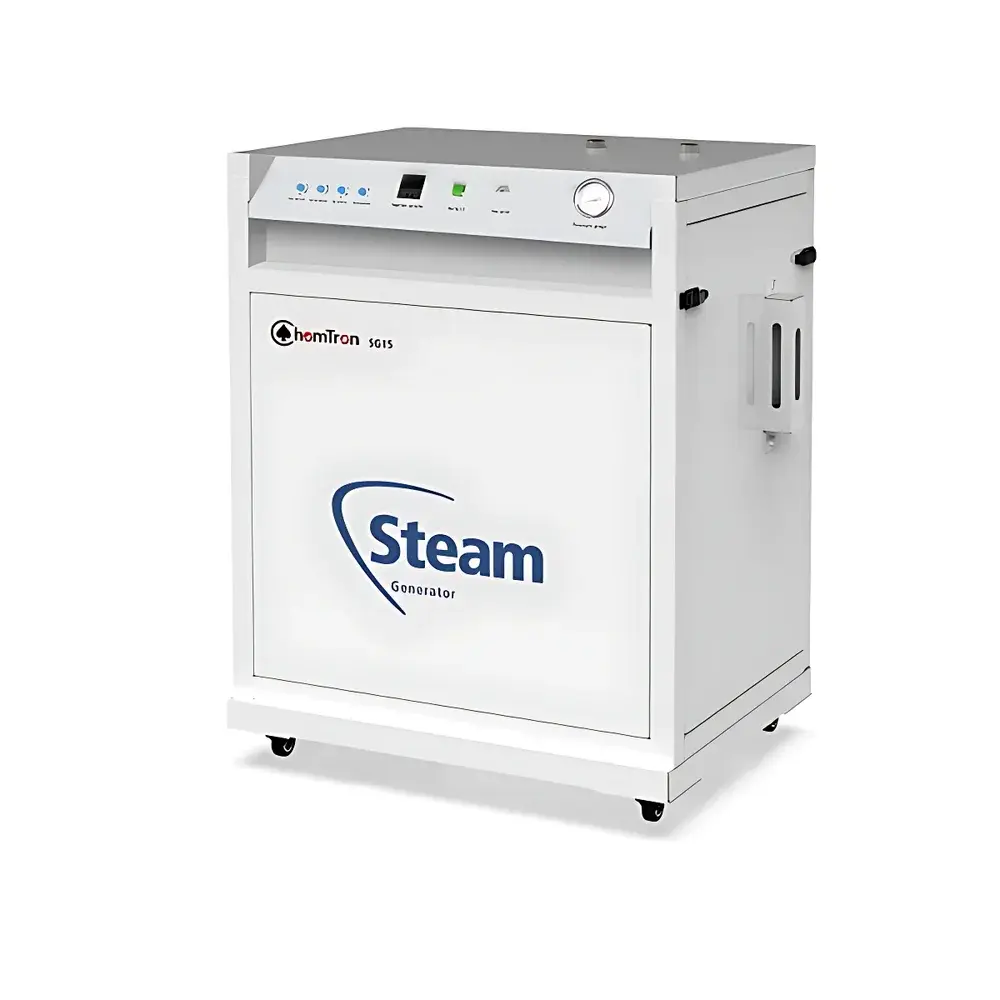
ChemTron SG15 / SG30 High-Temperature Steam Generator & Precision Steam Thermostatic System
| Brand | ChemTron |
|---|---|
| Origin | Germany |
| Model | SG15 / SG30 |
| Heating Power | 18 kW (SG15) / 48 kW (SG30) |
| Rated Steam Output | 0.025 t/h (SG15) / 0.065 t/h (SG30) |
| Rated Working Pressure | 0.7 MPa |
| Rated Steam Temperature | 171 °C |
| Water Capacity | 24 L (SG15) / 29 L (SG30) |
| Voltage | 380 V |
| Compliance | China Special Equipment Manufacturing License (Pressure Vessel & Boiler) |
| Optional | Soft Water Treatment Unit |
| Control | PLC-based Steam Temperature Regulation Module (customizable for external process integration) |
Overview
The ChemTron SG15 and SG30 are fully automated, high-reliability steam generators engineered for precise thermal management in laboratory and pilot-scale industrial applications. Unlike conventional steam boilers, these units operate on a compact, closed-loop principle utilizing electric resistance heating to generate saturated steam at a controlled pressure of 0.7 MPa — corresponding to a saturation temperature of 171 °C. Designed specifically for integration into temperature-critical processes such as jacketed reactor heating, rotary evaporation support, sterilization validation, and thermal stability testing, the system delivers stable, contaminant-free steam with minimal thermal inertia. Its modular architecture enables seamless coupling with external heat exchangers, reactor jackets, or custom thermal manifolds, making it suitable for GLP-compliant R&D environments where reproducibility, traceability, and regulatory alignment are mandatory.
Key Features
- Integrated high-water-level optical sensor with audible and visual alarm output — ensures immediate operator notification and automatic shutdown to prevent dry-firing or overpressure conditions.
- Optional soft water treatment module compatible with standard ion-exchange resin cartridges; mitigates scale formation in heating elements and steam pathways, extending service life and maintaining thermal efficiency over extended operation cycles.
- Fully compliant with Chinese Special Equipment Safety Technical Regulations: certified under both Pressure Vessel (TS Certificate) and Industrial Boiler (B Certificate) manufacturing licenses — documentation available for audit upon request.
- Robust stainless-steel construction (AISI 304 vessel, Incoloy 800 heating elements) rated for continuous duty at 0.7 MPa working pressure and 171 °C saturated steam temperature.
- Modular PLC control interface supports analog (4–20 mA) and digital (Modbus RTU) communication protocols, enabling integration into centralized SCADA or LIMS platforms for remote monitoring and data logging.
Sample Compatibility & Compliance
The SG15/SG30 system is not intended for direct sample contact but serves exclusively as a regulated thermal energy source for externally mounted equipment. It is routinely deployed in pharmaceutical cleanrooms (ISO Class 7–8), biotech process development labs, and food-grade pilot plants where steam purity and pressure stability are governed by internal SOPs aligned with ISO 13485, ASME BPE-2023, and EU GMP Annex 15. While the unit itself does not carry CE marking (due to China-specific certification pathway), its electrical design conforms to IEC 61000-6-2/6-4 immunity and emission standards. For FDA-regulated environments, the optional PLC module supports 21 CFR Part 11-compliant audit trails when paired with validated HMI software.
Software & Data Management
Standard operation requires no proprietary software — all setpoints, alarms, and operational logs are managed via an integrated 5.7″ TFT HMI with password-protected access levels (Operator, Technician, Administrator). For advanced data governance, the optional ChemTron SteamLink™ PLC module provides time-stamped event logging (start/stop cycles, pressure excursions, alarm triggers), configurable PID tuning parameters, and exportable CSV reports via USB or Ethernet. All logged data includes UTC timestamps and user ID attribution, fulfilling basic ALCOA+ principles for raw data integrity in quality-controlled laboratories.
Applications
- Thermostatic heating of glass-lined or stainless-steel jacketed reactors (10–200 L scale) in API synthesis and polymerization studies.
- Steam-assisted drying and solvent removal in lyophilization pre-conditioning and granulation process optimization.
- Calibration and performance verification of temperature sensors (RTDs, thermocouples) across the 100–170 °C range using traceable saturated steam points.
- Supporting accelerated stability testing per ICH Q1A(R3), where precise, uniform thermal exposure is required for shelf-life prediction.
- Providing sterile process steam for autoclave auxiliary functions or media preparation systems in academic core facilities.
FAQ
Is the SG15/SG30 certified for use in EU or US laboratories?
The unit holds China’s national Special Equipment Manufacturing Licenses (Pressure Vessel and Boiler) and meets IEC electrical safety standards, but lacks CE or UL listing. Installation in EU/US facilities requires local engineering review and third-party pressure equipment assessment per PED 2014/68/EU or ASME Section I.
Can the system maintain ±0.5 °C temperature stability at the point of use?
Stability at the reactor jacket inlet depends on external loop design, insulation, and flow rate. With properly sized piping and a calibrated external PID controller, typical deviation is ≤±1.2 °C over 8-hour continuous operation.
What maintenance intervals are recommended?
Daily visual inspection of water level and pressure gauge; quarterly descaling if untreated feedwater is used; annual calibration of pressure transducer and safety valve by authorized service provider.
Does ChemTron supply installation qualification (IQ) documentation?
Yes — factory-issued IQ templates (in English) covering mechanical completion, electrical verification, and safety interlock testing are provided with each shipment upon request.
Is distilled water required for operation?
No — deionized or softened water (hardness < 5 ppm CaCO₃ equivalent) is sufficient. Distilled water is discouraged due to potential corrosion from low conductivity in stainless-steel systems.



