
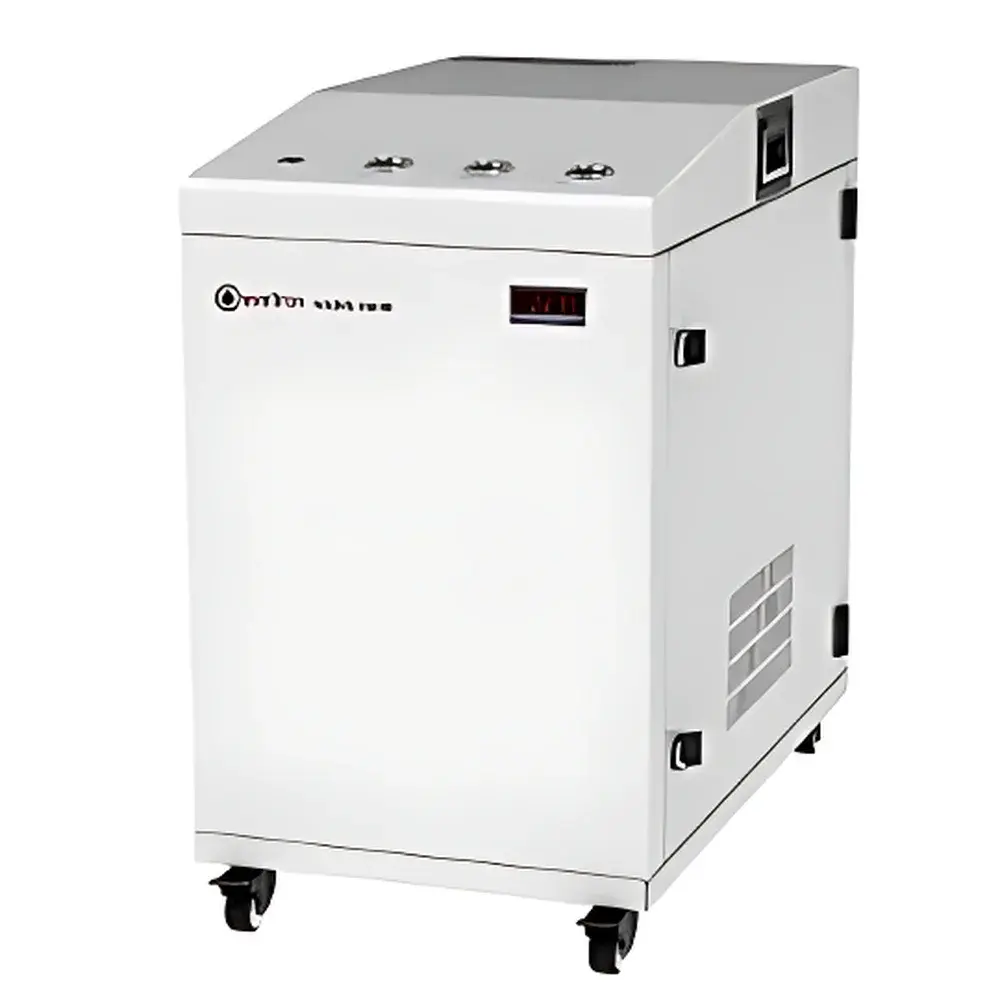
ChemTron WIND MS 5500HB LC-MS Dedicated Nitrogen Generator
| Brand | ChemTron |
|---|---|
| Origin | Germany |
| Model | WIND MS 5500HB |
| Nitrogen Flow | 10 L/min @ 60 psi |
| Air Flow (Port 2) | 22 L/min @ 100 psi |
| Air Flow (Port 3) | 10 L/min @ 60 psi |
| Purity | 96–99.9% N₂ |
| Dew Point | < −36 °C |
| Ambient Temperature Range | 10–35 °C |
| Relative Humidity | 0–80% RH (non-condensing) |
| Motor Speed | 1450 rpm |
| Power Consumption | 1200 W |
| Voltage | 220–240 V / 50 Hz |
| Noise Level | 58 dB(A) |
| Dimensions (W×L×H) | 480 × 825 × 770 mm |
| Weight | 95 kg |
| Interface | 6 mm push-to-connect or G¼” BSP threaded |
Overview
The ChemTron WIND MS 5500HB is a purpose-engineered nitrogen generator designed exclusively for liquid chromatography–mass spectrometry (LC-MS) applications. It integrates vacuum-pressure swing membrane separation with optimized air compression and multi-stage purification to deliver continuous, on-demand nitrogen gas at purity levels of 96–99.9%—sufficient for electrospray ionization (ESI), atmospheric pressure chemical ionization (APCI), and other LC-MS source gas requirements. Unlike high-pressure PSA systems, the WIND MS 5500HB employs thermally stabilized hollow-fiber membrane technology operating under controlled temperature and differential pressure conditions, ensuring stable nitrogen output without molecular sieve degradation or periodic regeneration cycles. Its integrated air compressor—designed for low-vibration, continuous-duty operation—supplies both instrument-grade air (for pneumatic controls and auxiliary functions) and feed air for nitrogen generation, eliminating external air supply dependencies. The system is validated for compatibility with AB SCIEX Triple Quad™ 5500 and earlier LC-MS platforms, as well as comparable instruments from Thermo Fisher, Waters, and Shimadzu requiring ≤10 L/min nitrogen at 60 psi.
Key Features
- Integrated oil-free scroll-type air compressor with anti-vibration mounting and thermal overload protection
- Hollow-fiber membrane module with active temperature stabilization for consistent N₂ separation efficiency and long-term stability
- Multi-stage air pre-treatment: cyclonic water separator, refrigerated air dryer (−18 °C pressure dew point), coalescing filter (0.01 µm particle retention), and activated carbon adsorption
- Stainless steel 5 L receiver tank (AISI 316), corrosion-resistant and chlorine-free, preventing microbial growth and metallic contamination
- Intelligent electronic pressure switch with adjustable cut-in/cut-out setpoints to optimize compressor duty cycle and reduce energy consumption
- Automatic condensate drainage with timed discharge intervals and visual level indicator
- Front-access quick-release side panels with integrated maintenance guide labels
- Low-noise architecture (58 dB[A]) achieved via acoustic insulation, optimized airflow routing, and heat-dissipating finned cooling surfaces
- Non-hazardous operating profile: no high-pressure storage vessels (>10 bar), no cryogenic components, and no phthalates or plasticizers in wetted materials
Sample Compatibility & Compliance
The WIND MS 5500HB meets critical operational prerequisites for regulated analytical laboratories. All wetted materials—including tubing, filters, membranes, and receiver tank—are certified compliant with USP Class VI and FDA 21 CFR Part 11 material compatibility standards. The system supports GLP/GMP workflows through configurable audit-trail-capable logging (via optional RS-485/Modbus interface), timestamped runtime tracking, and automated event recording (e.g., pressure excursions, drain cycles, thermal alerts). While not classified as medical device hardware, its design adheres to ISO 8573-1:2010 Class 2:2:2 for compressed air quality (solid particles, water, oil), and nitrogen output conforms to ASTM D6349–20 specifications for laboratory-grade nitrogen used in instrumental analysis. No external certification (e.g., CE, UKCA) is required for standalone use within EU/UK laboratory environments under Machinery Directive 2006/42/EC exemptions for research equipment.
Software & Data Management
The WIND MS 5500HB operates autonomously without proprietary software dependency. All operational parameters—including runtime hours, compressor start/stop count, pressure differentials, and ambient temperature—are stored in non-volatile memory and accessible via front-panel LED display. Optional analog (4–20 mA) and digital (RS-485 Modbus RTU) outputs enable integration into centralized facility monitoring systems (e.g., LabVantage, Siemens Desigo, or custom SCADA). Event logs are time-stamped and retain the last 500 entries, supporting root-cause analysis during QA audits. Firmware updates are performed via secure USB interface using signed binary packages; version history and checksum validation ensure integrity. No cloud connectivity or remote access capabilities are implemented—consistent with data sovereignty requirements in pharmaceutical and contract research organizations.
Applications
This generator serves as a primary nitrogen source for ESI and APCI ion sources in triple quadrupole, Q-TOF, and ion trap LC-MS systems. It supplies make-up gas, nebulizer gas, and curtain gas with minimal flow fluctuation (<±2% over 24 h) and negligible hydrocarbon carryover (<0.1 ppmv total VOC). Secondary air outputs support autosampler purge lines, valve actuation, and detector cooling fans. In method development labs, the dual-air-output configuration allows simultaneous operation of multiple ancillary instruments (e.g., GC carrier gas purging, FTIR desiccant regeneration) without cross-contamination risk. Its mobility—enabled by locking casters and compact footprint—facilitates deployment across shared core facilities, mobile analytical units, and ISO Class 7 cleanroom-adjacent prep areas where centralized gas infrastructure is unavailable or cost-prohibitive.
FAQ
What LC-MS models is the WIND MS 5500HB validated for?
It is factory-validated for AB SCIEX Triple Quad 4000, 5500, and QTRAP 5500 systems. Compatibility with Thermo Scientific TSQ Altis, Waters Xevo TQ-S, and Shimadzu LCMS-8050 is confirmed per application note WIND-MS-AN07.
Does the system require external cooling water or ventilation ducting?
No. The integrated air-cooled heat exchanger and passive convection fins eliminate need for chilled water or forced exhaust—only 150 mm rear clearance is required for thermal dissipation.
How often does the coalescing filter need replacement?
Under typical lab conditions (20 °C, 50% RH), the 0.01 µm filter is rated for 6,000 hours or 12 months—whichever occurs first—with automatic pressure-drop monitoring triggering front-panel alert.
Can the nitrogen purity be adjusted or monitored in real time?
Purity is fixed by membrane geometry and operating pressure differential; real-time O₂ monitoring is not included but can be added via external electrochemical sensor (part no. OX-SEN-200) with 4–20 mA output.
Is the stainless steel receiver tank passivated per ASTM A967?
Yes. All internal surfaces undergo nitric acid passivation and helium leak testing (<1 × 10⁻⁹ mbar·L/s) prior to shipment, with certificate of conformance provided.



