
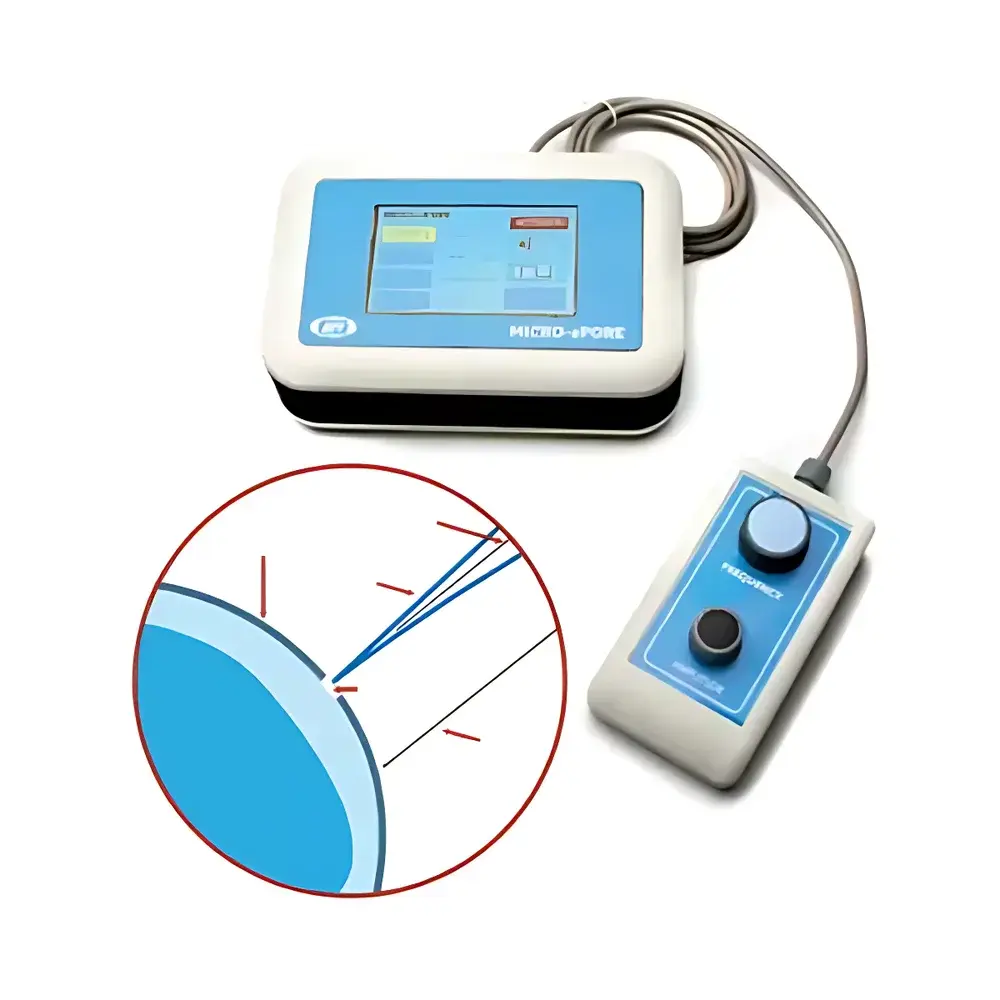
Chengmeng MEP Microelectrode-Based Electroporation System
| Brand | Chengmeng |
|---|---|
| Origin | Jiangsu, China |
| Manufacturer Type | Authorized Distributor |
| Country of Origin | China |
| Model | MEP Microelectrode-Based Electroporation System |
| High-Voltage Range | 0–1200 V (adjustable) |
| Low-Voltage Range | 0–50 V (for pre-pulse stabilization) |
| Capacitance Range | 1–100 µF (selectable) |
| Pulse Duration | 1–100 ms (adjustable) |
| Number of Pulses | 1–99 per cycle |
| Pulse Interval | 100 ms–5 s (programmable) |
| Output Waveform | Exponential decay and square-wave modes |
| Internal Resistance | <50 Ω (system-optimized for microelectrode coupling) |
| Electrode Compatibility | Standard 1.0 mm OD borosilicate capillaries (Sutter BF150-86-10, World Precision Instruments TW-100F, etc.) |
| Embryo Survival Rate (Mouse 2-cell stage) | 80–85% post-electroporation |
Overview
The Chengmeng MEP Microelectrode-Based Electroporation System is a precision-engineered platform designed for targeted, low-injury intracellular delivery in early-stage mammalian embryos and oocytes. Unlike conventional bulk electroporation systems that apply uniform electric fields across suspension cultures, the MEP system integrates a micromanipulation-compatible microelectrode probe to deliver spatially confined, transient electric pulses directly at the cell membrane interface. This approach leverages localized electroporation—inducing reversible, nanometer-scale pore formation via controlled transmembrane potential gradients—while minimizing thermal stress, osmotic shock, and off-target membrane damage. The system is optimized for applications requiring single-cell resolution and high developmental viability, including CRISPR-Cas9 ribonucleoprotein (RNP) delivery into mouse two-cell embryos, siRNA-mediated gene knockdown in zebrafish blastomeres, and pronuclear injection in rodent zygotes. Its architecture conforms to standard embryology workstation footprints and integrates seamlessly with inverted microscopes equipped with motorized micromanipulators.
Key Features
- Micropipette-integrated electroporation: Combines mechanical positioning with real-time electrical actuation for subcellular targeting accuracy.
- Dual-mode pulse generation: Selectable exponential decay (capacitor discharge) or square-wave (constant-voltage) output to match nucleic acid size and cell type requirements.
- Programmable multi-pulse protocols: Four user-defined programs stored onboard; each supports independent control over voltage, capacitance, pulse count, duration, and inter-pulse interval.
- Glove-compatible resistive touchscreen interface: 7-inch display with haptic feedback, calibrated for use under biosafety cabinet conditions.
- Footswitch and touch-initiated operation: Enables hands-free triggering during micromanipulation workflows without compromising sterility or posture.
- Real-time impedance monitoring: Onboard circuitry detects electrode tip contact and cell membrane proximity to prevent arcing or excessive current draw.
- Integrated injection counter with non-volatile memory: Tracks total electroporation events per session for GLP-compliant recordkeeping.
- Universal electrode holder: Compatible with standard XYZ manipulators (e.g., Sutter MP-285, Narishige MO-202, Eppendorf InjectMan NI2).
Sample Compatibility & Compliance
The MEP system supports a broad range of delicate biological specimens, including murine and human oocytes, two-cell to blastocyst-stage embryos, zebrafish embryos (1–4 cell), and Xenopus laevis oocytes. It meets essential functional safety criteria per IEC 61010-1 for laboratory electrical equipment and incorporates current-limiting circuitry compliant with EN 60601-1 Annex BB for biomedical microcurrent applications. While not FDA-cleared as a medical device, its operational parameters align with established research-use-only (RUO) guidelines from the International Embryo Transfer Society (IETS) and the American College of Medical Genetics (ACMG) for preimplantation genetic intervention studies. All firmware and parameter logs are timestamped and exportable in CSV format to support audit trails required under ISO/IEC 17025-accredited laboratory quality management systems.
Software & Data Management
The system operates independently without PC dependency but supports optional USB-C data export for post-hoc analysis. Parameter configurations—including voltage ramp profiles, pulse timing sequences, and electrode resistance baselines—are saved in encrypted binary files with SHA-256 checksums. No cloud connectivity or remote telemetry is implemented, ensuring full data sovereignty. For laboratories operating under 21 CFR Part 11 requirements, the optional Audit Trail Module (sold separately) provides electronic signature capture, role-based access control, and immutable log archiving compatible with LIMS integration via HL7 or ASTM E1384 interfaces.
Applications
- CRISPR-Cas9 RNP delivery into mouse two-cell embryos for biallelic editing with minimal mosaicism.
- Pronuclear injection of plasmid DNA or modified mRNA in rat and hamster zygotes.
- siRNA or antisense oligonucleotide transfection in zebrafish blastomeres for spatiotemporal gene silencing.
- Functional delivery of calcium indicators (e.g., Fluo-4 dextran) into Xenopus oocytes for electrophysiological assays.
- Co-delivery of Cas9 protein and sgRNA with fluorescent tracer dyes to validate subcellular localization fidelity.
- High-throughput embryo screening platforms where reproducible, low-variance transfection efficiency is critical for phenotypic consistency.
FAQ
What electrode types are supported?
Standard pulled borosilicate glass capillaries (1.0 mm OD, filamented or non-filamented) with tip diameters between 0.5–2.0 µm. Quartz and metal-coated electrodes are not recommended due to impedance mismatch.
Can the system be used for adherent cell lines?
No—the MEP platform is specifically engineered for suspended or mechanically immobilized single cells (e.g., embryos held by holding pipette). It is not validated for monolayer cultures or tissue slices.
Is calibration traceable to NIST standards?
Voltage and capacitance outputs are factory-calibrated using Fluke 8508A multimeter references; calibration certificates are provided with each unit and valid for 12 months.
Does the system support synchronization with imaging hardware?
Yes—TTL-compatible trigger output (5 V, 10 ns rise time) enables precise coordination with high-speed cameras or laser ablation systems for time-resolved pore dynamics studies.
What maintenance is required?
Annual verification of pulse waveform fidelity and electrode contact resistance; no consumables beyond standard capillaries and agarose-based electrode filling solutions.




