
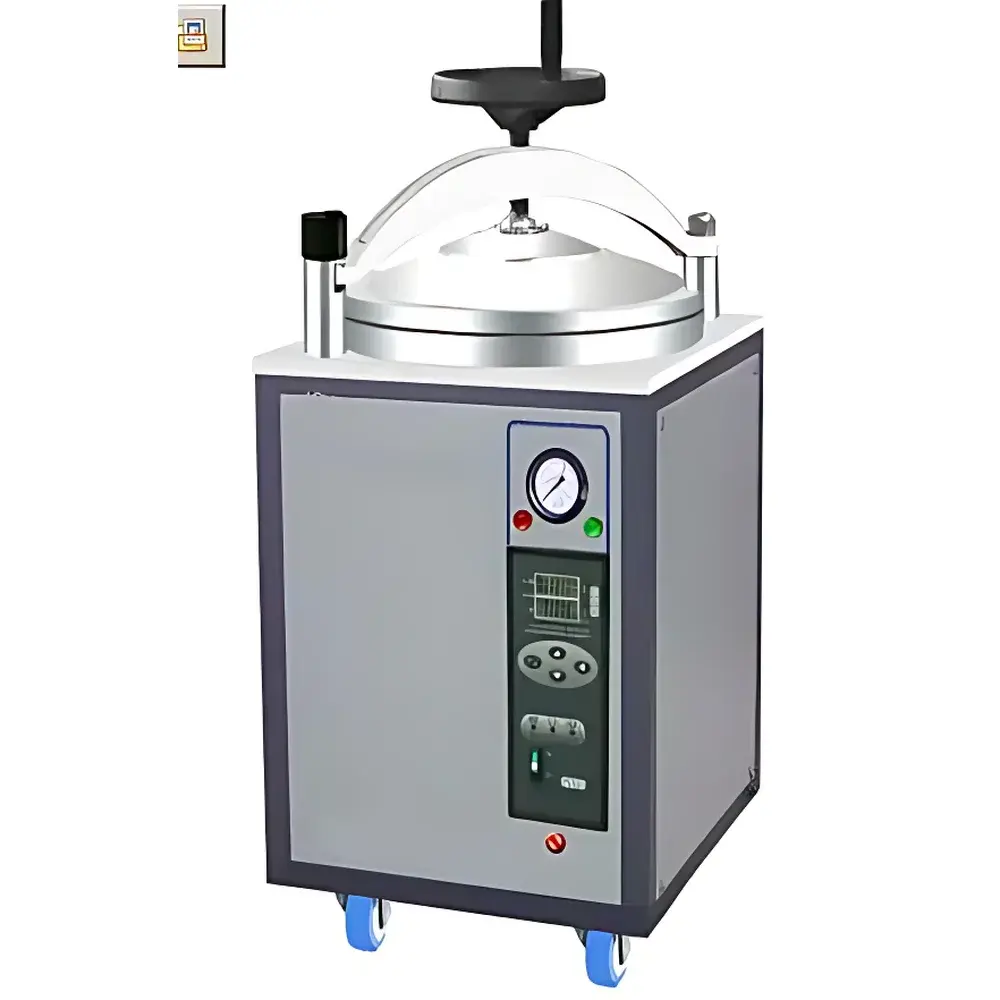
Chu Ding Technology LDZX-75KB 75L Manual-Latch Vertical Steam Sterilizer with Stainless Steel Chamber
| Brand | Chu Ding Technology |
|---|---|
| Origin | Shanghai, China |
| Model | LDZX-75KB |
| Chamber Volume | 75 L |
| Power Supply | 220 V AC |
| Heating Power | 3.5 kW |
| Chamber Dimensions (Ø × H) | 388 mm × 650 mm |
| Net Weight | 90 kg |
| External Dimensions (W × D × H) | 600 mm × 600 mm × 1400 mm |
| Operating Temperature Range | 50–126 °C |
| Timer Range | 0–99 h |
| Safety Pressure Relief | 0.145–0.165 MPa |
| Display | Digital LCD Panel |
| Door Type | Manual Rotary Latch |
| Safety Features | Low-Water Protection, Pressure Interlock, Audible End-of-Cycle Alert |
| Compliance | Meets GB 8599–2008 (Chinese National Standard for Large Steam Sterilizers), Designed for GLP/GMP-adjacent laboratory environments |
Overview
The Chu Ding Technology LDZX-75KB is a vertical, manually latched steam sterilizer engineered for reliable, repeatable moist-heat sterilization in academic, clinical, and industrial laboratory settings. It operates on the fundamental principle of saturated steam under controlled pressure—where elevated temperature (up to 126 °C) and corresponding absolute pressure (up to 0.165 MPa) synergistically denature microbial proteins and nucleic acids. Unlike autoclaves with automated door mechanisms or vacuum-assisted air removal, the LDZX-75KB employs a robust handwheel-operated sealing system, ensuring mechanical simplicity, long-term durability, and minimal maintenance dependency. Its 75-liter stainless steel chamber (AISI 304 grade) resists corrosion from repeated exposure to condensate and aggressive biological residues, supporting routine sterilization of wrapped instruments, unwrapped tools, culture media, saline solutions, glassware, textiles, and heat-stable pharmaceutical preparations. The unit conforms to GB 8599–2008—the Chinese national standard governing performance, safety, and validation requirements for large-capacity gravity-displacement steam sterilizers—and is routinely deployed in facilities where regulatory traceability aligns with ISO 13485, WHO TRS Annex 2, and FDA-recommended practices for non-sterile and low-risk sterile processing.
Key Features
- Manual rotary latch door mechanism with dual-seal gasket design ensures consistent chamber integrity and eliminates reliance on pneumatic or electromagnetic actuators
- Integrated low-water level protection circuit automatically halts heating if water volume falls below operational threshold, preventing heater dry-firing and thermal damage
- Microprocessor-based controller with digital LCD interface displays real-time pressure (MPa), temperature (°C), and remaining cycle time (hh:mm)
- User-programmable sterilization parameters: temperature adjustable from 50 °C to 126 °C in 1 °C increments; timer configurable from 0 to 99 hours in 1-minute steps
- Pressure safety interlock prevents door opening until internal pressure drops to ambient—mechanically enforced via cam-and-lever linkage synchronized with pressure transducer feedback
- Overpressure relief valve certified to activate within 0.145–0.165 MPa range, compliant with ASME BPVC Section VIII Div. 1 safety margin requirements
- Acoustic end-of-cycle alert followed by automatic power cutoff minimizes operator oversight burden during unattended operation
Sample Compatibility & Compliance
The LDZX-75KB accommodates a broad spectrum of load types without requiring pre-vacuum cycles: porous loads (e.g., surgical gowns, cotton packs), solid instruments (e.g., forceps, scalpels), liquids (e.g., nutrient broths, buffer solutions), and glass containers (e.g., Erlenmeyer flasks, test tubes). Load configuration must adhere to gravity-displacement best practices—i.e., avoiding dense stacking, permitting steam penetration via natural convection, and allowing adequate condensate drainage. While not validated for terminal sterilization of implantables per ISO 17665-1, the unit supports process qualification per ISO 11134 for Class B/B-type loads when paired with appropriate biological indicators (e.g., Geobacillus stearothermophilus spore strips) and thermocouple mapping. Documentation packages—including calibration records, preventive maintenance logs, and cycle printouts—can be generated manually for internal GLP audits or vendor-supported IQ/OQ protocols.
Software & Data Management
This model does not incorporate embedded Ethernet, USB export, or cloud connectivity. All operational data remain local to the LCD display and are not stored digitally. Users must manually record cycle parameters, start/stop timestamps, and observed pressure/temperature profiles for quality assurance purposes. For laboratories subject to 21 CFR Part 11 compliance, third-party external data loggers with timestamped analog inputs (e.g., calibrated pressure and PT100 temperature sensors) may be integrated upstream of the control panel. The absence of firmware-upgradable logic ensures deterministic behavior across device lifetime—critical in regulated environments where software validation burden must be minimized.
Applications
- Sterilization of reusable surgical instruments and dental handpieces in university teaching hospitals
- Preparation of agar plates, liquid media, and reagent solutions in microbiology and molecular biology core labs
- Decontamination of biohazardous waste bags and sharps containers prior to off-site incineration
- Heat stabilization of raw materials (e.g., plant extracts, fermentation substrates) in food science and bioprocessing pilot studies
- Validation of sterilization efficacy using standardized biological challenge tests per EN 285 Annex C
FAQ
Is the LDZX-75KB suitable for sterilizing liquids in sealed bottles?
Yes—provided bottles are loosely capped or vented to prevent explosive boiling; fill volume must not exceed 70% of container capacity to allow sufficient headspace for steam expansion.
Does it support vacuum-assisted air removal?
No—this is a gravity-displacement sterilizer; air is removed solely by steam influx. Vacuum pulses are unavailable, limiting its suitability for hollow-load sterilization per ISO 17665.
What maintenance intervals are recommended?
Daily: chamber wipe-down and gasket inspection; quarterly: safety valve functional test and pressure transducer verification; annually: full electrical safety check and heater resistance measurement.
Can it be used for depyrogenation?
No—dry-heat depyrogenation requires sustained temperatures ≥250 °C, exceeding the unit’s maximum operating limit.
Is third-party IQ/OQ support available?
Yes—Chu Ding Technology provides optional qualification documentation templates and on-site technician assistance for installation and operational qualification under client-defined protocols.



