
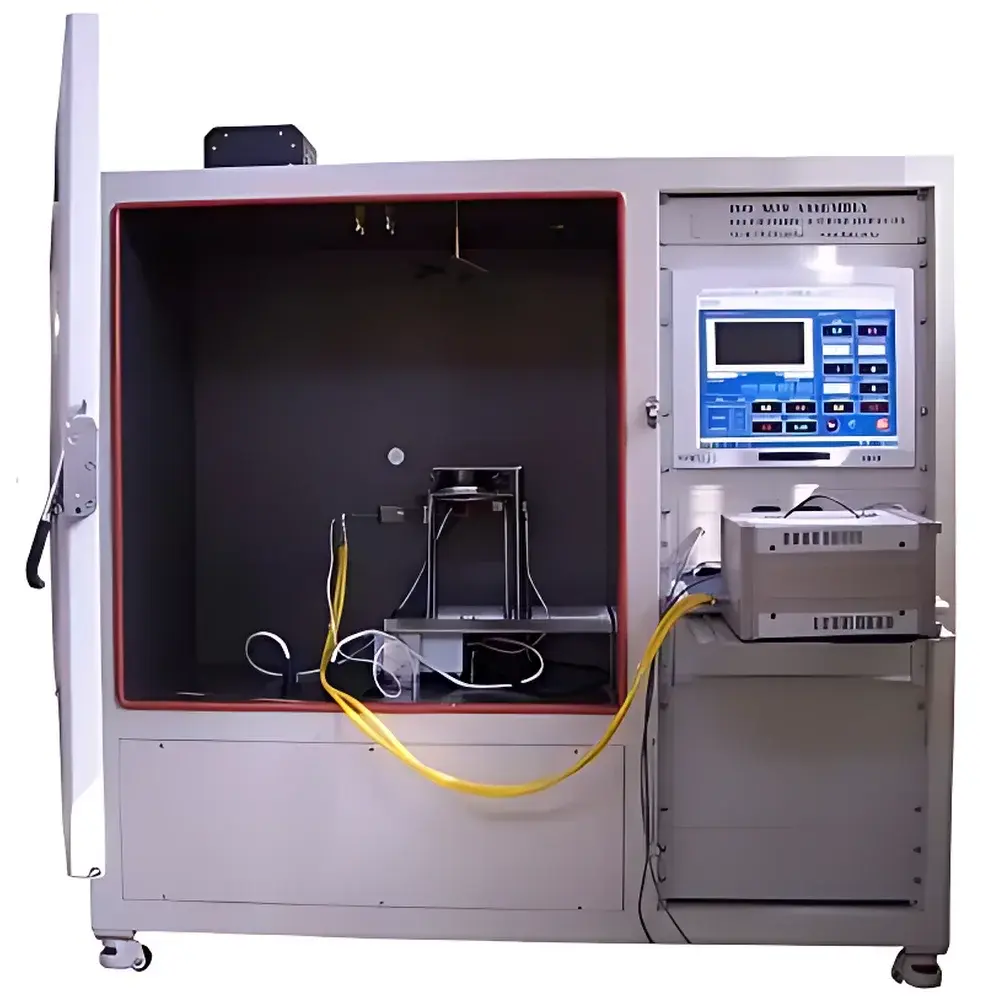
FESTEC SB 2005 ISO 5659-2 Smoke Density Chamber
| Brand | FESTEC |
|---|---|
| Origin | South Korea |
| Model | SB 2005 |
| Chamber Internal Dimensions | 914 × 914 × 610 mm |
| Wall Finish | Enamel-coated steel |
| Radiation Source | Optional ISO 5659-2 compliant conical heater (0–50 kW/m²) |
| Photodetector | S4 spectral response photomultiplier tube (dark current <10⁻⁹ A) with silicon photodiode backup |
| Temperature Monitoring | Digital display with calibrated thermocouple |
| Data Acquisition | Integrated software compliant with ISO 5659-2 reporting requirements |
| Gas Sampling | Dedicated port for detector tubes (e.g., CO, HCl, HCN) |
| Calibration | NIST-traceable radiometric calibration certificate available for heat flux meter |
Overview
The FESTEC SB 2005 ISO 5659-2 Smoke Density Chamber is a precision-engineered instrument designed for quantitative measurement of specific optical density (Ds) of smoke generated during controlled combustion of solid materials under radiant heating conditions. It operates in strict accordance with ISO 5659-2:2017, “Plastics — Smoke generation — Part 2: Determination of optical density by a single-chamber test,” and supports regulatory compliance for fire safety evaluation in transportation, construction, electronics, and cable industries. The chamber utilizes the principle of light attenuation through a defined smoke column: a collimated beam from a stabilized light source passes through the vertically oriented smoke plume within the enclosed test volume; attenuation is measured via dual photodetectors — an S4-response photomultiplier tube (PMT) for high-sensitivity low-light detection (dark current <10⁻⁹ A) and a redundant silicon photodiode for signal cross-validation. Optical density is calculated in real time using the Beer–Lambert relationship, with Ds = –log₁₀(T), where T is transmittance. The system’s 914 × 914 × 610 mm enamel-coated internal cavity ensures thermal stability up to 800 °C, chemical resistance against acidic pyrolysis byproducts, and minimal reflectance interference — critical for reproducible photometric integrity.
Key Features
- Enamel-finished internal chamber walls provide long-term resistance to thermal cycling, oxidation, and corrosive combustion residues including halogenated acids.
- Dual photodetection architecture: primary S4-spectral-response PMT (optimized for 300–650 nm) and secondary silicon photodiode ensure measurement redundancy and signal validation across varying smoke particle size distributions.
- Integrated digital display panel provides real-time readouts of optical density (Ds), chamber ambient temperature, and radiant heat flux (when equipped with optional NIST-traceable heat flux meter).
- Modular radiation source interface accommodates ISO 5659-2-compliant conical heaters delivering 0–50 kW/m² irradiance with ±2% spatial uniformity over the specimen surface.
- Front-mounted quartz observation window enables visual monitoring of flame development, charring behavior, and smoke stratification without compromising optical path integrity or chamber sealing.
- Gas sampling port compatible with standardized colorimetric detector tubes (e.g., Dräger, Gastec) for semi-quantitative analysis of toxic effluents such as carbon monoxide, hydrogen chloride, and hydrogen cyanide.
Sample Compatibility & Compliance
The SB 2005 accepts standard test specimens measuring 75 mm × 75 mm × thickness ≤ 50 mm, mounted vertically on a refractory support plate. Specimen holders are designed for rapid insertion and alignment under the radiation cone per ISO 5659-2 Clause 6. The system meets mechanical, thermal, and photometric performance criteria specified in ISO 5659-2 Annex A (verification procedures), including light source stability (<±1% over 30 min), chamber purge flow control (1.7 ± 0.2 L/s), and background optical density drift <0.02 Ds/min. It is routinely deployed in laboratories undergoing ISO/IEC 17025 accreditation and supports audit-ready documentation for GLP and GMP environments. While not itself certified to UL 94 or ASTM E662, its output data is accepted as input for those standards’ smoke toxicity and obscuration assessments.
Software & Data Management
The proprietary FESTEC Smoke Analysis Software (v3.x) acquires, processes, and reports data in full compliance with ISO 5659-2 Section 10 requirements. It records Ds(t) curves at 1-second intervals, calculates peak Ds, Ds at 4 min (Ds₄), and average Ds over prescribed time windows. All raw photodetector voltages, thermocouple readings, and user-defined metadata (specimen ID, operator, date/time, irradiance level) are stored in encrypted .csv and PDF report formats. Audit trail functionality logs all parameter changes and report generations. Software export modules support direct integration with LIMS platforms and include optional 21 CFR Part 11-compliant electronic signature and role-based access control packages.
Applications
- Fire safety qualification of interior materials for rail vehicles (EN 45545-2), aircraft cabins (SAE AS6019), and marine applications (IMO FTP Code Annex 1).
- Regulatory submission support for building products under EU Construction Products Regulation (CPR) and U.S. NFPA 262.
- R&D screening of flame-retardant polymer formulations, intumescent coatings, and composite laminates.
- Comparative smoke toxicity profiling when coupled with standardized gas detection tube arrays.
- Validation of computational fire models requiring empirical Ds(t) boundary conditions.
FAQ
What calibration documentation is provided with the heat flux meter?
A NIST-traceable calibration certificate is supplied with each optional heat flux meter, covering the 5–50 kW/m² range with expanded uncertainty ≤ ±2.5% (k=2).
Can the SB 2005 be used for ISO 5659-1 testing?
No — the SB 2005 is specifically configured for ISO 5659-2’s radiant heating methodology; ISO 5659-1 requires piloted ignition in a horizontal configuration and is not supported.
Is the software validated for regulated environments?
Yes — optional 21 CFR Part 11 validation packages include IQ/OQ documentation, electronic signature workflows, and change control logs.
What maintenance is required for the photomultiplier tube?
The PMT requires annual verification of dark current and gain stability; replacement is recommended every 36 months under continuous operation.
Does the system include exhaust gas treatment?
No — exhaust gases must be ducted to an external fume hood or scrubber system meeting local occupational health and environmental regulations.



