
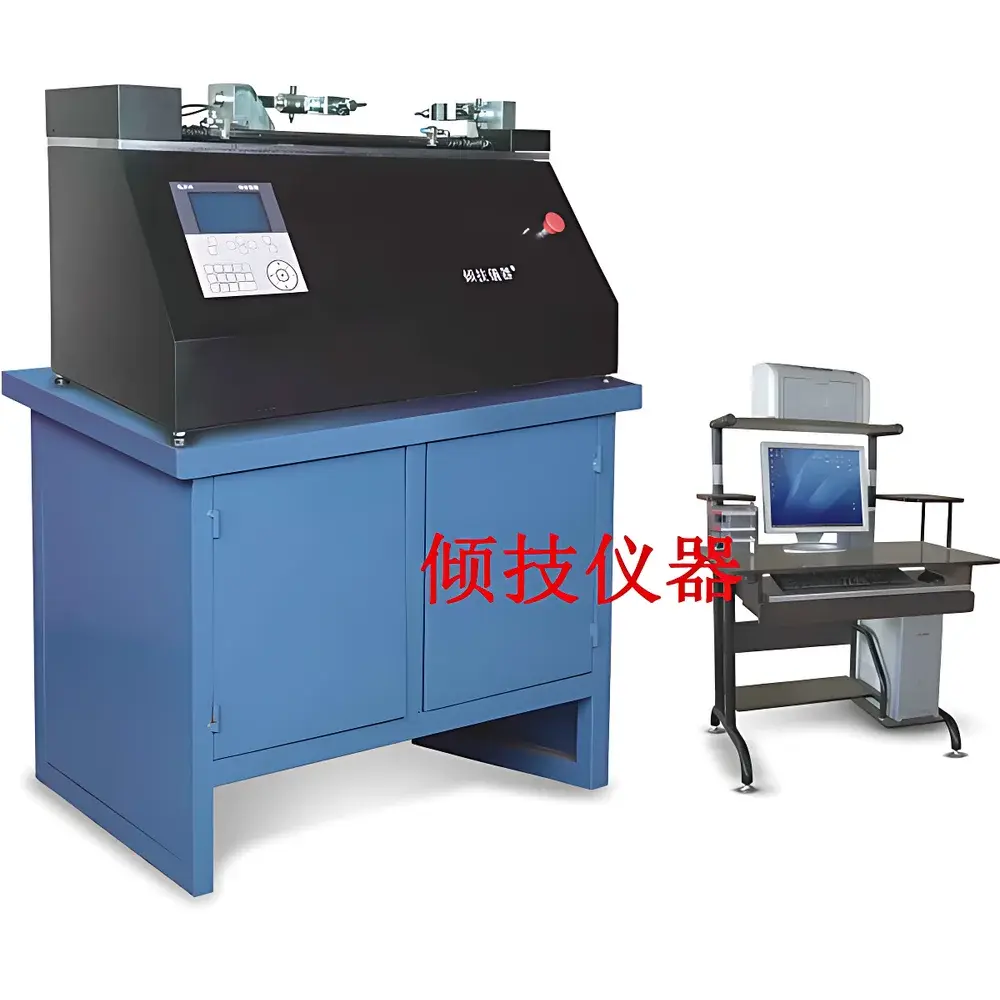
Qinji QJ310 Horizontal Plug-in/Withdrawal Force Tester
| Brand | Qinji |
|---|---|
| Origin | Shanghai, China |
| Model | QJ310 |
| Maximum Load Capacity | 2500 N or 5000 N |
| Load Cell Accuracy | 0.01% |
| Test Accuracy | < ±0.5% |
| Test Speed Range | 0.001–300 mm/min (standard), or 5–300 mm/min (optional configuration) |
| Effective Test Stroke | ≥200 mm |
| Power Supply | AC 220 V, 50/60 Hz |
| Dimensions (W×D×H) | 600 × 300 × 300 mm |
| Weight | ~40 kg |
Overview
The Qinji QJ310 Horizontal Plug-in/Withdrawal Force Tester is an electromechanical tensile and compression testing system engineered for precise quantification of insertion force, withdrawal force, retention force, and pull-off strength in electrical and mechanical interconnect components. It operates on the principle of controlled linear displacement actuation coupled with high-fidelity load measurement—utilizing a precision ball screw drive mechanism and a calibrated S-type or cantilever load cell—to generate repeatable, traceable force-displacement profiles. Designed specifically for horizontal-axis testing geometry, the instrument eliminates gravitational bias inherent in vertical configurations, ensuring consistent alignment between the actuator axis and the mating interface of connectors, terminals, wire harnesses, lamp holders, adhesive bonds, and PCB-mounted electronic assemblies. Its architecture complies with fundamental mechanical testing conventions defined in ISO 7500-1 (static calibration of uniaxial testing machines) and ASTM D903 (peel resistance of adhesive bonds), making it suitable for both R&D validation and routine QC/QA verification in electronics manufacturing, automotive wiring systems, and consumer appliance production environments.
Key Features
- Horizontal test configuration ensures coaxial alignment during plug-in and withdrawal cycles, minimizing bending moments and improving measurement fidelity for small-form-factor connectors.
- High-resolution ball screw transmission system delivers smooth, backlash-free motion across the full speed range—from ultra-slow creep testing (0.001 mm/min) to rapid functional verification (300 mm/min).
- Large-format LCD controller with real-time graphical display of force vs. displacement curves, peak load capture, and programmable test limits; supports manual jog, auto-return, and multi-step test sequencing.
- Integrated USB and RS-232 interfaces enable direct communication with Windows-based PCs running proprietary data acquisition software for automated report generation, statistical analysis (mean, SD, Cp/Cpk), and export to CSV/PDF formats.
- Rugged powder-coated steel frame and CNC-machined aluminum structural plates provide long-term dimensional stability and vibration damping under repeated loading conditions.
- Modular fixture interface accommodates standardized grip sets—including pneumatic clamps, wedge-action jaws, and custom-designed adapter plates—for rapid reconfiguration between wire harness bundles, crimped terminals, USB-C receptacles, and LED socket assemblies.
Sample Compatibility & Compliance
The QJ310 is validated for testing specimens conforming to common industry geometries and material classes: AWG 28–10 wire harnesses, IPC-2221-compliant PCB-mounted connectors, UL 498-rated plugs and sockets, ISO 8092-2 automotive terminal interfaces, and ASTM D3330-adhesive-bonded substrates. Fixture compatibility extends to DIN 41612, IEC 60603-2, and MIL-DTL-38999 series components via optional mounting brackets. While the base system meets CE marking requirements for electromagnetic compatibility (EN 61326-1) and low-voltage safety (EN 61000-6-2), users implementing the instrument in regulated environments (e.g., medical device component qualification or automotive Tier-1 supplier audits) may configure it with 21 CFR Part 11-compliant software modules that support electronic signatures, audit trails, and user access control levels—fully traceable to IQ/OQ/PQ documentation protocols.
Software & Data Management
Bundled PC software provides deterministic test method definition—including pre-load conditioning, dwell time at maximum force, return-to-start positioning, and pass/fail logic based on upper/lower specification limits. All raw data points (force in N, displacement in mm, time in s) are timestamped and stored locally with SHA-256 checksum integrity verification. Export functions comply with LIMS interoperability standards (ASTM E1482, ANSI/NIST ITL 100-11), enabling seamless integration into enterprise quality management systems such as MasterControl, TrackWise, or ETQ Reliance. Calibration certificates for the load cell and displacement encoder are issued annually per ISO/IEC 17025-accredited laboratories, with full traceability to NIM (National Institute of Metrology, China) reference standards.
Applications
- Insertion force validation of USB Type-A/B/C, HDMI, and Mini-DisplayPort connectors per IEC 62368-1 Annex G.
- Retention force assessment of automotive FAKRA and HSD connectors under thermal cycling preconditioning (per USCAR-2).
- Peel strength evaluation of pressure-sensitive adhesives used in flexible printed circuit (FPC) bonding.
- Pull-out resistance testing of LED lamp bases per IEC 61347-1 Clause 14.2.
- Terminal crimp integrity verification following IPC/WHMA-A-620 Class 2/3 requirements.
- Wire harness strain relief performance under dynamic flexing per SAE J1128.
FAQ
Is the QJ310 compliant with ISO 17025 calibration requirements?
Yes—the load cell and displacement transducer are supplied with factory calibration certificates traceable to national metrology institutes; annual recalibration services are available through authorized service centers accredited to ISO/IEC 17025.
Can the system perform cyclic plug-in/withdrawal tests?
Yes—programmable test sequences support up to 999 cycles with independent control over insertion speed, dwell duration, withdrawal rate, and inter-cycle pause intervals.
What is the recommended maintenance schedule?
Lubrication of the ball screw assembly every 500 hours of operation; periodic verification of grip jaw parallelism and load cell zero balance before critical test runs.
Does the instrument support GLP/GMP audit readiness?
When equipped with optional 21 CFR Part 11 software, it provides full electronic record retention, role-based user authentication, and immutable audit logs required for pharmaceutical or medical device component testing.



