
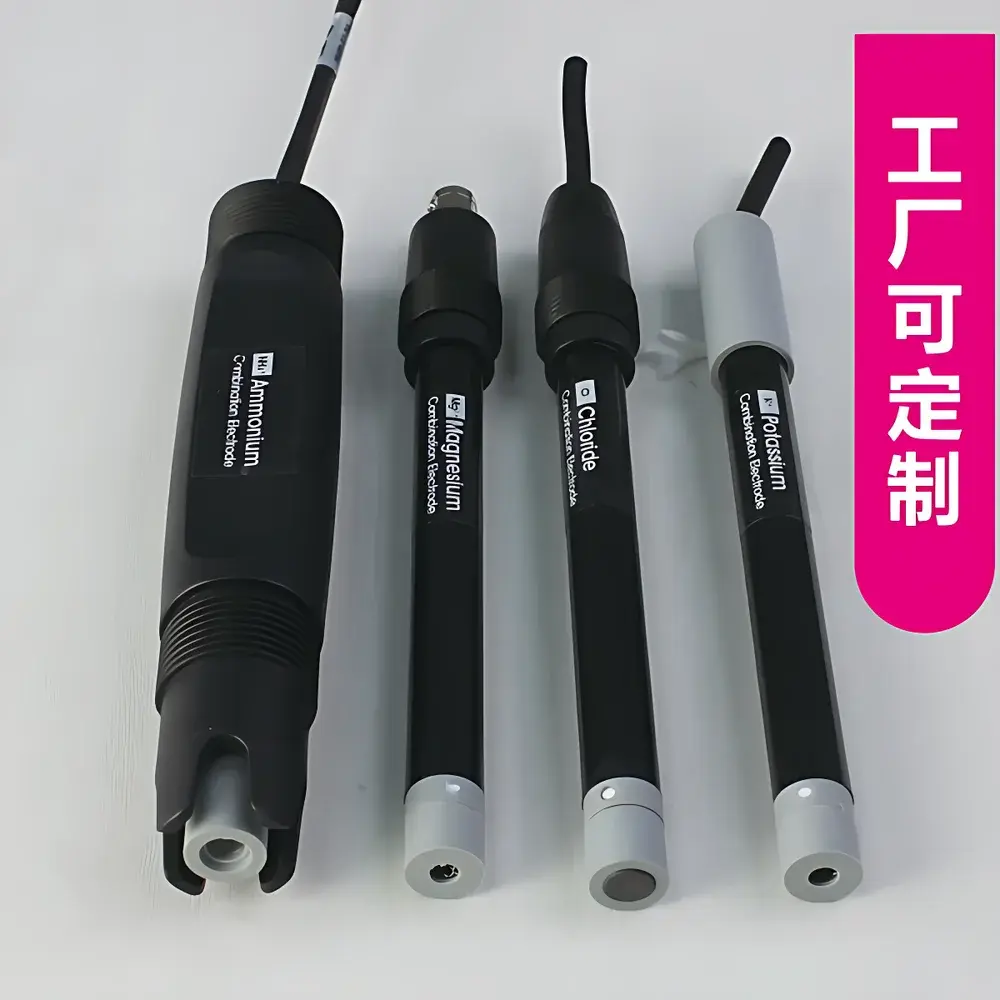
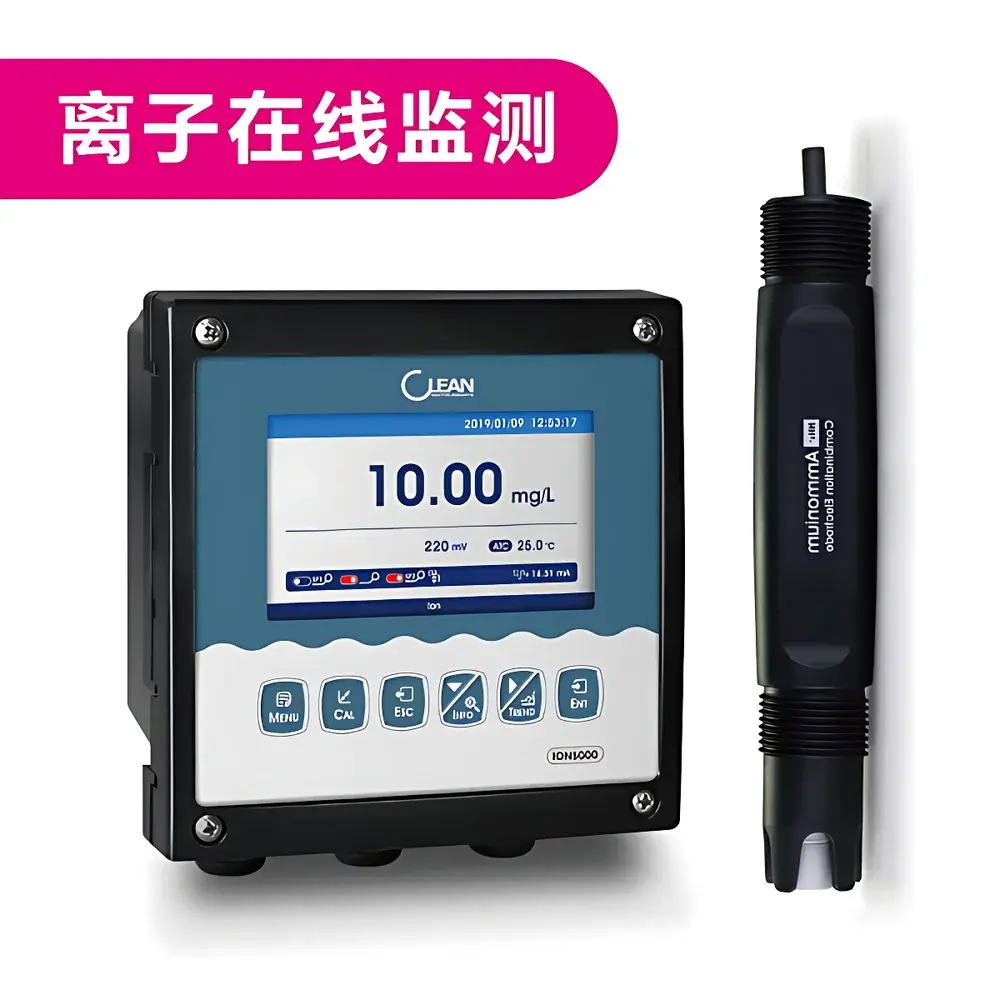
CLEAN CS6710Ca Ammonium Ion-Selective Electrode (NH₄⁺)
| Brand | CLEAN |
|---|---|
| Origin | Shanghai, China |
| Manufacturer Type | Authorized Distributor |
| Product Category | Domestic |
| Model | CS6710Ca |
| Instrument Type | Online-Ready ISE |
| Measurement Range | 0.1–18,000 ppm NH₄⁺ |
| Detection Limit | 0.1 ppm NH₄⁺ |
| Response Time | ≤30 s to 95% of final signal |
| Output Sensitivity | 55 ± 3 mV/decade |
| Operating Temperature | 0–50 °C |
| pH Range for Measurement | 4–10 |
| Input Impedance | 20–50 MΩ |
| Reference System | Double-junction Ag/AgCl with single-pore ceramic junction |
| Body Material | PMMA + PVC |
| Threaded Connection | PG13.5 / NPT 3/4″ |
| Cable Length | 5 m |
| Pressure Rating | 0–2 atm |
| Temperature Compensation Options | 10 kΩ, 22 kΩ, PT100, or PT1000 thermistors |
| Zero Point Calibration | 10 ppm NH₄⁺ isopotential point |
| Interference | K⁺ (significant), Na⁺ (minor), Ca²⁺/Mg²⁺ (negligible at pH 4–10) |
| Storage | Long-term — dry |
| Compatible Instruments | Benchtop ion meters, pH/mV meters with millivolt input, and OEM online ammonia analyzers |
Overview
The CLEAN CS6710Ca Ammonium Ion-Selective Electrode (NH₄⁺ ISE) is a potentiometric sensor engineered for reliable, direct measurement of ammonium ion activity in aqueous media. Based on a polymeric membrane formulation incorporating a neutral carrier selective for NH₄⁺, the electrode operates according to the Nernst equation—generating a stable, logarithmic mV output proportional to the negative decadic logarithm of NH₄⁺ activity (pNH₄). Unlike colorimetric or enzymatic methods, this ISE requires no reagents, consumables, or optical components, making it suitable for long-term unattended operation in industrial process streams and environmental monitoring networks. Its design integrates a double-junction reference system with a single-pore ceramic liquid junction, minimizing clogging risk and reducing contamination from sample matrix ions—critical for wastewater, boiler feedwater, and agricultural runoff applications where chloride, sulfide, or organic fouling may compromise conventional electrodes.
Key Features
- Stable Nernstian response of 55 ± 3 mV per decade change in NH₄⁺ concentration across the full 0.1–18,000 ppm range
- Fast equilibration: achieves ≥95% of final potential within 30 seconds under standard flow conditions (≥100 mL/min)
- Dual-junction reference architecture with PMMA/PVC body and chemically resistant ceramic junction ensures robustness in high-TDS and variable-pH environments
- Integrated temperature compensation support for 10 kΩ, 22 kΩ, PT100, or PT1000 sensors—enabling accurate activity-to-concentration conversion per ISO 10523 and ASTM D1072
- PG13.5 and NPT 3/4″ threaded mounting options facilitate direct integration into inline housings, flow cells, or submersible probe assemblies
- Input impedance compatibility (20–50 MΩ) with standard laboratory ion meters, pH/mV analyzers, and industrial PLC analog inputs (±500 mV, high-impedance mode)
Sample Compatibility & Compliance
The CS6710Ca is validated for use in natural waters (surface, groundwater), treated effluents, boiler feedwater, fertilizer solutions, and soil leachates—provided sample pH remains between 4.0 and 10.0. Outside this range, NH₃/NH₄⁺ speciation shifts significantly, introducing non-Nernstian deviation; therefore, pH adjustment or activity-based calibration is recommended for regulatory reporting. The electrode exhibits moderate selectivity against potassium (log KPOTK⁺,NH₄⁺ ≈ −1.2), requiring correction in high-K⁺ matrices (e.g., fertilizer brines) via separate K⁺ ISE or ionic strength adjustment. It complies with ISO 7888 (electrochemical water analysis), meets functional requirements for EPA Method 350.1 (ammonia by ISE), and supports GLP-compliant data acquisition when paired with audit-trail-enabled software (e.g., compliant with FDA 21 CFR Part 11 when used in pharmaceutical water systems).
Software & Data Management
When connected to CLEAN-compatible or third-party ion meters (e.g., Thermo Orion Star A329, Metrohm 916 Ti-Touch), the CS6710Ca supports automated calibration routines, slope verification, and drift monitoring. Raw mV outputs are traceable to NIST-traceable NH₄⁺ standards (e.g., 1, 10, 100 ppm NH₄Cl in 0.1 M KNO₃). For online deployment, the electrode interfaces with SCADA systems via 4–20 mA transmitters (with optional built-in temperature compensation) or digital RS-485/Modbus RTU modules. All calibration events, temperature readings, and raw potential logs can be exported in CSV or XML format—supporting trend analysis, alarm thresholds (e.g., >500 ppm NH₄⁺ in boiler feed), and periodic verification per ISO/IEC 17025 clause 7.7.
Applications
- Real-time monitoring of ammonium in municipal wastewater treatment plant influent, nitrification basins, and effluent discharge points
- Boiler feedwater quality control to prevent ammonium-induced copper alloy corrosion (ASTM D4691 guidance)
- In-field quantification of ammonium leaching from agricultural soils and manure-amended fields
- Process control in nitrogen fertilizer production and blending facilities
- Compliance testing for surface water bodies under EU WFD (Water Framework Directive) and US Clean Water Act §304(a) criteria
- Research-grade ammonium profiling in limnological and estuarine studies where continuous, low-maintenance sensing is required
FAQ
What is the recommended storage protocol for long-term electrode stability?
Store dry at room temperature in its original protective cap. Avoid prolonged exposure to air moisture or organic solvents. For short-term (≤7 days), immerse the sensing tip in 10 ppm NH₄⁺ standard solution buffered to pH 7.0.
Can this electrode be used in seawater or high-salinity brines?
Yes—with caution. Ionic strength effects must be compensated using a known ionic strength adjuster (e.g., 0.1 M KNO₃ background) or activity-based calibration. Expect reduced lifetime beyond 35,000 µS/cm conductivity due to junction clogging.
How often should calibration be performed in continuous online operation?
Perform two-point calibration (e.g., 10 ppm and 1000 ppm NH₄⁺) every 24–72 hours depending on matrix variability; verify slope daily using a mid-range check standard.
Is temperature compensation mandatory?
Yes. The Nernst slope varies with temperature (≈0.198 mV/°C per decade at 25 °C); uncompensated measurements introduce systematic error exceeding ±10% over 0–50 °C.
What maintenance is required to sustain reproducibility?
Rinse thoroughly with deionized water after each measurement; avoid wiping the membrane. Replace the internal filling solution annually or if drift exceeds ±2 mV/hour. Inspect the ceramic junction monthly for blockage using 10% HNO₃ soak (5 min), followed by thorough rinsing.







