
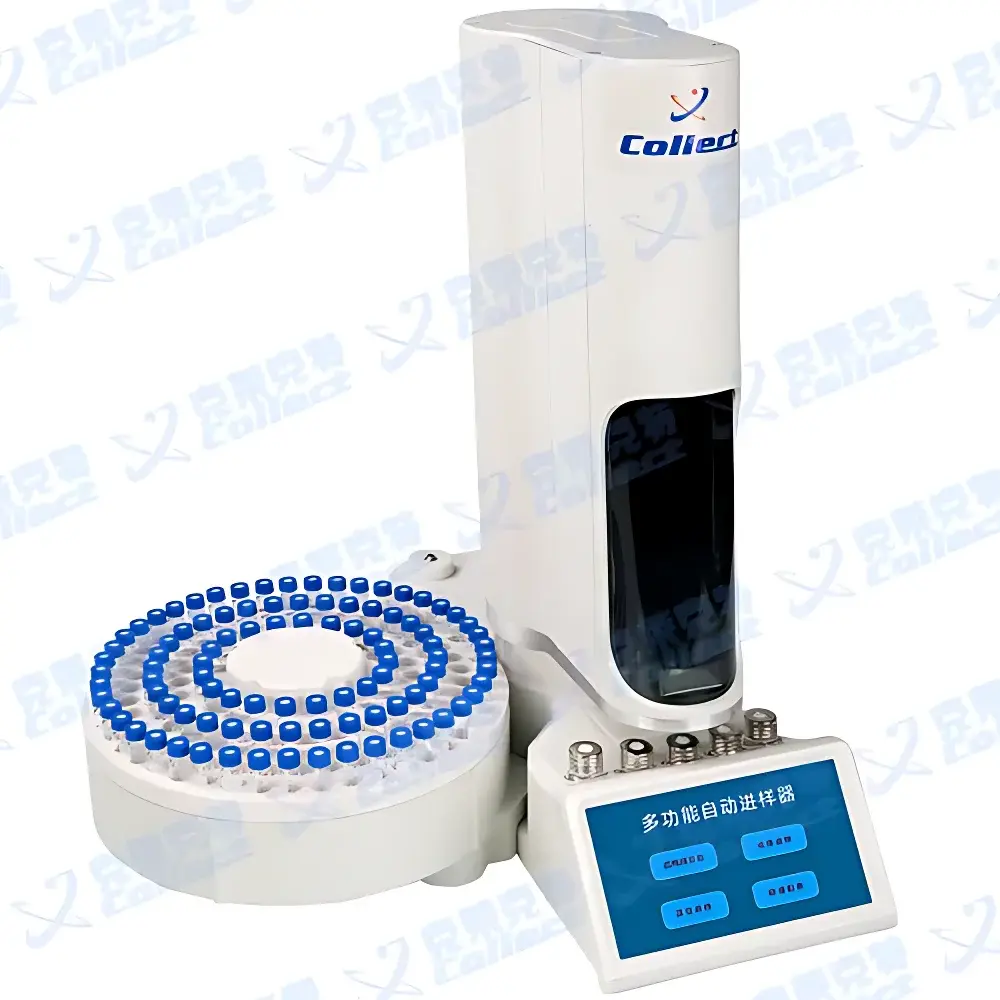
Cleket AS-3901AHF Fully Automated Headspace Sampler
| Brand | Cleket |
|---|---|
| Origin | Henan, China |
| Manufacturer Type | Manufacturer |
| Product Category | Domestic |
| Model | AS-3901AHF |
| Instrument Type | Static Headspace Sampler |
| Automation Level | Fully Automatic |
| Vial Heating Range | Ambient to 200 °C (1 °C increments) |
| Valve & Transfer Line Temperature Control Range | Ambient to 200 °C (1 °C increments) |
| Temperature Control Accuracy | ±1 °C |
| Sample Loop Volume | Standard 2.5 mL (customizable to 5 mL) |
| Vial Capacity | 36 positions |
| Vial Size | Standard 20 mL (customizable to 10 mL) |
| Liquid Injection Mode | 160-position tray for 2 mL vials |
| Headspace Injection Precision | RSD < 2.0% (ethanol/water solution) |
| Auto-Standard Preparation | Up to 10 stock solutions |
Overview
The Cleket AS-3901AHF Fully Automated Headspace Sampler is a modular, multi-functional sample introduction platform engineered for high-throughput, reproducible static headspace analysis in regulated and research-grade gas chromatography (GC) laboratories. It operates on the fundamental principle of phase equilibrium partitioning—where volatile analytes in solid or liquid matrices are thermally equilibrated in the headspace above the sample, followed by quantitative transfer of the vapor phase into the GC inlet via a heated, gas-tight syringe. Designed to meet the operational rigor of ISO/IEC 17025-accredited labs and GLP-compliant environments, the AS-3901AHF supports full bidirectional instrument control (GC and data system), enabling unattended sequence execution—from vial heating and equilibration to needle penetration, vapor aspiration, pressurized injection, and post-injection purge—all governed by deterministic timing and thermal management protocols.
Key Features
- Modular architecture allowing seamless transition between liquid injection, static headspace sampling, and automated standard solution preparation—achieved solely by swapping sample trays without hardware reconfiguration.
- 6.5-inch high-resolution capacitive touchscreen with customizable workflow templates, intuitive parameter entry, and real-time status monitoring including temperature ramp profiles and sequence progress.
- Precision stepper-motor-driven XYZ motion system ensuring repeatable needle positioning (±0.01 mm), programmable insertion depth (2–40 mm), and variable injection speed profiles (fast/medium/slow/user-defined) to accommodate high-viscosity solvents or thermally labile compounds.
- Dual independent heating zones: one for 36-position vial oven (ambient to 200 °C, ±1 °C accuracy), and another for the transfer line, valve, and 2.5 mL (or optional 5 mL) gas-tight syringe—eliminating condensation and adsorption losses during vapor transfer.
- Simultaneous thermal equilibration of up to seven vials per cycle, with user-defined agitation duration (0–120 min) and balance delay (0–120 s), optimizing sensitivity for low-concentration volatiles such as benzene in aqueous matrices (detection limit ≤1 ppb).
- Full GC and data system reverse control capability: automatic initiation of GC oven ramp, detector activation, and data acquisition software launch upon sequence start—enabling true walk-away operation.
Sample Compatibility & Compliance
The AS-3901AHF accommodates diverse sample formats—including liquids, slurries, polymers, soils, and pharmaceutical tablets—via standardized 20 mL crimp-top headspace vials (10 mL option available). Its inert, heated sampling path ensures compatibility with corrosive or reactive volatiles (e.g., H2S, formaldehyde, residual solvents per ICH Q3C). The system adheres to ASTM D6866, USP , and ISO 11843-2 requirements for method validation, supporting documented calibration, audit trails, and electronic signatures when integrated with 21 CFR Part 11–compliant chromatography data systems (CDS). All thermal and motion parameters are logged with timestamps, enabling full traceability for regulatory submissions.
Software & Data Management
Control is executed via embedded real-time operating system firmware with local storage of method files, sequence logs, and error diagnostics. The device communicates with third-party GC and CDS platforms (Agilent OpenLab, Thermo Chromeleon, Shimadzu GCsolution) using industry-standard RS-232, USB, or Ethernet interfaces. Method parameters—including vial heating profile, equilibration time, loop fill volume, injection speed, and post-injection needle wash cycles—are stored in encrypted binary format with version control. Audit trail functionality records all user actions, parameter changes, and system events, satisfying ALCOA+ data integrity principles required under GMP and GLP frameworks.
Applications
- Residual solvent analysis in APIs and excipients per ICH Q3C guidelines.
- Environmental testing of VOCs in groundwater, wastewater, and soil extracts (EPA Methods 502.2, 524.4, 8260D).
- Food and beverage quality control: ethanol quantification, flavor compound profiling, and packaging migration studies.
- Forensic toxicology: blood alcohol and volatile drug screening.
- Materials science: outgassing characterization of adhesives, composites, and battery electrolytes.
- Automated calibration curve generation via on-board standard dilution—reducing manual pipetting errors and exposure to hazardous standards.
FAQ
Does the AS-3901AHF support both positive-pressure and atmospheric-pressure headspace sampling?
Yes. Users can select either pressurized equilibration (for enhanced sensitivity with low-volatility analytes) or ambient-pressure sampling (to prevent baseline drift during aqueous analysis).
Can the system be integrated into an existing GC workflow without hardware modification?
Yes. It features universal GC trigger outputs and accepts TTL/relay signals from any major GC manufacturer, requiring no firmware or mechanical adaptation.
Is the 2.5 mL sample loop compliant with EPA Method 8260D requirements?
Yes—the heated, inert-loop configuration meets the volumetric accuracy and carryover specifications outlined in Section 9.2.2 of EPA 8260D for environmental VOC analysis.
How does the system ensure cross-contamination prevention between samples?
It performs automated needle washes with solvent and inert gas before and after each injection, plus configurable hot-gas purges of the transfer line and valve at user-defined temperatures and durations.
What validation documentation is provided with the instrument?
Each unit ships with Factory Acceptance Test (FAT) report, IQ/OQ protocol templates, temperature uniformity mapping data for the vial oven, and syringe calibration certificates traceable to NIST standards.





