
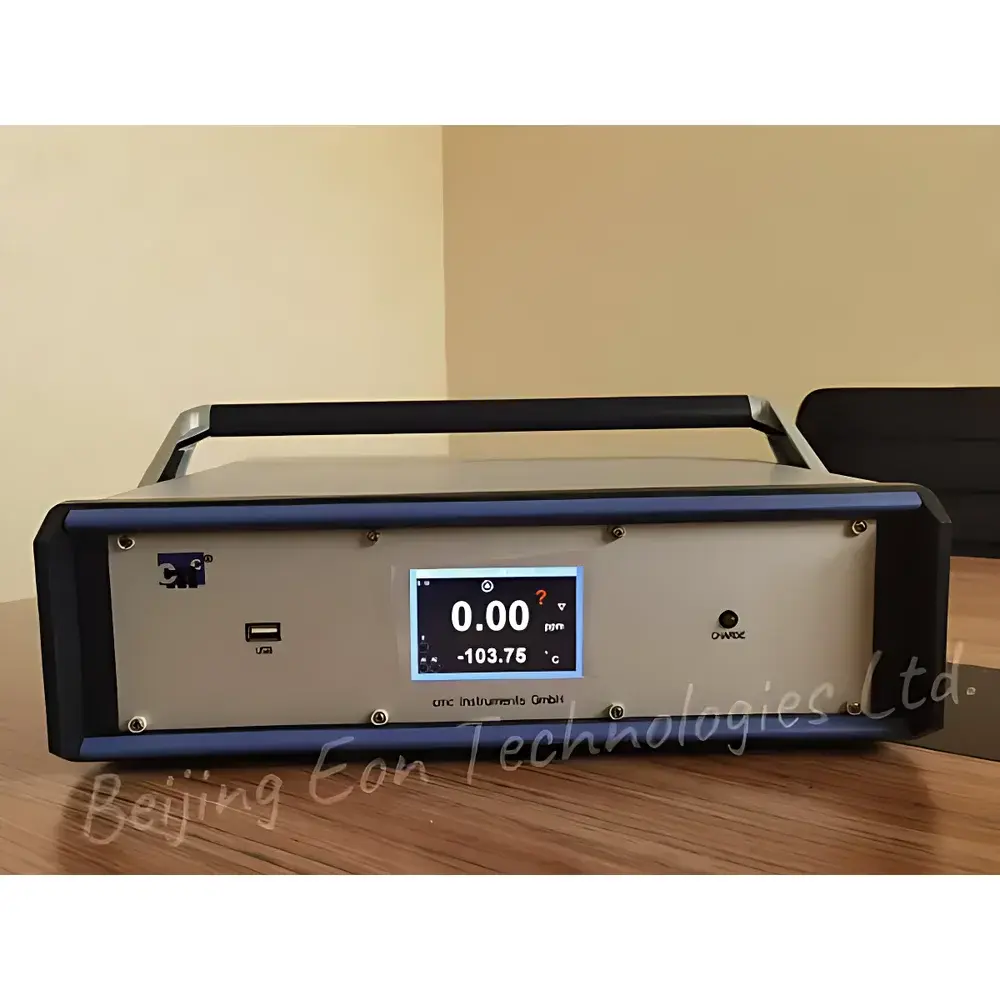
CMC iTMA-210-P Portable Electrolytic Dew Point Analyzer for Chlorine and Hydrogen Chloride
| Brand | CMC |
|---|---|
| Origin | Germany |
| Model | iTMA-210-P |
| Instrument Principle | Electrolytic (P₂O₅ sensor) |
| Operating Temperature | +5 to +50 °C |
| Accuracy | ±1% of full scale |
| Repeatability | ±0.1% of full scale |
| Measurement Range | 0–10 / 100 / 1000 / 2500 ppm (auto/manual range switching) |
| Display | Touchscreen with multilingual UI (including Chinese) |
| Output | 4–20 mA analog, high/low alarm relay |
| Power | Rechargeable Li-ion battery or 80–230 VAC, 50–60 Hz |
| Power Consumption | 8 W |
| Enclosure Rating | IP20 |
| Dimensions | 420 × 115 × 390 mm |
| Weight | ~6 kg |
Overview
The CMC iTMA-210-P is a portable, microprocessor-controlled electrolytic dew point analyzer engineered for trace moisture measurement in aggressive, corrosive, and flammable process gases—specifically optimized for chlorine (Cl₂), hydrogen chloride (HCl), sulfur dioxide (SO₂), hydrogen sulfide (H₂S), and other high-purity acid gases. Unlike capacitive or chilled-mirror technologies, the iTMA-210-P employs a solid-state P₂O₅ (phosphorus pentoxide) sensor based on the principle of quantitative electrolysis: water vapor in the sample gas is irreversibly decomposed into hydrogen and oxygen at a hygroscopic phosphoric acid (H₃PO₄)-coated electrode assembly. The resulting electrolytic current is directly proportional to the water concentration, enabling absolute, calibration-free measurement across four auto-switching ranges (0–10, 0–100, 0–1000, and 0–2500 ppmv). This fundamental electrochemical method eliminates drift-related recalibration needs and ensures metrological traceability without reliance on reference standards—critical for compliance with ISO 8573-1 (compressed air purity), ASTM D6673 (moisture in SF₆), and IEC 62271-4 (moisture in high-voltage insulating gases).
Key Features
- True absolute measurement via P₂O₅ electrolytic sensor—no zero/span drift, no periodic recalibration required under stable operating conditions
- Dual-electrode configuration housed in borosilicate glass cylinder; electrode materials selectable (Pt or Rh wire) for optimal chemical compatibility with Cl₂, HCl, and other reactive gases
- Ultra-fast response time (< 60 s to 90% of final value) and high sensitivity (±0.1% repeatability) suitable for real-time QC monitoring in chlor-alkali plants and semiconductor etch gas delivery systems
- Intelligent range management: automatic switching between 0–10 ppm and 0–2500 ppm ranges based on signal amplitude, minimizing operator error and maximizing dynamic resolution
- Integrated self-diagnostic routine at power-on: verifies sensor integrity, amplifier linearity, battery health, and communication interface status
- Compliant with NAMUR NE 43 signaling standards for analog output and alarm relay behavior—enabling seamless integration into DCS/PLC environments in hazardous-area-adjacent installations
Sample Compatibility & Compliance
The iTMA-210-P is validated for continuous online analysis of ultra-dry industrial gases where conventional sensors fail due to chemical attack or poisoning. It supports direct sampling of Cl₂ (liquid or gaseous), anhydrous HCl, SO₂, H₂S, F₂, PH₃, and halogenated refrigerants (e.g., R-134a, R-22) without conditioning or dilution. Excluded gases include NH₃, amines, and strong reducing agents that react stoichiometrically with P₂O₅ or degrade the H₃PO₄ electrolyte layer. All firmware and hardware design align with IEC 61000-6-2 (EMC immunity) and IEC 61000-6-4 (EMC emissions). While not intrinsically safe certified, its IP20 enclosure is rated for controlled indoor environments compliant with EN 60529 and suitable for use in non-classified zones adjacent to Class 1 Div 2 areas when installed per ISA-RP12.6.
Software & Data Management
The embedded touchscreen interface provides real-time ppmv readings, trend graphs (up to 72 h history), and configurable alarm thresholds with latching/non-latching relay outputs. Data logging is stored internally (≥10,000 records) with UTC timestamps and supports export via USB-C to CSV format. No proprietary software is required: raw data files are human-readable and compatible with LabVIEW, MATLAB, or LIMS platforms. Audit trail functionality meets GLP/GMP expectations—each parameter change, alarm event, or sensor regeneration action is timestamped and user-annotatable. While not FDA 21 CFR Part 11 compliant out-of-the-box, optional firmware upgrade enables electronic signature support and role-based access control for regulated pharmaceutical or biotech applications.
Applications
- Chlor-alkali production: monitoring moisture in liquefied chlorine prior to cylinder filling (per ISO 7505 and DIN 30951)
- HCl synthesis and purification: verifying <5 ppmv H₂O in anhydrous hydrogen chloride used for semiconductor-grade silicon etching
- Gas cylinder certification labs: validating moisture content in specialty gas blends per ISO 8573-8 and CGA G-4.1
- Power transformer SF₆ reclamation units: detecting hydrolysis byproducts before and after filtration
- R&D laboratories studying corrosion kinetics of metal alloys exposed to humidified Cl₂/HCl atmospheres
FAQ
Does the P₂O₅ sensor require periodic replacement?
No—under normal operation, the sensor is regenerable in situ via reverse-polarity current application, restoring the H₃PO₄ film without disassembly. Lifetime exceeds 2 years with daily use in Cl₂ service.
Can the iTMA-210-P measure moisture in wet chlorine containing HOCl or ClO₂?
No—oxidizing species beyond Cl₂ may interfere with the electrolytic reaction or degrade the electrode coating. Sample must be free of residual hypochlorous acid or chlorine dioxide.
Is external sample conditioning (e.g., pressure regulation or particulate filtration) required?
Yes—a 0.1 µm particulate filter and pressure regulator (set to 1–2 bar abs) are mandatory upstream to prevent sensor fouling and ensure laminar flow through the measurement cell.
How is traceability maintained without routine calibration?
The electrolytic principle is fundamentally absolute: water quantification relies on Faraday’s law of electrolysis. Factory verification against NIST-traceable dew point standards is documented in the Certificate of Conformance supplied with each unit.
What maintenance intervals are recommended for field operation?
Sensor regeneration every 3–6 months depending on sample cleanliness; battery health check every 12 months; annual verification of analog output linearity using a precision current source.




