
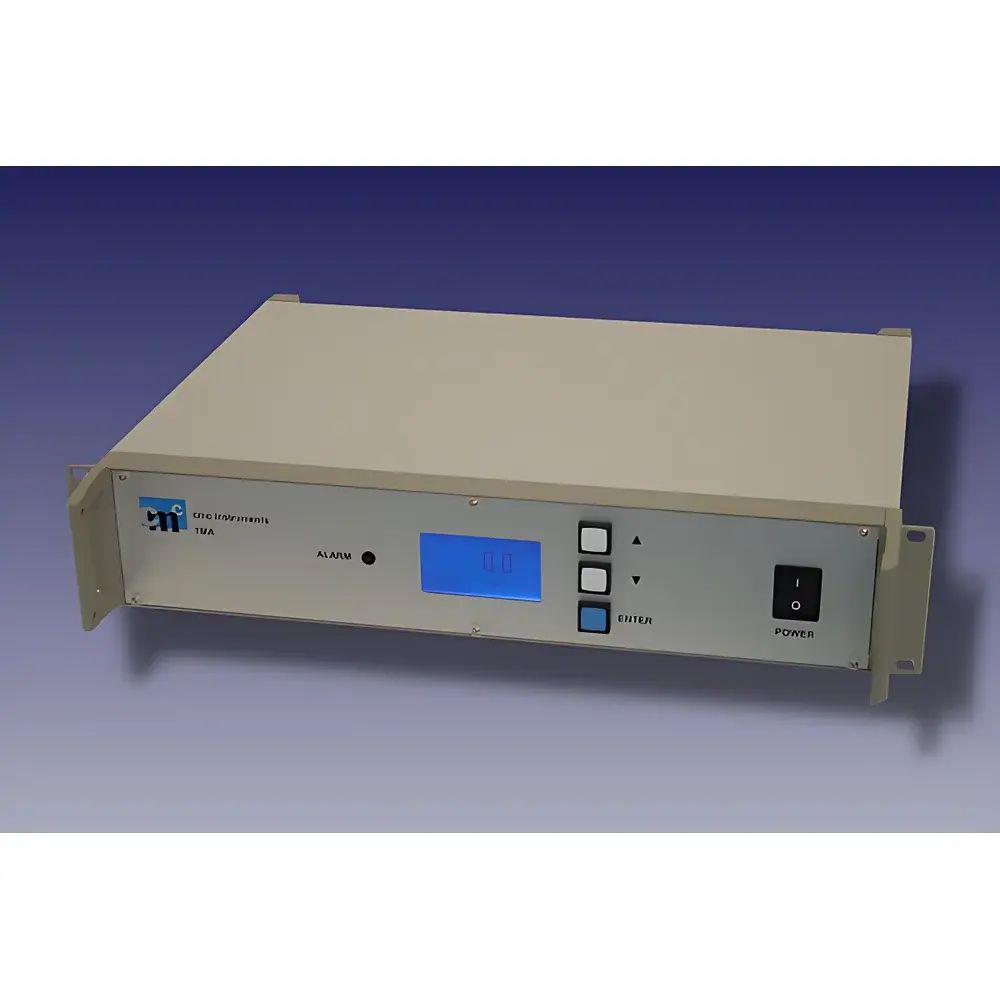
CMC TMA-102-19″ P₂O₅ Electrolytic Trace Moisture Analyzer for Chlorine and Hydrogen Chloride
| Brand | CMC (Schimse) |
|---|---|
| Origin | Germany |
| Model | TMA-102-19" |
| Instrument Principle | Phosphorus Pentoxide (P₂O₅) Electrolytic Method |
| Operating Temperature | -10 to 50 °C |
| Accuracy | ±1% of full scale |
| Repeatability | ±1% of full scale |
| Measurement Ranges | 0–10 ppm / 0–100 ppm / 0–1000 ppm / 0–2500 ppm (auto/manual range switching) |
| Power Supply | 80–230 VAC, 50–60 Hz |
| Analog Output | 4–20 mA / 0–20 mA / 0–10 V (selectable) |
| Alarm Output | 1 relay output |
| Enclosure | 19" rack-mount chassis, IP20 |
| Dimensions | 445 mm × 88 mm × 308 mm (W × H × D) |
| Weight | ~6 kg |
Overview
The CMC TMA-102-19″ is a high-stability, electrolytic trace moisture analyzer engineered for continuous, absolute measurement of water vapor in aggressive and reactive process gases—particularly chlorine (Cl₂), hydrogen chloride (HCl), sulfur dioxide (SO₂), hydrogen sulfide (H₂S), and other high-purity acid gases. Unlike optical or capacitive methods, it employs the fundamental electrochemical principle of phosphorus pentoxide (P₂O₅) electrolysis: water molecules are quantitatively decomposed into hydrogen and oxygen at a P₂O₅-coated electrode pair, generating a stoichiometric current directly proportional to the water concentration in the sample stream. This method delivers true zero-baseline, calibration-free operation over extended intervals—eliminating drift-related recalibration cycles typical of alternative sensor technologies. The instrument is designed for integration into industrial gas purification loops, cylinder filling stations, semiconductor etch gas supply lines, and chlor-alkali plant off-gas monitoring systems where long-term reliability under corrosive conditions is non-negotiable.
Key Features
- True absolute measurement principle: No reliance on reference standards or periodic span calibration; sensor regeneration restores baseline performance without hardware replacement
- P₂O₅ sensor architecture with dual parallel electrodes (Pt or Rh wire) coated with ultra-thin phosphoric acid (H₃PO₄) film—optimized for chemical stability in Cl₂ and HCl environments
- Auto-ranging capability across four selectable spans (0–10 ppm, 0–100 ppm, 0–1000 ppm, 0–2500 ppm), enabling seamless transition between ultra-trace and low-part-per-million moisture detection
- Full microprocessor control with built-in self-diagnostic routines at power-on and during continuous operation—verifies sensor integrity, amplifier gain, and signal path continuity
- NAMUR-compliant interface design: Supports standard 4–20 mA analog output with user-selectable scaling, plus one configurable relay alarm output for process interlock or maintenance alerting
- Rugged 19″ rack-mount enclosure (IP20) engineered for panel integration in control rooms or analyzer shelters; compact footprint (445 × 88 × 308 mm) minimizes space requirements
Sample Compatibility & Compliance
The TMA-102-19″ is validated for use with inert gases (He, Ne, Ar, Kr, Xe), diatomic gases (H₂, N₂, O₂, F₂), oxidizing species (O₃), halogenated compounds (SF₆, Freons), hydrocarbons (CH₄, C₂H₂), and critically—corrosive acid gases including Cl₂, HCl, SO₂, and H₂S. Its P₂O₅ sensor exhibits no cross-sensitivity to common interferents such as CO₂, CO, or NOₓ, provided the sample matrix does not contain reducing agents or strong nucleophiles that react with phosphoric acid (e.g., NH₃ or amines). The analyzer conforms to NAMUR NE 21/NE 43 recommendations for signal conditioning and fault reporting. While not intrinsically rated for hazardous areas, it may be deployed in Zone 2 or Class I, Division 2 environments when installed upstream of sample conditioning systems meeting ATEX/IECEx or NEC requirements.
Software & Data Management
The TMA-102-19″ operates as a stand-alone, embedded-system analyzer with no external PC dependency. All configuration—including range selection, analog output mapping, alarm thresholds, and unit display (ppmv, µL/L, or dew point °C)—is managed via front-panel membrane keypad and LCD interface. Internal non-volatile memory logs operational status, sensor voltage, electrolysis current, and diagnostic flags for up to 30 days at 1-minute intervals. Data export is supported via isolated 4–20 mA output connected to DCS/SCADA historians or PLC-based data acquisition systems. For laboratories requiring audit-ready records, the device supports optional RS-485 Modbus RTU communication (firmware upgrade required) compatible with LIMS integration and GLP/GMP-aligned electronic record retention per FDA 21 CFR Part 11 when paired with validated supervisory software.
Applications
- Real-time moisture monitoring in chlorine liquefaction and cylinder charging lines—ensuring compliance with ISO 8573-1 Class 1.1.1 or CGA G-4.1 specifications for Cl₂ purity
- In-line verification of HCl gas dryness prior to silicon epitaxy or polysilicon deposition reactors
- Quality assurance in SF₆ reclamation units servicing high-voltage switchgear, where residual moisture accelerates decomposition and arc byproduct formation
- Off-gas analysis from wet scrubbers handling SO₂/H₂S streams in flue gas desulfurization (FGD) systems
- Final purity certification of specialty gases used in photolithography, atomic layer deposition (ALD), and plasma etching tools
FAQ
Does the P₂O₅ sensor require periodic calibration with certified moisture standards?
No—the electrolytic principle provides absolute measurement traceable to Faraday’s law; calibration is only needed if sensor regeneration fails to restore baseline current, typically after >2 years of continuous operation in clean gas streams.
Can the TMA-102-19″ measure moisture in hot, pressurized Cl₂ lines directly?
No—sample gas must be conditioned to ambient pressure and ≤50 °C prior to inlet; optional CMC gas coolers and pressure regulators are available for high-temperature/pressure applications.
What maintenance is required for long-term operation?
Annual visual inspection of inlet filter and desiccant trap (if installed); sensor regeneration is performed automatically during idle periods or manually via front-panel command—no consumables or spare parts required under normal service conditions.
Is the 19″ chassis compatible with standard 19″ rack mounting hardware?
Yes—the unit meets EIA-310-D mechanical dimensions and includes pre-drilled mounting flanges for 19″ rack integration with standard cage nuts and screws.
How does the analyzer handle condensable contaminants like oil mist or particulates?
A certified coalescing filter (e.g., Parker Hannifin SS-100 series) and sintered metal particulate filter must be installed upstream; unfiltered gas will irreversibly foul the P₂O₅ film and invalidate measurement accuracy.





