
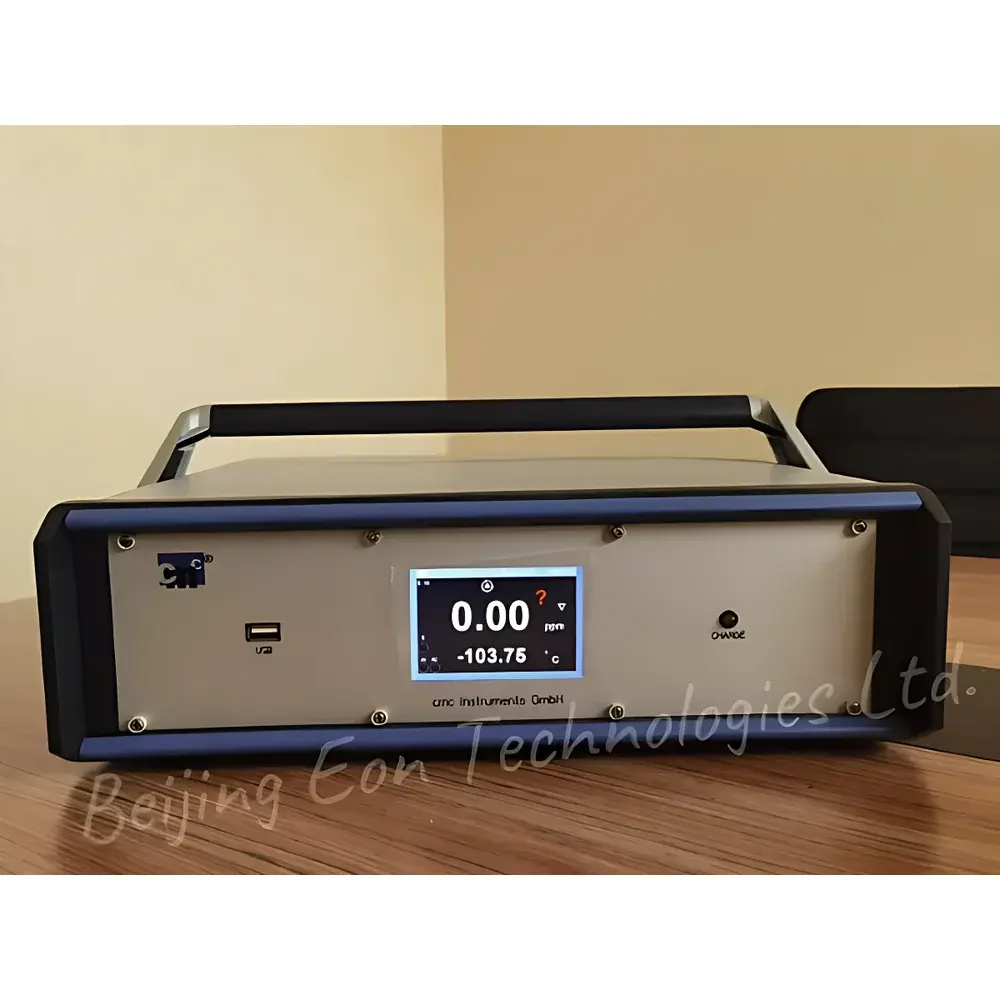
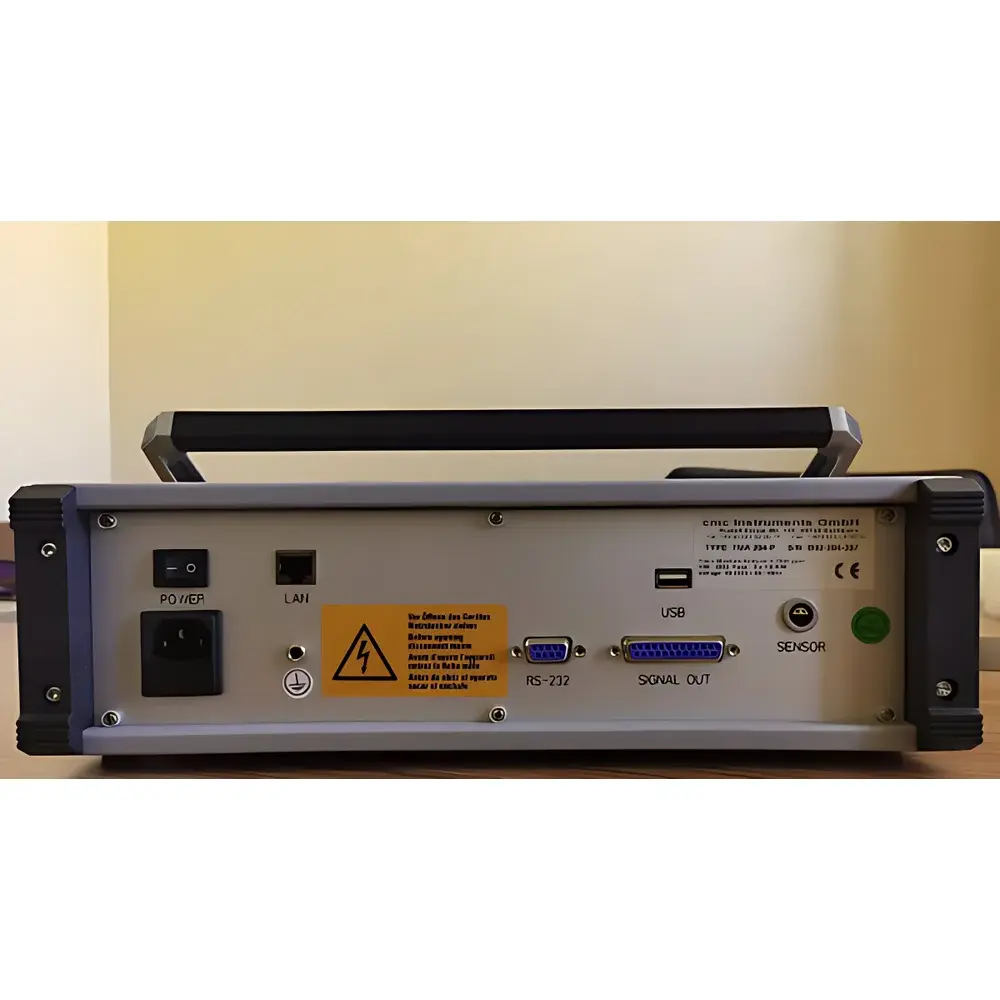
CMC TMA-204-P Portable Electrolytic P₂O₅ Dew Point Analyzer for Chlorine and Hydrogen Chloride
| Brand | CMC |
|---|---|
| Origin | Germany |
| Model | TMA-204-P |
| Instrument Principle | Electrolytic (P₂O₅ sensor) |
| Operating Temperature | +5 to +50 °C |
| Accuracy | ±1% of full scale |
| Repeatability | ±0.1% of full scale |
| Measurement Ranges | 0–10 ppm / 0–100 ppm / 0–1000 ppm / 0–2500 ppm (auto/manual range switching) |
| Response Time (T₉₀) | <1 s |
| T₅₀ Response | <8 s |
| Sample Flow Rate | 20 NL/h |
| Recommended Sample Pressure | 0.1–0.5 barg |
| Display | Touchscreen with multilingual UI (including Chinese) |
| Analog Output | 0/4–20 mA (configurable) |
| Alarm Outputs | High/Low limit relays (user-definable) |
| Power Supply | Internal rechargeable Li-ion battery or 80–230 VAC, 50–60 Hz |
| Dimensions | 363 × 115 × 377 mm (W × H × D) |
| Weight | ~6 kg |
| Cable Length | Standard 3 m (up to 300 m optional) |
Overview
The CMC TMA-204-P is a portable, microprocessor-controlled electrolytic moisture analyzer engineered for trace water measurement in aggressive and reactive process gases—particularly chlorine (Cl₂), hydrogen chloride (HCl), sulfur dioxide (SO₂), hydrogen sulfide (H₂S), and other high-purity acid gases. It employs the well-established phosphorus pentoxide (P₂O₅) electrolytic principle: water vapor in the sample gas is quantitatively decomposed into hydrogen and oxygen at a hygroscopic P₂O₅-coated electrode pair, generating an electrolytic current directly proportional to the water concentration. This absolute measurement method eliminates drift-related recalibration requirements under stable operating conditions and ensures long-term stability without zero/scale gas dependency. The sensor’s glass-bodied cylindrical construction, paired with inert platinum or rhodium electrodes and a precisely controlled H₃PO₄ electrolyte film, provides exceptional chemical resistance and metrological integrity in corrosive environments where traditional capacitive or chilled-mirror dew point sensors fail.
Key Features
- True absolute measurement principle—no calibration gases required for routine operation
- Electrolytic P₂O₅ sensor with regenerable electrode membrane for extended service life in Cl₂/HCl streams
- Ultra-fast response: T₉₀ < 1 second; T₅₀ < 8 seconds—enabling real-time monitoring of moisture transients in purge lines or cylinder validation
- Four auto-switching measurement ranges (0–10, 0–100, 0–1000, 0–2500 ppm) optimized for both ultra-trace and low-level moisture detection
- Integrated touchscreen interface with configurable language support—including English, German, French, and Chinese—for global field deployment
- Robust mechanical design compliant with NAMUR NE 21 and NE 43 standards for hazardous area instrumentation interfaces
- Dual power mode: internal rechargeable lithium-ion battery (≥8 h typical runtime) or universal AC input (80–230 VAC, 50–60 Hz)
- Full self-diagnostic startup sequence verifying sensor integrity, electronics functionality, and signal path continuity
Sample Compatibility & Compliance
The TMA-204-P is specifically validated for use with chemically demanding gases including Cl₂, HCl, SO₂, H₂S, F₂, PH₃, SF₆, and halogenated hydrocarbons (e.g., Freons), as well as noble gases (He, Ne, Ar, Kr, Xe), diatomic gases (H₂, N₂, O₂, O₃), and hydrocarbons (CH₄, C₂H₂, CO₂). Its P₂O₅ sensor avoids catalytic interference or surface adsorption artifacts common in metal-oxide or quartz-crystal sensors. While most applications require no periodic recalibration, users handling gases known to react with phosphoric acid (e.g., strong alkalis or ammonia) must consult CMC’s application note AN-TMA-02 prior to deployment. The analyzer meets CE marking requirements per Directive 2014/30/EU (EMC) and 2014/35/EU (LVD); its electrical interface complies with NAMUR NE 21 (output signal behavior) and NE 43 (fault signaling), facilitating integration into SIL-2-capable safety instrumented systems when used with certified logic solvers.
Software & Data Management
Data acquisition and configuration are managed via the embedded real-time operating system with non-volatile memory storing ≥30 days of timestamped moisture readings (1-min intervals default). All analog outputs (4–20 mA), relay alarms, and digital diagnostics are time-synchronized and logged with UTC timestamps. The device supports Modbus RTU over RS-485 (optional module) for SCADA integration and includes audit trail functionality compliant with GLP and GMP Annex 11 expectations: every parameter change, alarm event, or sensor regeneration command is recorded with user ID (if configured), timestamp, and pre-/post-value. Export is supported via USB-C port to CSV files compatible with LIMS and MES platforms. Firmware updates are performed securely via signed binary packages, preserving configuration integrity across revisions.
Applications
- Moisture verification in chlorine liquefaction and cylinder filling stations per ISO 8573-8 and ASTM D7443
- In-line monitoring of HCl synthesis off-gas and purification trains to prevent corrosion in downstream stainless steel piping
- Quality control of SF₆ for high-voltage switchgear—ensuring compliance with IEC 60480 limits (≤20 ppmv H₂O)
- Validation of dry air or nitrogen purge cycles in semiconductor fab tool chambers prior to process gas introduction
- Field verification of moisture content in natural gas transmission lines meeting GPA 2166 specifications
- Lab-grade reference analysis for calibrating tunable diode laser (TDLAS) or cavity ring-down (CRDS) analyzers
FAQ
Does the TMA-204-P require zero or span calibration during routine operation?
No—its electrolytic P₂O₅ sensor provides absolute measurement based on Faraday’s law. Only initial verification with NIST-traceable moisture standards is recommended upon commissioning or after sensor regeneration.
Can the analyzer be used in pressurized sample lines above 0.5 barg?
Yes, provided a calibrated pressure regulator and back-pressure controller are installed upstream to maintain the specified 0.1–0.5 barg inlet pressure range and prevent membrane stress or flow-induced turbulence.
Is the touchscreen interface suitable for glove-compatible operation in chemical handling areas?
Yes—the capacitive touch panel supports operation with standard nitrile or butyl rubber gloves, and all critical functions (range selection, alarm threshold setting, data export) are accessible via large, high-contrast icons with haptic feedback.
What maintenance intervals are recommended for field use?
Sensor membrane regeneration is typically required every 6–12 months depending on cumulative exposure to >100 ppm H₂O; full unit verification (electrical, thermal, flow) is advised annually per ISO/IEC 17025 guidelines.
How is traceability ensured for regulatory audits?
Each unit ships with a factory calibration certificate referencing EURAMET CG-16 and ISO/IEC 17025-accredited moisture standards. Digital logs include cryptographic hash signatures for tamper-evident audit trails compliant with FDA 21 CFR Part 11 when connected to validated network infrastructure.





