
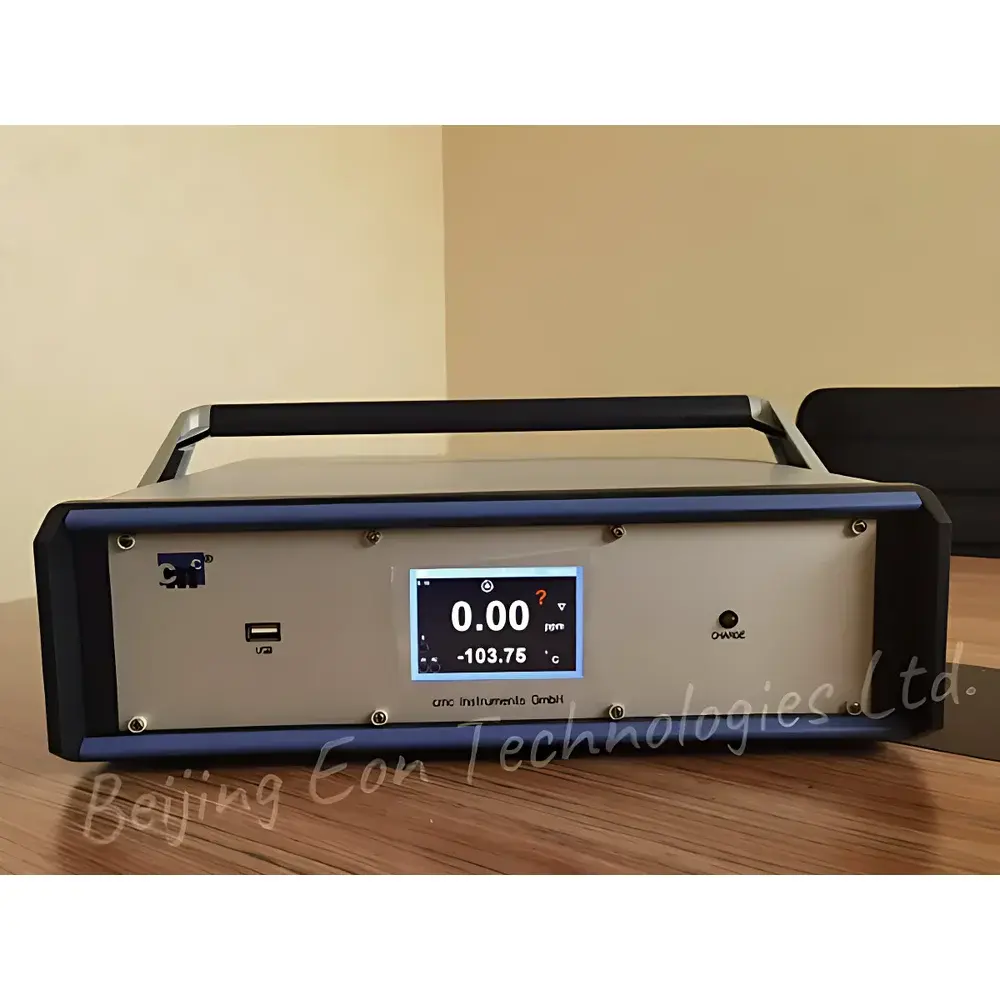
CMC TMA-210-P Portable Electrolytic Dew Point Analyzer
| Brand | CMC (HimSi) |
|---|---|
| Origin | Germany |
| Model | TMA-210-P |
| Instrument Principle | Electrolytic (P₂O₅ sensor) |
| Operating Temperature Range | +5 °C to +150 °C |
| Accuracy | ±1% of full scale |
| Repeatability | ±0.1% of full scale |
| Measurement Ranges | 0–10 ppm, 0–100 ppm, 0–1,000 ppm, 0–2,500 ppm (auto/manual range switching) |
| Display | Touchscreen with multilingual UI (including Chinese) |
| Alarm Outputs | Configurable high/low limit relays |
| Analog Output | 4–20 mA (user-configurable) |
| Power Supply | Internal rechargeable Li-ion battery or 80–230 VAC, 50–60 Hz |
| Power Consumption | 8 W |
| Environmental Operating Temp. | −10 °C to +50 °C |
| Enclosure Rating | IP20 |
| Dimensions | 363 mm (W) × 115 mm (H) × 377 mm (D) |
| Weight | ~6 kg |
Overview
The CMC TMA-210-P is a portable, microprocessor-controlled electrolytic dew point analyzer engineered for trace moisture quantification in industrial and laboratory gas streams. It employs the well-established phosphorus pentoxide (P₂O₅) sensor principle: moisture molecules in the sample gas are electrolytically decomposed at a hygroscopic H₃PO₄-coated electrode assembly into hydrogen and oxygen, yielding P₂O₅ as the stable reaction product. Since P₂O₅ exhibits exceptional affinity for water vapor, the system establishes a dynamic equilibrium between ambient moisture and the electrochemical cell. The resulting electrolysis current is directly proportional to the partial pressure of water vapor—enabling absolute, calibration-free measurement across its full operational range. Unlike optical or capacitive methods, this technique delivers inherent stability and immunity to interference from condensable organics or particulates, making it particularly suited for demanding applications involving corrosive, reactive, or high-purity process gases.
Key Features
- True absolute measurement principle—no periodic recalibration required under normal operating conditions
- P₂O₅ sensor architecture with dual parallel electrodes (Pt or Rh wire), housed in borosilicate glass cylinder for chemical inertness and thermal stability
- Ultra-fast response time (< 30 s to 90% of final value) due to minimal sensor dead volume and optimized gas flow path
- Four selectable measurement ranges (0–10 ppm, 0–100 ppm, 0–1,000 ppm, 0–2,500 ppm) with automatic or manual switching
- Integrated touchscreen interface supporting multilingual operation—including English, German, French, and Chinese—for global field deployment
- Onboard self-diagnostic routines executed at power-up and during continuous operation, verifying sensor integrity, amplifier gain, and power supply health
- Compliance with NAMUR NE 43 signaling standards for analog output and alarm relay behavior in process automation environments
Sample Compatibility & Compliance
The TMA-210-P demonstrates broad compatibility with non-reactive and moderately aggressive gases, including noble gases (He, Ne, Ar, Kr, Xe), diatomic gases (H₂, N₂, O₂, D₂), oxidizers (O₃, F₂), acid gases (Cl₂, HCl, SO₂, H₂S), halocarbons (SF₆, Freons), and hydrocarbons (CH₄, C₂H₂, CO₂). It is explicitly validated for use with high-purity specialty gases where moisture specifications fall below 1 ppmv—critical in semiconductor manufacturing, fiber optic cable production, and ultra-high-vacuum system commissioning. While P₂O₅ sensors are incompatible with strongly reducing agents (e.g., PH₃ beyond trace levels) or gases that chemically attack phosphoric acid (e.g., NH₃), the instrument’s firmware includes configurable gas-specific correction factors and warning flags to prevent erroneous interpretation. The device meets CE marking requirements and conforms to IEC 61000-6-2 (EMC immunity) and IEC 61000-6-4 (EMC emission) standards.
Software & Data Management
Data acquisition and configuration are managed via the embedded real-time operating system, which logs timestamped moisture readings, sensor voltage, temperature, and diagnostic status at user-defined intervals (1 s to 60 min). All data are stored internally on non-volatile flash memory (≥1 million records) and exportable via USB 2.0 to CSV or Excel-compatible formats. The unit supports optional PC-based configuration software (CMC ConfigTool v3.x) for advanced setup—including custom alarm hysteresis, analog output scaling, and password-protected parameter locking. While not natively compliant with FDA 21 CFR Part 11, audit trail functionality (user login, parameter change log, calibration event timestamping) can be enabled to support GLP/GMP-aligned quality systems when deployed in regulated pharmaceutical or biotech environments.
Applications
- Moisture monitoring in bulk gas delivery systems (on-site generators, cylinder banks, pipeline networks)
- Verification of dryness during purging of transformers, GIS switchgear, and SF₆-insulated equipment
- In-line verification of dryer performance in compressed air and nitrogen generation plants
- Quality control of electronic-grade gases used in CVD, ALD, and etching processes
- Field validation of cryogenic distillation column off-gas purity prior to liquefaction
- Research-grade moisture profiling in fuel cell feed gas streams and hydrogen refueling infrastructure
FAQ
Does the P₂O₅ sensor require periodic replacement or regeneration?
Yes—the sensor’s H₃PO₄ electrolyte film degrades over time due to cumulative electrolysis and exposure to trace contaminants. CMC recommends sensor regeneration every 12–24 months under typical use; full replacement is advised after 3–5 years or following exposure to condensable vapors or excessive moisture overload.
Can the TMA-210-P measure moisture in natural gas pipelines?
It is suitable for dry natural gas streams (< 50 ppmv H₂O) upstream of dehydration units or downstream of molecular sieve beds—but not for wet, hydrocarbon-saturated gas without prior conditioning (e.g., coalescing filtration and hydrocarbon removal), as heavy organics may coat the sensor surface.
Is the instrument compatible with hazardous area classifications?
No—the TMA-210-P carries an IP20 enclosure rating and is rated for non-hazardous locations only. For Zone 1/2 or Class I Div 1 environments, an explosion-proof barrier kit and intrinsically safe signal isolator must be integrated externally per IEC 60079-11 requirements.
What maintenance is required beyond sensor regeneration?
Routine maintenance includes quarterly verification of zero drift using dry nitrogen (≤0.1 ppmv), inspection of inlet filter integrity, and validation of battery charge cycle performance. No optical alignment or mechanical recalibration is necessary.
Related Products




