
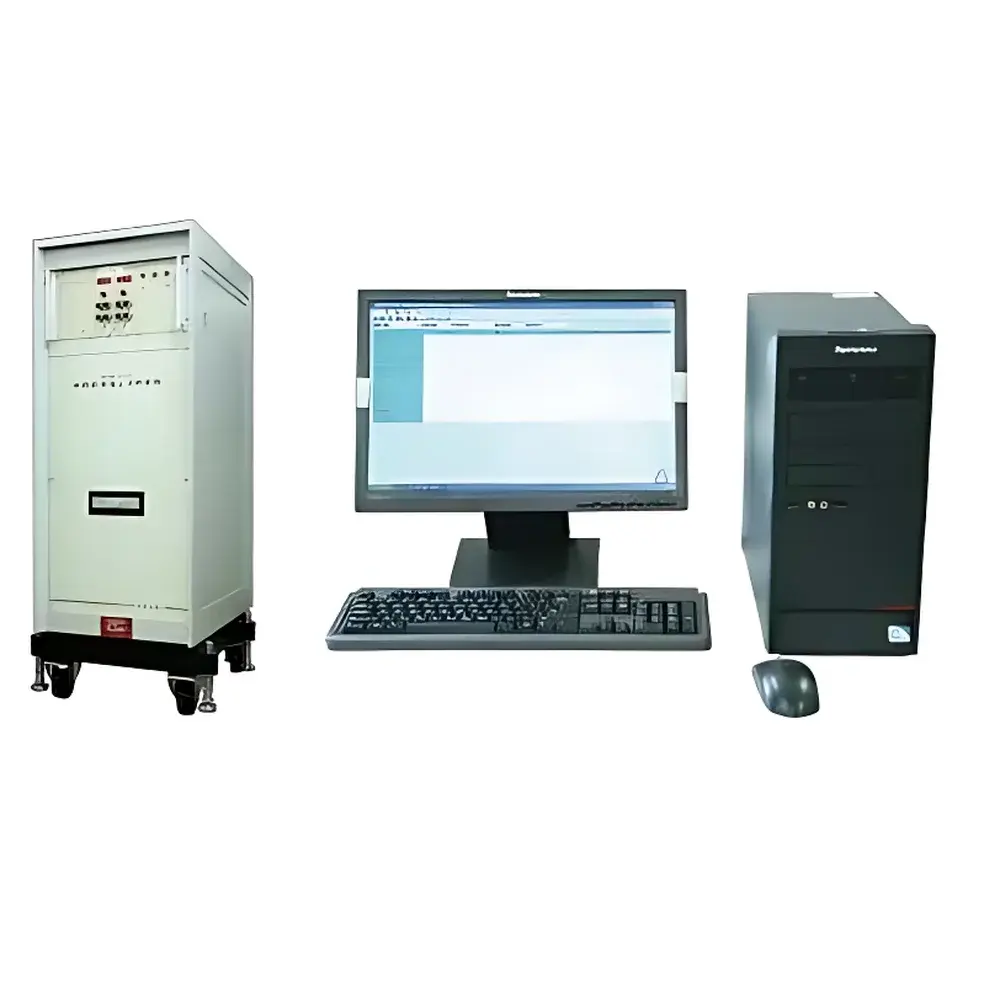
CNCS BH1227 Low-Background Alpha/Beta Liquid Scintillation Counter
| Brand | CNCS (China Nuclear Control Systems) |
|---|---|
| Origin | Beijing, China |
| Model | BH1227 |
| Instrument Type | Laboratory-Based Liquid Activity Meter |
| Measurement Medium | Aqueous Samples |
| Detector Type | Plastic Scintillator (ST-1221) with CR120 PMT |
| Measurement Capability | Simultaneous Total Alpha and Total Beta Activity Concentration |
| Detection Efficiency | β: 0.5×10⁻²–3×10⁻² Bq (10–40 mBq·L⁻¹) |
| α | 5×10⁻⁴ Bq (5–20 mBq·L⁻¹) |
| Anti-coincidence Shielding | ST401 Plastic Scintillator + Three CR119 PMTs (Efficiency >99%) |
| Shielding | 75 mm Lead + 15 mm Steel Enclosure (Modular Two-Section Design) |
| Counting Area Options | Φ30 mm (177.5 px²), Φ45 mm (397.5 px²), Φ52 mm (525 px²) |
| Compliance | Meets GB/T 11682–2003 (Chinese National Standard for Low-Background Alpha/Beta Counters, Grade II) |
Overview
The CNCS BH1227 Low-Background Alpha/Beta Liquid Scintillation Counter is a laboratory-grade activity meter engineered for precise quantification of total alpha and total beta radioactivity in aqueous environmental and regulatory samples. It operates on the principle of dual-channel plastic scintillation detection—where alpha and beta emissions induce distinct light pulses in low-background ST-1221 scintillator material, differentiated by pulse shape and energy threshold discrimination. Four independent counting channels enable parallel analysis of up to four samples without cross-talk or throughput compromise. The system integrates active anti-coincidence shielding using a triple-PMT parallel-plate configuration (ST401 scintillator + CR119 photomultipliers) to suppress cosmic-ray-induced background events, achieving >99% anti-coincidence efficiency. Its shielded architecture—comprising 75 mm lead and 15 mm structural steel—meets the attenuation requirements specified in GB/T 11682–2003 (Grade II low-background instrumentation standard), delivering a typical background count rate below 0.05 cpm per channel under optimized conditions.
Key Features
- Four fully independent measurement channels with simultaneous alpha/beta discrimination per sample
- Modular ST-1221 plastic scintillator detectors with selectable active areas (Φ30 mm, Φ45 mm, or Φ52 mm) — chemically resistant, cleanable surface, long-term stability
- Low-noise CR120 photomultiplier tubes coupled directly to scintillators for high signal-to-noise ratio
- Dual high-voltage power supplies (3 kV each) with independent channel regulation for consistent gain stability
- Integrated anti-coincidence veto system using three CR119 PMTs and ST401 plastic scintillator panel (300 × 50 mm)
- Removable upper lead chamber (100 mm effective thickness) for simplified sample loading and maintenance access
- Embedded microcontroller-based measurement control unit with real-time dead-time correction and spectral validation
Sample Compatibility & Compliance
The BH1227 is validated for liquid-phase analysis of acid-digested or evaporated environmental matrices—including drinking water, groundwater, seawater, rainwater, and effluent samples—following standardized preparation protocols (e.g., evaporation to dryness, nitric acid dissolution, and planchet mounting). It complies with Chinese national standards GB/T 11682–2003 (Grade II performance classification) and supports method development aligned with ISO 9698:2019 (Water quality — Determination of gross alpha and gross beta activity concentrations — Liquid scintillation counting method). While not pre-certified for FDA 21 CFR Part 11 or EU Annex 11, its audit-ready data logging architecture—including timestamped raw counts, calibration metadata, and operator ID fields—facilitates integration into GLP- or GMP-compliant workflows upon local validation.
Software & Data Management
The instrument ships with CNCS-AlphaBeta v3.2 acquisition and analysis software (Windows OS compatible), featuring bilingual UI support (English/Chinese toggle), context-sensitive help, and automated sequence execution. All measurements are stored in encrypted SQLite databases with immutable audit trails: each record includes sample ID, geometry, counting duration, background subtraction parameters, decay correction settings (user-definable half-lives), and QC flag status. Export formats include CSV (for LIMS ingestion), PDF (print-ready reports with calibration certificates), and XML (for interoperability with laboratory information management systems). Software supports multi-point efficiency calibration using traceable NIST-traceable alpha/beta reference sources (e.g., ²⁴¹Am, ⁹⁰Sr/⁹⁰Y, ²³⁰Th).
Applications
- Environmental radiation monitoring: routine surveillance of drinking water supplies and nuclear facility discharge streams per national regulatory limits
- Radiological emergency response: rapid screening of field-collected water samples following radiological incidents
- Geological survey laboratories: characterization of natural radionuclides (²³⁸U, ²³²Th series, ⁴⁰K) in hydrological studies
- Pharmaceutical QA/QC: verification of radiopurity in radiopharmaceutical synthesis intermediates and final products
- Academic research: low-level radioecology, sediment chronology (²¹⁰Pb dating), and atmospheric deposition studies
- Custom regulatory compliance: method adaptation for IAEA Safety Standards Series No. RS-G-1.7 and EURATOM Directive 2013/51/Euratom
FAQ
What sample preparation methods are recommended for optimal BH1227 performance?
Evaporation to dryness followed by homogenous resuspension in dilute nitric acid (0.1–1 M) and transfer to standardized planchets is preferred. Membrane filtration is acceptable for suspended particulates but requires separate blank correction.
Can the BH1227 measure solid samples directly?
No—it is configured exclusively for liquid or solution-state samples. Solid matrices must be acid-digested or leached prior to analysis.
Is hardware calibration traceable to international standards?
Yes; detector efficiency calibrations use NIST-traceable alpha (²⁴¹Am) and beta (⁹⁰Sr/⁹⁰Y) point sources, with certificate-of-calibration provided for each delivered unit.
How is background variability managed across extended operation?
The system performs automatic background trending over 72-hour intervals and applies dynamic correction factors during sample analysis—configurable via software thresholds.
Does the BH1227 support remote monitoring or network integration?
Local Ethernet connectivity enables TCP/IP-based command-and-control (SCPI-compatible subset) and secure file transfer (SFTP), supporting centralized lab network deployment with appropriate firewall configuration.
Related Products







