
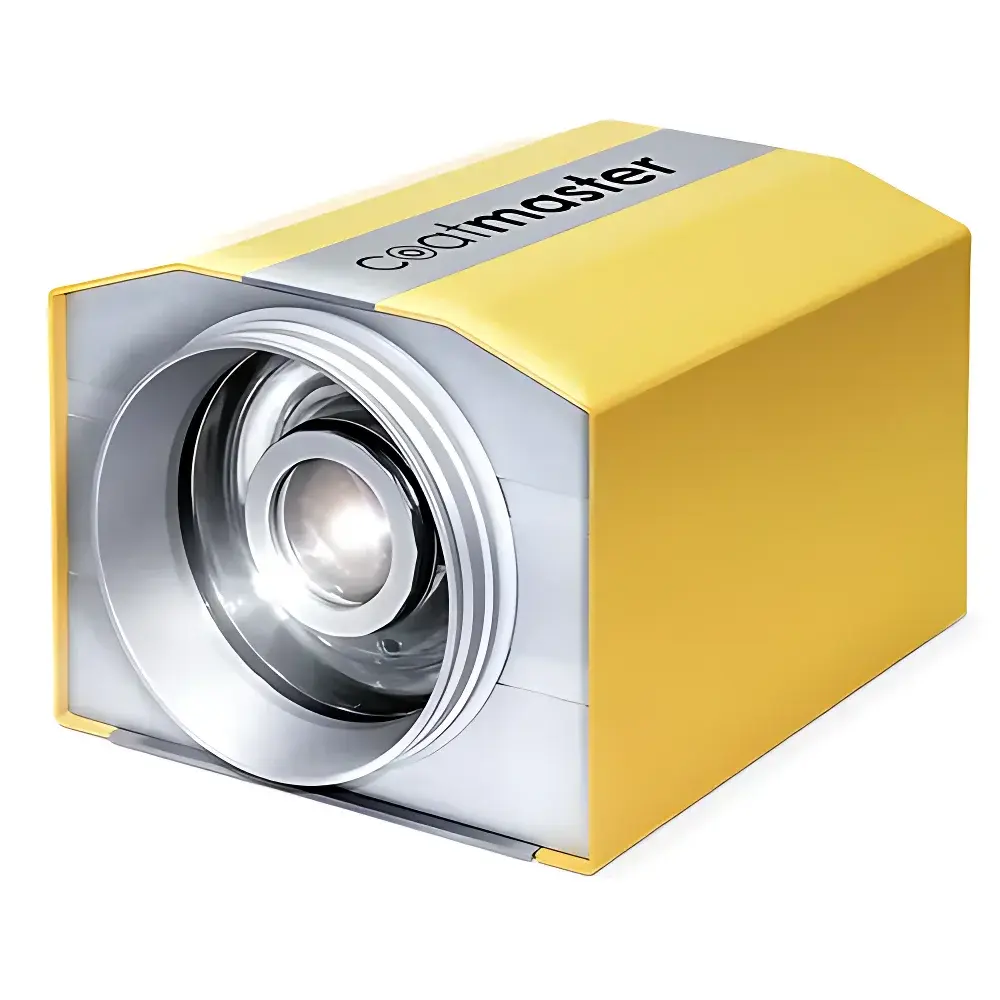
Coatmaster Inline Full-Scale Non-Contact Wet-Film Thickness Gauge for Coil Coating Applications
| Brand | Coatmaster |
|---|---|
| Origin | Switzerland |
| Model | Inline Full |
| Measurement Principle | Advanced Photothermal (ATO) Method with DSP-Based Real-Time Analysis |
| Compliance | Designed for ISO/IEC 17025-aligned QC environments, compatible with GLP/GMP data integrity requirements |
| Output Interface | Ethernet/IP, OPC UA, analog 4–20 mA |
| Operating Speed Range | Up to 800 m/min |
| Spot Size | Adjustable (typically 3–10 mm Ø) |
| Environmental Rating | IP65 industrial enclosure |
Overview
The Coatmaster Inline Full-Scale Non-Contact Wet-Film Thickness Gauge is an engineered solution for real-time, non-destructive measurement of uncured organic coatings applied to continuous metal strip substrates in coil coating lines. It operates on the principle of Advanced Photothermal Analysis (ATO), a physics-based technique that combines controlled optical excitation with high-speed thermal response detection. A calibrated pulsed light source uniformly heats a localized area of the wet film surface; an integrated high-frame-rate infrared detector captures the transient surface temperature decay profile at microsecond resolution. Since the thermal diffusion time constant is directly correlated with both coating thickness and its effective thermal diffusivity—governed by composition, solids content, and solvent volatility—the system computes wet-film thickness through proprietary inverse modeling algorithms validated against reference gravimetric and dry-film cross-section measurements. Unlike beta-backscatter or eddy-current gauges, ATO requires no radioactive sources, physical contact, or substrate conductivity assumptions, making it uniquely suited for multi-layer, low-Z polymer systems on aluminum, galvanized steel, or pre-treated stainless substrates.
Key Features
- True non-contact operation: No mechanical interference with moving web, eliminating wear, calibration drift, or risk of surface damage.
- Real-time wet-film thickness output at line speeds up to 800 m/min, synchronized to encoder-triggered spatial sampling intervals as fine as 1 mm.
- Simultaneous wet- and dry-film equivalent thickness estimation via embedded material-specific calibration matrices, supporting rapid process feedback prior to curing.
- Ruggedized IP65 housing with active thermal stabilization, rated for ambient temperatures from 5 °C to 45 °C and relative humidity ≤85% non-condensing.
- Modular optical head design allows flexible mounting configurations—top-down, side-view, or dual-head differential mode—for edge-to-edge profiling across widths up to 2,200 mm.
- Integrated diagnostics including beam alignment monitoring, detector saturation detection, and ambient IR background compensation.
Sample Compatibility & Compliance
The system is validated for aqueous and solvent-borne coil coatings—including acrylics, polyesters, PVDF, and epoxy primers—with solids content ranging from 25% to 75% w/w and wet-film thicknesses between 5 µm and 150 µm. It accommodates dynamic web motion with lateral runout ≤±2 mm and vertical vibration amplitudes up to 0.5 mm peak-to-peak without signal degradation. From a regulatory standpoint, the instrument supports audit-ready data capture per FDA 21 CFR Part 11 requirements when paired with compliant SCADA or MES platforms; raw thermal transients and processed thickness values are timestamped, digitally signed, and stored with full metadata (line speed, zone temperature, coating ID). Calibration traceability follows ISO/IEC 17025 principles using NIST-traceable reference standards prepared under ASTM D7091 and ISO 2808 protocols.
Software & Data Management
Coatmaster Control Suite v5.x provides a Windows-based HMI with configurable dashboards, real-time thickness mapping (2D heatmaps), statistical process control (SPC) charts (X̄/R, Cpk), and automated alarm triggers based on user-defined upper/lower control limits. All measurement data—including raw IR frames, fitted decay curves, and thickness grids—is exported in CSV, HDF5, or OPC UA-compatible formats. The software includes built-in tools for multi-point calibration validation, drift correction via reference stripe analysis, and batch-level reporting aligned with IATF 16949 documentation requirements. Audit trails record operator logins, parameter changes, calibration events, and data export actions with immutable timestamps.
Applications
- Primary coil coaters performing architectural, appliance, or automotive-grade pre-painted metal production.
- Quality assurance labs conducting incoming inspection of coated strip prior to slitting or stamping.
- Process engineering teams optimizing applicator settings (e.g., roll gap, viscosity, pressure) using closed-loop feedback from inline thickness deviation maps.
- Environmental compliance initiatives targeting VOC reduction—precise wet-film control minimizes over-application and subsequent solvent emissions during cure.
- Technical service support for troubleshooting edge-thinning, orange peel, or cratering defects linked to localized thickness variation.
FAQ
Can the system measure thickness on highly reflective or transparent coatings?
Yes—ATO is insensitive to optical reflectivity or transparency because it relies on absorbed photon energy conversion to heat, not reflected intensity. Coatings with absorption coefficients >10³ cm⁻¹ at the excitation wavelength (typically 808 nm or 940 nm) yield optimal signal-to-noise ratios.
Is recalibration required when switching between different coating chemistries?
A chemistry-specific calibration matrix must be loaded for each product family; however, no hardware adjustment is needed. Matrix generation requires only three representative wet-film thickness levels measured offline using destructive reference methods.
How does ambient lighting or furnace radiation affect measurement accuracy?
The system employs narrowband spectral filtering and lock-in amplification synchronized to the optical pulse train, rejecting broadband IR noise from ovens or plant lighting with >60 dB suppression.
What level of integration is supported with existing PLC or MES infrastructure?
Native support for Siemens S7-1500, Rockwell ControlLogix, and Schneider Modicon PACs via EtherNet/IP and Profinet; OPC UA server enables bidirectional data exchange with PI System, Ignition, or custom MES applications.



