
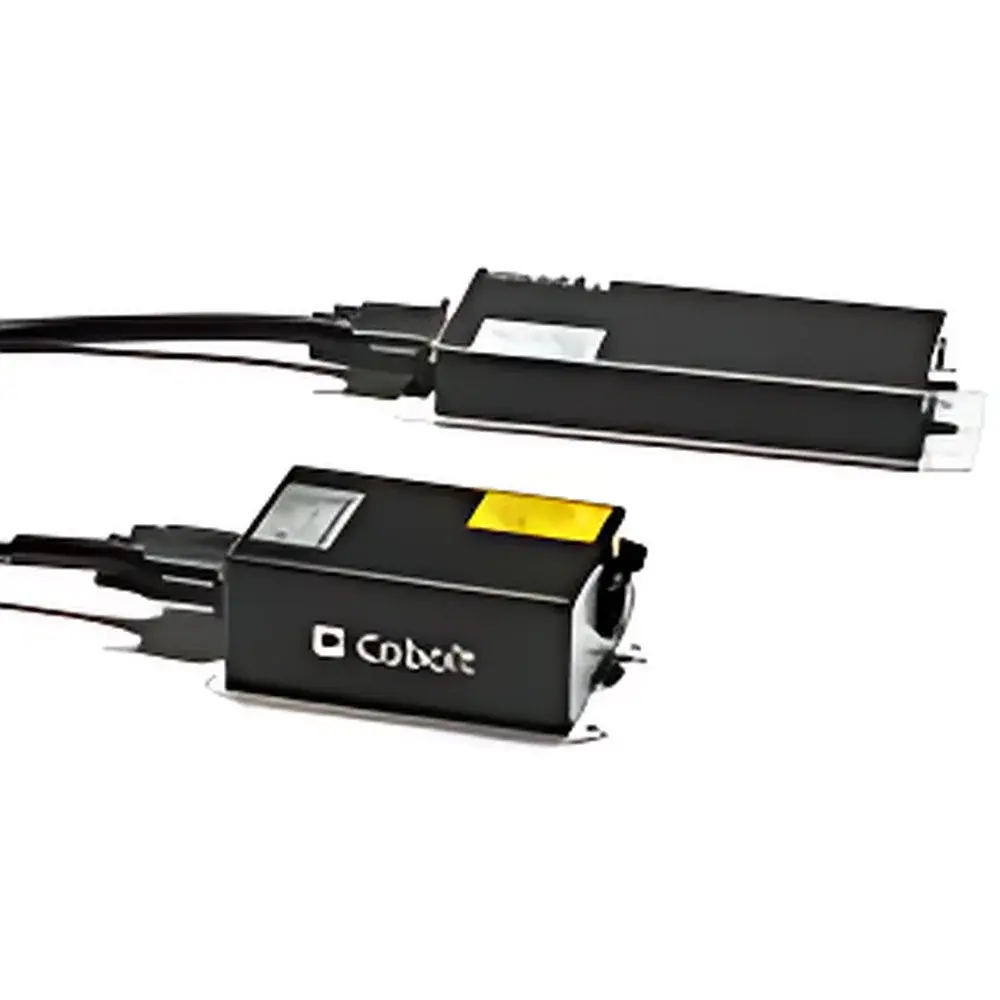
Cobolt NewOpto Series Passive Q-Switched Nanosecond Pulsed Laser
| Brand | Cobolt |
|---|---|
| Origin | Sweden |
| Model | NewOpto |
| Wavelength | 1064 nm / 532 nm / 355 nm |
| Pulse Energy | 30–150 μJ |
| Repetition Rate | >7 kHz |
| Pulse Width | <5 ns |
| Peak Power | >6 kW to >30 kW |
| Average Power | >0.2 W to >1.0 W |
| Pulse-to-Pulse Jitter | <1 μs |
| Polarization Extinction Ratio | Vertical, >100:1 |
| Beam Profile | TEM₀₀, M² < 1.2–1.3 |
| Beam Symmetry | >1:0.80–0.90 |
| Warranty | 12 months |
Overview
The Cobolt NewOpto Series is a family of compact, diode-pumped solid-state (DPSS) nanosecond pulsed lasers engineered for high stability and OEM integration in demanding scientific and industrial applications. Utilizing passive Q-switching with semiconductor saturable absorber mirrors (SESAMs), these lasers deliver precise, temporally stable optical pulses across three fundamental harmonics—1064 nm (fundamental), 532 nm (second harmonic), and 355 nm (third harmonic)—without external electronic modulation or active cavity control. The architecture ensures intrinsic synchronization between pulse generation and pump diode current, minimizing timing jitter and enabling reliable triggering for time-resolved measurements. Designed for continuous-duty operation under ambient laboratory or embedded system conditions, the NewOpto platform complies with IEC 60825-1:2014 Class 4 laser safety requirements and features integrated thermal management and hermetically sealed optics to maintain long-term beam pointing stability and power consistency.
Key Features
- Passive Q-switched DPSS design eliminates need for RF drivers or external modulators, reducing system complexity and electromagnetic interference (EMI)
- Sub-5 ns pulse width with <1 µs pulse-to-pulse timing jitter—critical for time-of-flight (ToF), LIBS, and fluorescence lifetime imaging (FLIM)
- TEM₀₀ spatial mode with M² 1:0.80 ensures diffraction-limited focusing for high-resolution ablation and nonlinear frequency conversion
- Vertical linear polarization with extinction ratio >100:1 supports polarization-sensitive experiments including Raman spectroscopy and electro-optic sampling
- Robust mechanical housing with industry-standard 30 mm cage system compatibility and integrated mounting flanges for rapid integration into optical tables or custom enclosures
- Compliant with RoHS 2011/65/EU and REACH (EC) No. 1907/2006; CE-marked for EMC Directive 2014/30/EU and Low Voltage Directive 2014/35/EU
Sample Compatibility & Compliance
The NewOpto Series is compatible with standard optical components rated for nanosecond pulse durations and peak intensities up to 1 GW/cm² at 1064 nm. Its output meets ISO 11146-1:2005 beam parameter measurement standards and is suitable for use in regulated environments requiring traceable calibration—including ISO/IEC 17025-accredited laboratories. While not pre-certified for FDA 21 CFR Part 11, the laser’s deterministic trigger interface (TTL-compatible sync output) enables seamless integration with validated data acquisition systems supporting audit trail and electronic signature requirements per GMP/GLP frameworks. All units undergo 100% factory burn-in testing and include full spectral, temporal, and spatial characterization reports.
Software & Data Management
Cobolt provides the NewOpto Control Suite—a cross-platform (Windows/macOS/Linux) application built on Qt and libusb—for real-time monitoring of operating temperature, pump current, and internal photodiode feedback. The suite supports SCPI-compliant USB and RS-232 communication protocols, enabling script-driven control via Python (pySerial), MATLAB Instrument Control Toolbox, or LabVIEW. Logging functionality records timestamped operational parameters (e.g., pulse energy drift, repetition rate deviation) in CSV format for trend analysis and preventive maintenance planning. Optional OEM firmware allows embedding of user-defined safety interlocks and hardware-enforced power limits aligned with site-specific laser safety officers’ (LSOs) protocols.
Applications
- Laser-Induced Breakdown Spectroscopy (LIBS) for elemental analysis in metallurgy, geology, and planetary exploration rovers
- Time-resolved fluorescence and phosphorescence decay studies in photochemistry and biophysics
- Pump-probe spectroscopy requiring synchronized dual-wavelength excitation (e.g., 1064 nm pump + 532 nm probe)
- Micromachining of polymers, thin-film solar cells, and transparent conductive oxides where thermal load must be minimized
- OEM integration into portable environmental sensors for atmospheric aerosol detection via elastic backscatter lidar (e.g., 355 nm channel)
- Seed source for optical parametric oscillators (OPOs) targeting mid-IR spectral regions (3–12 µm) in gas sensing applications
FAQ
Is the NewOpto Series compatible with third-party pulse pickers or amplifiers?
Yes—its low-jitter TTL sync output and consistent pulse train enable reliable triggering of external acousto-optic modulators (AOMs) and regenerative amplifiers. External cavity length matching is recommended for sub-nanosecond synchronization.
What cooling method does the laser require?
Air-cooling only; no water chiller or thermoelectric cooler (TEC) integration is necessary. Ambient operating temperature range is +15 °C to +35 °C with <80% non-condensing humidity.
Can output wavelength be customized beyond 1064/532/355 nm?
No—harmonic generation stages are fixed per model variant. However, the 1064 nm fundamental output may be used as input for external nonlinear crystals (e.g., BBO, LBO) to generate additional wavelengths under user-controlled phase-matching conditions.
Does the warranty cover field-replaceable modules?
The 12-month limited warranty covers defects in materials and workmanship. Field-replaceable units (FRUs), including pump diodes and SESAMs, are available under separate service agreements with documented recalibration and alignment verification.
How is beam pointing stability quantified over time?
Beam pointing drift is specified as <5 µrad RMS over 8 hours at constant ambient temperature, measured per ISO 11551:2008 using quadrant photodiode tracking and digital signal averaging.




