
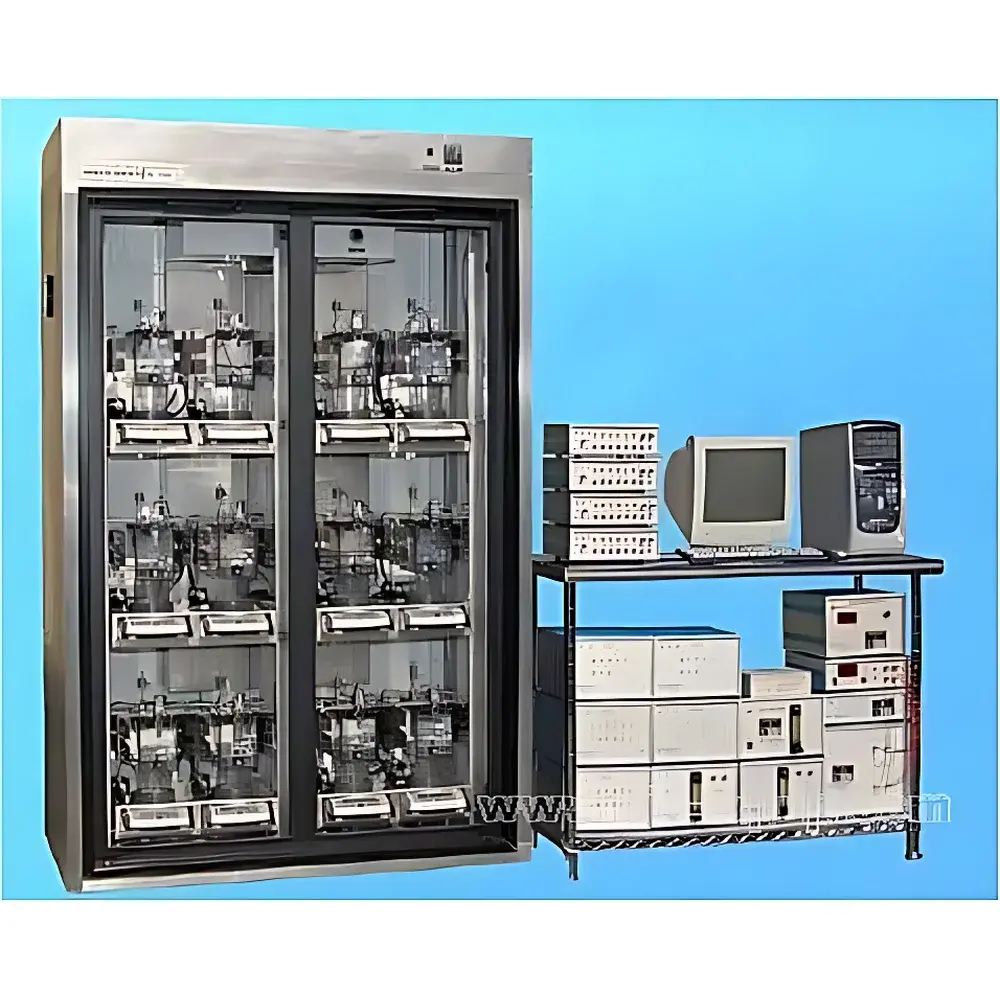
Columbus Instruments CLAMS Comprehensive Laboratory Animal Monitoring System
| Brand | Columbus Instruments |
|---|---|
| Origin | USA |
| Manufacturer Type | Authorized Distributor |
| Product Origin | Imported |
| Model | CLAMS |
| Pricing | Upon Request |
Overview
The Columbus Instruments CLAMS (Comprehensive Laboratory Animal Monitoring System) is a modular, open-circuit indirect calorimetry and multimodal phenotyping platform engineered for longitudinal, non-invasive assessment of energy metabolism and behavioral physiology in rodents. Operating on the principle of mass-flow–normalized gas exchange analysis, CLAMS precisely quantifies oxygen consumption (VO₂), carbon dioxide production (VCO₂), respiratory exchange ratio (RER), and derived heat production (kcal/h) under standardized STP conditions (0 °C, 760 mmHg), eliminating temperature- and pressure-induced volumetric drift. Unlike volumetric systems, CLAMS employs high-stability mass-flow sensors calibrated to absolute gas mass—ensuring metrological traceability and inter-laboratory reproducibility. The system supports parallel monitoring of up to 32 individually housed animals across customizable metabolic cages, with fully automated operation for continuous 72-hour acquisition cycles. All subsystems—including activity tracking, feeding/water intake, wheel running, sleep staging, telemetry-based core body temperature and heart rate, and optional environmental sensing—are synchronized via a centralized control architecture compliant with GLP data integrity requirements.
Key Features
- Open-circuit indirect calorimetry with STP-normalized mass-flow gas analysis (VO₂, VCO₂, RER, heat)
- Simultaneous 12-channel gas measurement with CO₂ detection limit of ±0.001% and O₂ resolution of ±0.01%
- Triaxial activity monitoring (X/Z-plane locomotion + gait event detection) using calibrated infrared beam arrays
- Automated feeding and drinking assessment with dual-compartment feeders (primary intake + spill capture) to minimize mass error
- Non-invasive sleep staging algorithm analyzing bout count, mean bout duration, total sleep time, and latency metrics
- Wireless telemetry integration for concurrent core temperature and heart rate acquisition across 1–32 mice (upgradeable to blood pressure)
- Modular cage expansion: scalable from 1 to 32 metabolic chambers without hardware reconfiguration
- Real-time data visualization: numeric tables and dynamic plots updated at user-defined intervals during acquisition
Sample Compatibility & Compliance
CLAMS is validated for C57BL/6, BALB/c, DBA/2, and other common inbred/outbred mouse strains (18–40 g); rat configurations available upon request. All metabolic cages comply with NIH Guide for the Care and Use of Laboratory Animals housing specifications. Gas analyzers meet ASTM D6866-22 requirements for CO₂/O₂ sensor calibration traceability. Data acquisition software adheres to FDA 21 CFR Part 11 criteria for electronic records and signatures, including full audit trail logging, user role-based access control, and immutable raw data archiving. System validation documentation supports ISO/IEC 17025-compliant laboratory accreditation workflows.
Software & Data Management
The CLAMS Control & Analysis Suite runs on a dedicated Windows-based workstation with real-time synchronization of all subsystem clocks (±10 ms precision). Raw data streams are stored in binary format with embedded metadata (cage ID, timestamp, calibration constants, operator ID). Export functions support CSV, Excel (.xlsx), and HDF5 formats for interoperability with MATLAB, Python (Pandas/NumPy), R, and commercial biostatistics platforms. Integrated data reduction tools enable cohort-level parameter grouping, normalization (e.g., per gram lean mass), and statistical overlay (ANOVA, RM-ANOVA, post-hoc Tukey). All plots retain original measurement units and STP correction flags; no proprietary file locking is enforced.
Applications
- Preclinical evaluation of anti-obesity therapeutics and metabolic syndrome models
- Chronobiology studies requiring 72-hour uninterrupted circadian rhythm profiling
- Neurobehavioral phenotyping in transgenic lines (e.g., Alzheimer’s, Parkinson’s models)
- Diet-induced obesity (DIO) and caloric restriction intervention trials
- Toxicology assessments integrating metabolic stress response with activity and sleep architecture
- Validation of wireless telemetry endpoints against gold-standard indirect calorimetry baselines
- Environmental perturbation studies using optional integrated sensors (ambient T°, RH, barometric pressure, photoperiod)
FAQ
What is the maximum continuous acquisition duration without manual intervention?
CLAMS supports fully automated 72-hour acquisitions; food and water can be replenished mid-run without system reset or data loss.
Can existing CLAMS installations be upgraded to include telemetry or environmental monitoring?
Yes—hardware modules (telemetry receivers, environmental sensor hubs) and corresponding software licenses are field-installable with firmware version 4.2 or later.
Is STP normalization applied automatically during acquisition or only during post-processing?
STP correction is applied in real time using live barometric and temperature inputs from integrated or optional external sensors—no post-hoc recalibration required.
Does CLAMS comply with regulatory submission requirements for IND-enabling studies?
Yes—the system’s Part 11-compliant audit trail, electronic signature workflow, and documented IQ/OQ/PQ protocols satisfy FDA and EMA expectations for nonclinical study data integrity.
How is feeding accuracy maintained when animals scatter food pellets?
The dual-chamber feeder design captures >98.7% of spillage (per internal validation report CR-CLAMS-FEED-2023), with mass-loss algorithms compensating for residual dust accumulation via baseline drift correction.





