
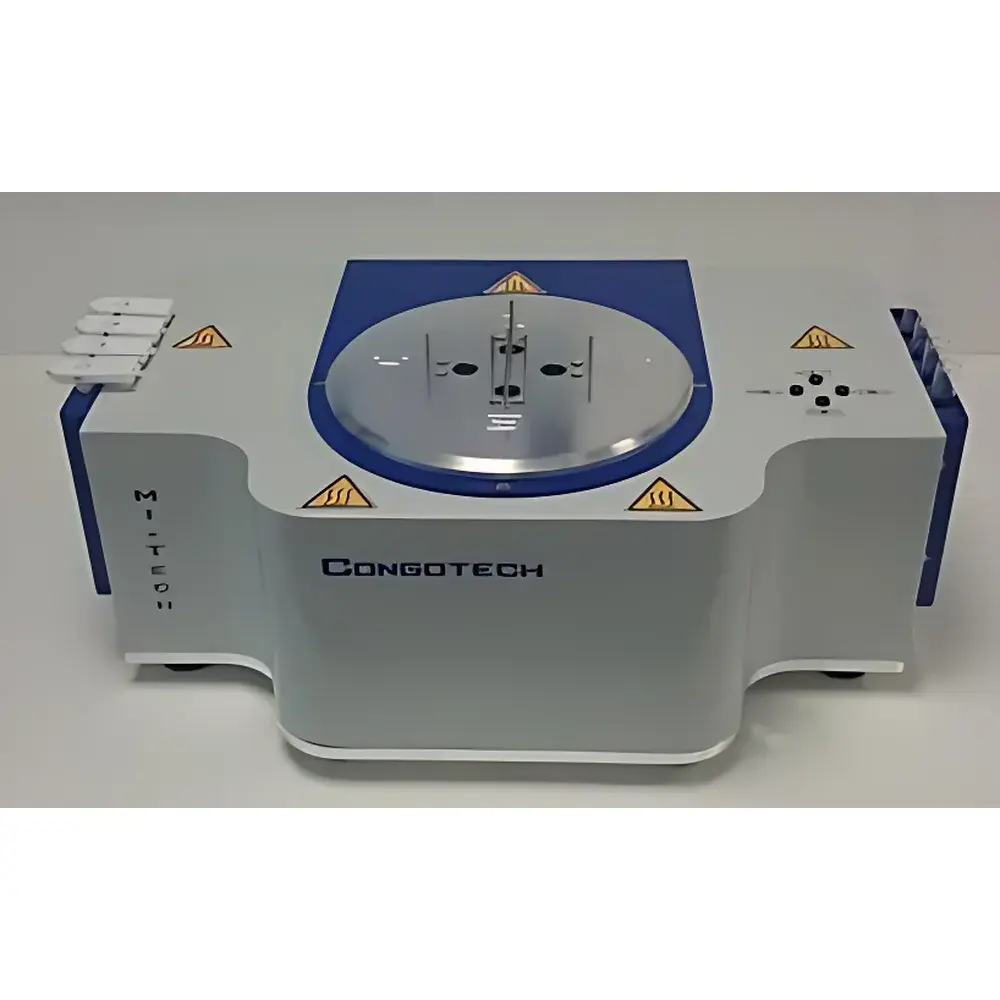
CONGOTECH PVC Resin Thermal Stability Analyzer
| Origin | France |
|---|---|
| Manufacturer Type | Authorized Distributor |
| Origin Category | Imported |
| Model | CONGOTECH |
| Pricing | Upon Request |
Overview
The CONGOTECH PVC Resin Thermal Stability Analyzer is a purpose-built, benchtop thermal degradation testing instrument engineered for quantitative assessment of hydrochloric acid (HCl) evolution during controlled thermal decomposition of polyvinyl chloride (PVC) and related thermoplastic materials. It operates on the well-established Congo Red test principle—defined in ISO 182-2:2001 and GB/T 2917.1–2002—as a standardized method to evaluate the onset and kinetics of dehydrochlorination. When subjected to elevated temperatures under inert or ambient atmospheric conditions, PVC undergoes sequential elimination of HCl, generating acidic volatiles that lower local pH. The analyzer employs a calibrated Congo Red indicator strip mounted in a fixed optical path; color transition from red to blue (corresponding to pH ≈ 3.5) is optically monitored in real time. The time-to-endpoint—defined as the elapsed time from temperature stabilization to the inflection point of the differential absorbance curve—is reported as the thermal stability index (TSI), expressed in minutes. This endpoint correlates directly with the material’s inherent resistance to thermal degradation and serves as a critical quality control parameter in resin manufacturing, compound formulation, and stabilizer efficacy evaluation.
Key Features
- Four independent sample positions enabling parallel, comparative thermal stability testing under identical environmental conditions
- Precision temperature control system with range from 20 °C to 250 °C and stability of ±0.1 °C at setpoint
- Optical detection module with ±1 CCU (Colorimetric Color Unit) resolution for high-fidelity Congo Red chromatic transition monitoring
- PTFE-mounted indicator strip holder ensuring consistent positioning, minimal contamination, and reproducible light-path geometry
- Integrated USB interface for direct data acquisition and real-time visualization of both raw absorbance and first-derivative curves
- Modular hardware architecture compliant with IEC 61000-4 electromagnetic compatibility standards and CE marking requirements
Sample Compatibility & Compliance
The analyzer accepts standard borosilicate glass sample tubes (Ø16 × 160 mm, wall thickness 1 mm) containing 3 g of representative PVC material. Compatible sample forms include plastisols (cast as 0.5 mm films and diced into 2 mm squares), granules (ground to ≤1.4 mm particle size if oversized), and pre-formed films or sheets (cut to 2 mm segments). All test protocols adhere strictly to ISO 182-2:2001 “Plastics — Determination of thermal stability of poly(vinyl chloride) — Part 2: Congo Red method” and GB/T 2917.1–2002 “Determination of hydrogen chloride and other acidic products evolved from poly(vinyl chloride) homopolymers and copolymers and their mixtures and articles at elevated temperature — Congo Red method”. Instrument design supports GLP-compliant operation through secure user authentication, audit-trail-enabled software logging, and timestamped database storage of all raw spectral and thermal profiles.
Software & Data Management
The proprietary CONGOTECH Analysis Suite provides bilingual (English/French) graphical user interface with intuitive workflow navigation. Users define test parameters—including target temperature, dwell time, and sample metadata—prior to run initiation. Real-time display includes dual-axis plots showing absolute absorbance vs. time and its numerical derivative (dA/dt), with automatic identification and annotation of the maximum derivative point—the primary stability metric. All datasets are stored in an encrypted SQLite database with immutable timestamps, operator ID, and instrument serial number. Export options include CSV for external statistical analysis and PDF reports formatted per ISO/IEC 17025 documentation requirements. Software architecture complies with FDA 21 CFR Part 11 provisions for electronic records and signatures when deployed in regulated environments.
Applications
This analyzer is routinely deployed in R&D laboratories and QC departments across PVC resin producers, compounders, and additive suppliers. Primary use cases include batch-to-batch consistency verification of suspension, emulsion, and microsuspension PVC resins; comparative evaluation of heat stabilizers (e.g., Ca/Zn, organotin, lead-free alternatives); shelf-life prediction of formulated compounds; and troubleshooting of processing-related discoloration or gel formation during extrusion or calendering. It also supports regulatory submissions requiring documented thermal degradation behavior under standardized test conditions, particularly for medical-grade and food-contact PVC formulations where residual acidity may impact biocompatibility or extractables profiles.
FAQ
What is the fundamental measurement principle of the CONGOTECH analyzer?
It quantifies the time required for thermally induced HCl evolution from PVC to trigger a defined colorimetric endpoint (Congo Red pH transition at ~3.5) under controlled isothermal conditions.
Does the instrument require calibration with reference standards?
No routine calibration is needed for the optical sensor; however, annual verification using traceable NIST-calibrated temperature probes and certified Congo Red strips is recommended for ISO 17025 accreditation.
Can test temperature be varied incrementally within a single run?
No—the instrument maintains a single, user-defined isothermal condition per test cycle; multi-temperature profiling requires sequential runs.
Is the software compatible with LIMS integration?
Yes—CSV export functionality enables seamless ingestion into laboratory information management systems supporting ASTM E1482 or HL7 ADT interfaces.
What maintenance is required for long-term operational reliability?
Routine cleaning of the optical chamber and sample tube holder with lint-free isopropanol wipes; annual inspection of heating element integrity and thermocouple drift by authorized service personnel.





