
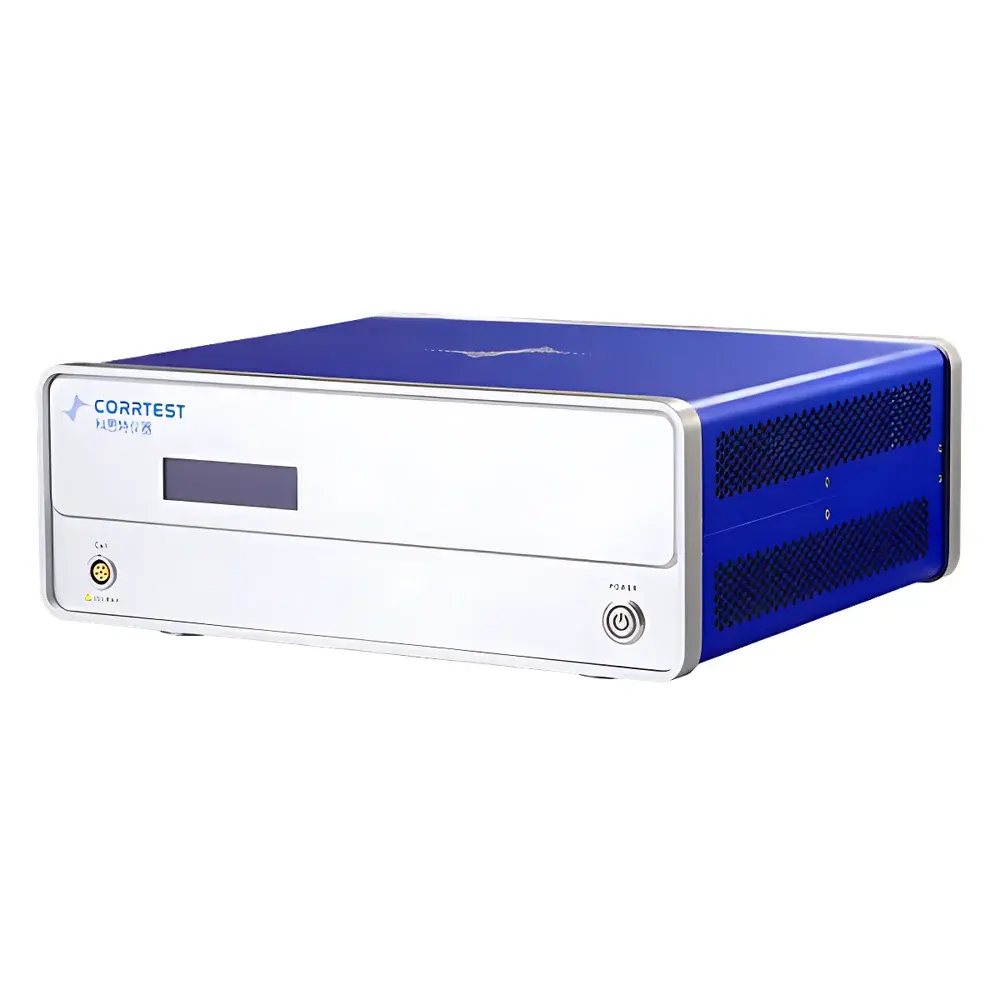
CorrTest CS150M Electrochemical Workstation
| Brand | CorrTest |
|---|---|
| Model | CS150M |
| Current Range | ±2.0 A |
| Current Accuracy | 0.1% of full-scale reading |
| Potential Accuracy | 0.1% of full-scale reading ±1 mV |
| Potentiostatic Range | ±10 V |
| EIS Frequency Range | 10 µHz to 115 kHz |
| Potential Resolution | 3 mV (<10 Hz), 10 mV (>100 Hz) |
| Current Sensitivity | 1 pA |
| Rise Time | <1 ms (<10 mA), <10 ms (<2 A) |
| Reference Electrode Input Impedance | 10¹² Ω |
| Current Ranges | 2 nA–2 A (10 decades) |
| Compliance Voltage | ±21 V |
| CV/LSV Scan Rate | 0.001 mV/s–10 V/s |
| CA/CC Pulse Width | 0.0001–65,000 s |
| AD Acquisition | 16-bit @ 1 MHz, 20-bit @ 1 kHz |
| DA Resolution | 16-bit, Settling Time: 1 ms |
| Minimum CV Potential Increment | 0.075 mV |
| SWV Frequency | 0.001–100 kHz |
| DPV/NPV Pulse Width | 0.0001–1000 s |
| Low-Pass Filter | 8-stage programmable |
| Communication Interface | USB 2.0 |
Overview
The CorrTest CS150M Electrochemical Workstation is a high-fidelity, dual-channel potentiostat/galvanostat engineered for precision electrochemical characterization across academic research, industrial R&D, and quality assurance laboratories. It operates on the fundamental principles of controlled-potential and controlled-current electrochemistry, enabling quantitative measurement of interfacial charge transfer kinetics, mass transport phenomena, and surface redox processes. Its architecture supports both steady-state and transient electrochemical techniques—including potentiodynamic polarization, chronoamperometry, cyclic voltammetry, and electrochemical impedance spectroscopy (EIS)—with calibrated signal fidelity over six decades of current (2 nA–2 A) and a wide potential window (±10 V). Designed for reproducibility in demanding environments, the CS150M integrates low-noise analog front-end circuitry, high-speed 16-bit/20-bit ADC/DAC conversion, and real-time digital filtering to minimize drift and artifact interference—critical for long-duration corrosion monitoring or low-current biosensor evaluation.
Key Features
- True dual-channel operation supporting independent or synchronized control of two working electrodes (e.g., for zero-resistance ammeter ZRA or rotating ring-disk electrode RRDE configurations)
- Ultra-low current detection capability down to 1 pA with auto-ranging current amplifiers and programmable low-pass filtering (8-stage)
- High-speed transient response: potential step rise time <1 ms at sub-10 mA loads, ensuring accurate kinetic resolution in fast electron-transfer systems
- Comprehensive EIS capability spanning 10 µHz to 115 kHz with phase accuracy <0.3° and magnitude error <0.1%—validated per ASTM G106 and ISO 16773-2
- Digital IR compensation with real-time solution resistance (Rs) measurement and positive feedback correction
- Integrated compliance voltage up to ±21 V for high-impedance or non-aqueous electrolyte studies (e.g., Li-ion battery electrolytes, ionic liquids)
- USB 2.0 interface with deterministic latency and driver-free plug-and-play compatibility under Windows 10/11 (64-bit)
Sample Compatibility & Compliance
The CS150M accommodates standard three-electrode electrochemical cells (working, reference, counter) as well as specialized configurations including rotating disk electrodes (RDE), coated metal coupons, embedded rebar samples, and microfluidic electrochemical flow cells. Its input impedance (>1012 Ω) ensures minimal loading error with high-impedance reference electrodes (e.g., Ag/AgCl, SCE, Hg/HgO). The system complies with key international standards for electrochemical instrumentation and data integrity: ASTM G5, G102, G169 (corrosion testing); ISO 16773-1 (EIS methodology); USP and (electrochemical sensor qualification); and FDA 21 CFR Part 11 requirements when operated with audit-trail-enabled software configuration. All hardware components meet CE marking directives (EMC Directive 2014/30/EU, Low Voltage Directive 2014/35/EU).
Software & Data Management
CorrTest Measurement & Analysis Software v4.x provides a validated, modular platform for experiment design, execution, and post-processing. It features GLP-compliant electronic lab notebook functionality—including user authentication, method versioning, raw data encryption (AES-256), and immutable audit trails for all parameter changes and result exports. Supported techniques include Tafel analysis, EPR (Electrochemical Potentiokinetic Reactivation), EN (Electrochemical Noise), GITT/PITT for battery materials, and automated corrosion rate calculation per ASTM G102. Data export formats include CSV, TXT, and binary .CORR files; integrated Python API enables custom script integration for machine learning–driven feature extraction or batch processing pipelines. All software updates undergo regression testing against NIST-traceable reference datasets.
Applications
- Energy storage materials: In-situ/operando characterization of Li-ion cathodes/anodes, solid-electrolyte interphase (SEI) formation, and supercapacitor electrode kinetics
- Corrosion science: Quantitative evaluation of inhibitor efficiency, coating delamination onset, galvanic coupling in multi-metal assemblies, and concrete-embedded rebar degradation
- Electrocatalysis: HER/OER/ORR activity mapping, turnover frequency (TOF) derivation, and stability assessment under accelerated stress testing (AST)
- Bioelectrochemistry: Amperometric detection of neurotransmitters, enzyme kinetics via mediated electron transfer, and redox profiling of extracellular electron shuttles
- Electroplating & surface engineering: Real-time monitoring of nucleation overpotential, deposit morphology evolution, and bath additive decomposition pathways
- Photoelectrochemistry: Combined potentiostatic control with external light sources for IPCE and incident-photon-to-current efficiency quantification
FAQ
What electrochemical techniques are natively supported without add-on modules?
All core techniques—including OCP, LSV/CV, CA/CP/CC, EIS, Tafel, EPR, EN, ZRA, GITT, PITT, and RDE rotation control—are fully integrated and require no optional firmware licenses.
Is the CS150M suitable for battery cycling tests under GBT 31486 or IEC 62660-1 protocols?
Yes—the instrument supports programmable current/voltage cutoffs, capacity limiting, and thermal derating profiles compatible with those standards when configured with appropriate cell holders and safety interlocks.
Can raw time-domain data be exported at full acquisition rate (1 MHz)?
Yes—16-bit time-stamped current/potential streams are saved losslessly in binary format; post-acquisition decimation and spectral analysis are performed offline to preserve fidelity.
Does the system support third-party scripting (e.g., MATLAB, Python) for automated test sequences?
Yes—native COM/ActiveX and TCP/IP interfaces enable bidirectional communication; Python SDK includes documented classes for sequence generation, real-time plotting, and event-triggered action.
What is the recommended calibration interval and traceability basis?
Annual calibration is advised using NIST-traceable reference resistors (e.g., Fluke 742A) and potentiostatic standards (e.g., Gamry EIS Check Cell); certificates document as-found/as-left deviations per ISO/IEC 17025.




