
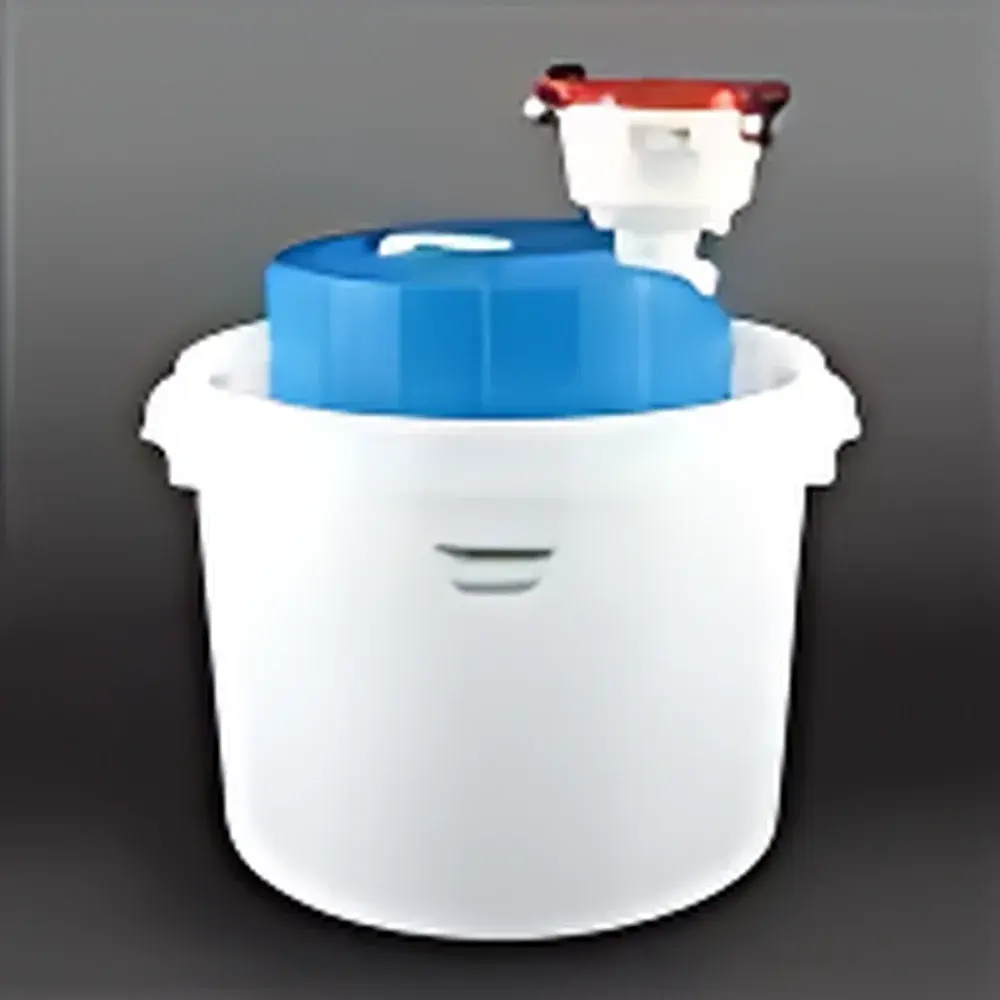
CP Lab Safety EF-4-FS70C-SYSN 4″ ECO Waste Collection Funnel System
| Brand | CP Lab Safety |
|---|---|
| Origin | USA |
| Manufacturer Type | Authorized Distributor |
| Product Origin | Imported |
| Model | EF-4-FS70C-SYSN |
| Price | Upon Request |
Overview
The CP Lab Safety EF-4-FS70C-SYSN is a rigorously engineered 4-inch ECO waste collection funnel system designed for safe, compliant, and vapor-suppressed disposal of volatile organic solvents in analytical, synthetic, and life science laboratories. Unlike conventional open-top waste containers—known sources of chronic solvent exposure, fire hazard, and cross-contamination—the EF-4-FS70C-SYSN employs a sealed, threaded-neck architecture to integrate directly with standard laboratory containers (e.g., LDPE, PP, or HDPE bottles, carboys, and safety cans), establishing a closed-loop waste handling pathway. Its operational principle relies on passive vapor containment via geometric neck extension (11 inches), high-density polyethylene (HDPE) chemical resistance, and integrated particulate filtration—collectively reducing airborne solvent concentrations by up to 99% (per internal ASTM D5032-compliant vapor emission testing under static bench conditions). This system supports institutional adherence to OSHA 29 CFR 1910.1200 (Hazard Communication), NFPA 30 (Flammable and Combustible Liquids Code), and EPA hazardous waste management guidelines (40 CFR Part 262).
Key Features
- Threaded 4-inch (101.6 mm) funnel aperture compatible with industry-standard 38–430, 53 mm, 63 mm, 70 mm, 83 mm, and 100 mm container necks—including Justrite safety cans, LDPE/PP reagent bottles (2 L to 20 L), and 5-gallon poly drums.
- 11-inch extended HDPE neck minimizes headspace turbulence and vapor escape during active liquid transfer, significantly lowering time-weighted average (TWA) solvent exposure.
- Integrated sintered polypropylene filter (nominal pore size: 100 µm) retains solid particulates, preventing clogging and enabling reuse across multiple solvent batches without filter replacement.
- Compact footprint (5″ × 7″ top dimension; 450 mL capacity) allows stable placement inside fume hoods, sink basins, or on lab benches without obstructing workflow or compromising ventilation efficiency.
- Chemically inert HDPE construction resists corrosion from common HPLC mobile phases (acetonitrile, methanol, THF), peptide synthesis reagents (DMF, DCM), and chromatographic eluents—validated per ASTM D543 immersion testing at 23 °C for 72 hours.
- Modular configuration supports up to six HPLC-compatible quick-disconnect (QD) inlet ports for parallel waste streams from LC systems, DNA synthesizers, protein sequencers, and medium-pressure chromatography units.
Sample Compatibility & Compliance
The EF-4-FS70C-SYSN is validated for use with Class I flammable liquids (flash point < 100 °F), including acetone, ethyl acetate, chloroform, hexane, and isopropanol. It meets UL 1313 certification requirements for non-conductive plastic waste funnels used in flammable liquid handling environments. The system is routinely deployed in GLP- and GMP-regulated facilities where trace solvent exposure must be documented per ISO 15190:2020 (medical laboratories) and USP (analytical instrument qualification). All component materials comply with FDA 21 CFR 177.1520 (HDPE for indirect food contact) and RoHS Directive 2011/65/EU.
Software & Data Management
While the EF-4-FS70C-SYSN is a passive mechanical device requiring no firmware or embedded electronics, its integration into digital lab infrastructure is supported through compatibility with electronic lab notebook (ELN) platforms (e.g., LabArchives, Benchling) and LIMS systems. Users may log installation date, container type, solvent class, and volume thresholds as structured metadata—enabling audit-ready traceability for EHS reporting and regulatory inspections. Optional barcode-labeled mounting kits (sold separately) facilitate asset tracking and inventory reconciliation aligned with ISO/IEC 17025:2017 clause 6.6 (equipment management).
Applications
- HPLC and UHPLC waste stream containment during method development and routine QC analysis.
- DNA oligonucleotide synthesis waste capture from phosphoramidite-based instruments, mitigating DMF and acetonitrile inhalation risks.
- Protein purification workflows involving imidazole, guanidine hydrochloride, or urea-containing buffers.
- Medium-pressure flash chromatography (Biotage, ISCO) effluent collection with simultaneous particulate retention.
- GC sample preparation and derivatization waste handling where volatile halogenated solvents (e.g., chloroform, carbon tetrachloride) pose acute inhalation hazards.
- Academic teaching labs requiring OSHA-compliant solvent disposal protocols for undergraduate organic chemistry instruction.
FAQ
Can the EF-4-FS70C-SYSN be autoclaved?
No. HDPE has a maximum continuous service temperature of 60 °C; autoclaving (121 °C, saturated steam) will cause irreversible deformation and seal failure.
Is the funnel compatible with strong oxidizers such as nitric acid or hydrogen peroxide?
Not recommended. While HDPE exhibits good resistance to dilute oxidizers, concentrated nitric acid (>20%) and >30% H₂O₂ may induce surface embrittlement over prolonged exposure—consult CP Lab Safety’s Chemical Resistance Guide before deployment.
How often should the filter be replaced?
Filter replacement is condition-dependent. Under typical HPLC mobile phase use, the 100 µm sintered PP filter remains functional for ≥500 mL of filtered waste; visual inspection for discoloration or flow restriction is the primary maintenance indicator.
Does this system meet NFPA 30 requirements for flammable liquid storage?
Yes—when paired with UL-listed safety cans or grounded poly drums, the sealed funnel interface satisfies NFPA 30 Section 4.3.2.2 for “approved containers” used in dispensing and waste collection operations.
Can multiple EF-4-FS70C-SYSN units be daisy-chained for centralized waste collection?
No. Each unit operates as an independent, single-point containment module. Centralized vacuum-assisted waste networks require dedicated manifold systems (e.g., ChemCollect™) and are not interoperable with this passive funnel design.



