
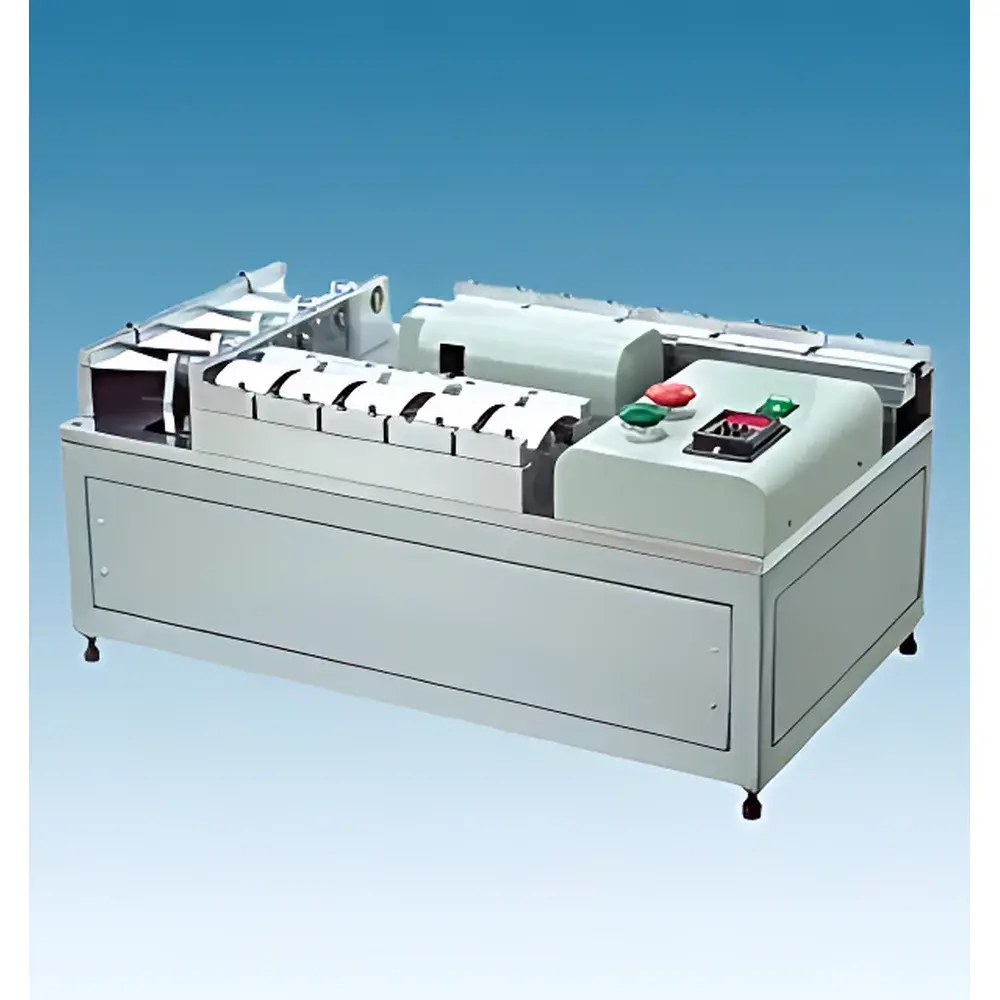
Hengyi Hengyitest IC Card Dynamic Bending-Torsion Tester
| Brand | Hengyi (Hengyitest) |
|---|---|
| Origin | Shanghai, China |
| Manufacturer Type | Direct Manufacturer |
| Region | Domestic (China) |
| Model | Bending-Torsion Tester |
| Voltage | AC 220 V ±5% |
| Power Consumption | 35 W |
| Bending/Torsion Speed | 30 rpm / 0.5 Hz |
| Cycle Count Range | 1–9999 cycles |
| Torsion Angle | ±15° ±1° (bidirectional, d = 86 mm |
| Long-edge Maximum Displacement | 20 mm (0.00 mm / −1.00 mm) |
| Long-edge Minimum Displacement | 2 mm ±0.50 mm |
| Short-edge Maximum Displacement | 10 mm (0.00 mm / −1.00 mm) |
| Short-edge Minimum Displacement | 1 mm ±0.50 mm |
| Fixture Mounting Dimensions | Fully Compliant with GB/T 16649.1, GB/T 17554.1–2006, ISO/IEC 10373, and ISO/IEC 7816–1998 |
| Motor System | STK AC Variable-Speed Motor (Taiwan) |
| Gear Reduction | High-Precision Gearbox (Hengyi, Taiwan) |
| Counting System | High-Accuracy Optical Encoder + Dedicated Counter (Hengyi, Taiwan) |
Overview
The Hengyi Hengyitest IC Card Dynamic Bending-Torsion Tester is a precision-engineered mechanical endurance testing instrument designed to evaluate the structural integrity and fatigue resistance of contact and contactless smart cards under controlled, repetitive bending and torsional stress. It operates on the principle of cyclic mechanical deformation—applying standardized angular displacement and axial deflection to simulate real-world handling conditions such as card insertion, removal, pocket flexing, and lateral twisting encountered during daily use. The system complies strictly with international test standards including ISO/IEC 7816–1998 (Parts 1–3), ISO/IEC 10373–1 (Test Methods for Identification Cards), GB/T 16649.1 (Identification Cards – Integrated Circuit(s) Cards – Part 1: Physical Characteristics), and GB/T 17554.1–2006 (Identification Cards – Test Methods – Part 1: Mechanical Characteristics). Its dual-axis actuation architecture enables simultaneous or independent execution of bending (long-edge flexure) and torsion (rotational twist about the card’s central axis), replicating multi-directional mechanical loads that contribute to delamination, conductor fracture, or substrate cracking in embedded IC modules.
Key Features
- Bi-directional torsion capability with precise ±15° angular control (±1° tolerance) at a defined pivot diameter of 86 mm—enabling full 30° total twist per cycle while maintaining traceable kinematic repeatability.
- Independent long-edge and short-edge displacement control: long-edge deflection range 1–20 mm (with asymmetric tolerance bands: +0.00 mm / −1.00 mm at max; ±0.50 mm at min); short-edge range 1–10 mm (same tolerance structure).
- Dual-mode actuation: selectable 30 rpm rotational speed for torsion or 0.5 Hz sinusoidal frequency for bending—both synchronized to an integrated optical encoder-based counting system for cycle-accurate termination.
- Modular fixture interface conforming exactly to dimensional specifications in GB/T 16649.1 and ISO/IEC 7816, ensuring repeatable card clamping geometry across laboratories and accreditation audits.
- Low-power, high-stability drive train comprising a Taiwan-sourced STK AC variable-speed motor coupled with a Hengyi-designed high-ratio, low-backlash planetary gearbox—optimized for long-term duty cycling without thermal drift or positional hysteresis.
- Embedded optical counter with non-contact sensing provides tamper-resistant cycle logging, supporting GLP-compliant test documentation and audit-ready data traceability.
Sample Compatibility & Compliance
This tester accommodates standard ID-1 format cards (85.6 mm × 53.98 mm × 0.76 mm) as defined in ISO/IEC 7810, including magnetic stripe cards, contact-type IC cards (e.g., EMV-compliant payment cards), contactless RFID cards (e.g., MIFARE, DESFire), and hybrid dual-interface cards. All mechanical fixtures—including clamping jaws, pivot pins, and support rails—are manufactured to nominal tolerances ≤ ±0.05 mm to prevent parasitic loading or edge slippage during high-cycle testing. The system satisfies mechanical test requirements outlined in ISO/IEC 10373–1 Annex A (Bending Resistance) and Annex B (Torsion Resistance), and supports validation protocols required for national certification bodies (e.g., China’s CCID Certification Center) and global payment schemes (Visa, Mastercard, UnionPay). Test reports generated using this instrument are admissible in regulatory submissions where mechanical durability evidence is mandated under ISO/IEC 17025-accredited laboratory conditions.
Software & Data Management
The tester operates in standalone mode with front-panel digital controls and LED cycle display; no proprietary software is required for basic operation. However, optional RS-232 or USB-to-serial interface modules enable integration with external lab management systems (LIMS) or custom Python/Matlab scripts for automated test sequencing and raw cycle-log export. All counter values—including start time, stop time, final cycle count, and operator ID (manually entered)—are retained in non-volatile memory for ≥10,000 test records. While the base unit does not include FDA 21 CFR Part 11-compliant electronic signatures or audit trails, its deterministic hardware-based counting architecture ensures intrinsic data integrity—making it suitable for environments governed by ISO/IEC 17025 Clause 7.7 (Ensuring Validity of Results) and internal QA procedures aligned with GMP/GLP principles.
Applications
- Pre-certification mechanical stress screening of smart card prototypes prior to ISO/IEC 10373 conformance testing.
- Comparative durability assessment of laminated substrates (PVC, PETG, polycarbonate) and adhesive systems used in multi-layer card construction.
- Failure mode analysis of embedded antenna traces and wire-bonded IC dies under combined flex-torque loading.
- Supplier qualification testing for card personalization bureaus and secure printing facilities requiring documented mechanical robustness evidence.
- Research into fatigue life prediction models for thin-film interconnects in miniaturized contactless IC packages.
FAQ
Does this tester support automated data export to Excel or CSV formats?
Yes—when equipped with the optional serial communication module, cycle logs can be streamed in ASCII format and parsed by third-party tools for direct import into spreadsheet or statistical analysis platforms.
Is calibration certification included with shipment?
A factory-issued calibration report (traceable to CNAS-accredited standards) is provided upon request; annual recalibration services are available through Hengyi’s authorized service centers in Shanghai and Shenzhen.
Can the machine test cards with non-standard thicknesses (e.g., 0.8 mm or 1.0 mm)?
The standard fixture set is optimized for 0.76 mm ID-1 cards; custom-height spacers and adjustable clamping inserts are available for thicknesses between 0.5 mm and 1.2 mm—subject to prior engineering review.
What maintenance intervals are recommended for long-term reliability?
Gearbox lubrication and motor brush inspection are advised every 5,000 operating hours; optical sensor cleaning and mechanical alignment verification should occur quarterly in high-throughput labs.
Is the torsion angle programmable beyond ±15°?
No—the mechanical limit stop and encoder feedback loop are hardwired to ±15° ±1° per ISO/IEC 10373–1 compliance; deviation would invalidate conformance to referenced standards.



